

Page Contents
1. Introduction
The field of laser therapy has revolutionized modern medicine and rehabilitation, offering non-invasive treatment options for a wide range of conditions. As healthcare continues to evolve toward more precise and effective therapeutic interventions, understanding the distinctions between different laser modalities becomes increasingly important for both practitioners and patients seeking optimal outcomes.
1.1 What Is Laser Therapy?
Laser therapy, also known as photobiomodulation therapy (PBMT), utilizes focused light energy to stimulate cellular processes and promote healing. The term “laser” stands for Light Amplification by Stimulated Emission of Radiation, representing a concentrated beam of coherent light that penetrates tissues at specific wavelengths. This therapeutic approach harnesses the power of photons to interact with chromophores in cells, triggering cascades of biological responses including enhanced mitochondrial function, increased adenosine triphosphate (ATP) production, and modulation of inflammatory mediators. The precision of laser therapy allows clinicians to target specific tissue depths and cellular mechanisms, making it an invaluable tool in contemporary healthcare.
1.2 Why Understanding Different Types of Laser Therapy Matters
Distinguishing between various laser therapy modalities is crucial for making informed treatment decisions and achieving optimal therapeutic outcomes. Each type of laser therapy operates with distinct parameters, including power density, wavelength specifications, and penetration capabilities, which directly influence treatment efficacy and patient safety. Healthcare providers must understand these differences to select appropriate protocols for specific conditions, while patients benefit from knowledge that helps them understand their treatment options and expected outcomes. Misunderstanding laser classifications can lead to inappropriate treatment selection, suboptimal results, or unnecessary safety concerns, making education in this area essential for all stakeholders in the healthcare continuum.
1.3 Overview of Class IV and Low-Level Laser Therapy (LLLT)
The two primary categories of therapeutic lasers discussed in this comprehensive guide represent fundamentally different approaches to photobiomodulation therapy. Low-Level Laser Therapy (LLLT), also referred to as cold laser therapy, operates at lower power outputs and relies primarily on photochemical effects to stimulate cellular repair mechanisms. Class IV laser therapy, conversely, utilizes higher power densities to achieve deeper tissue penetration and can produce both photochemical and photothermal effects. Understanding these distinctions is essential for healthcare providers, patients, and researchers working in the field of laser medicine and rehabilitation.
2. Basics of Laser Therapy
Before delving into the specific characteristics of Class IV and LLLT modalities, it’s essential to establish a foundational understanding of how laser therapy functions at the cellular and tissue levels. This knowledge provides the scientific framework necessary to appreciate the subtle yet significant differences between these therapeutic approaches.
2.1 How Laser Therapy Works: The Science Behind It
Laser therapy operates through the fundamental principle of photobiomodulation, where specific wavelengths of light interact with cellular chromophores to initiate therapeutic biological responses. The primary target for laser energy is cytochrome c oxidase, a key enzyme in the mitochondrial electron transport chain responsible for cellular energy production. When photons are absorbed by these chromophores, they trigger a cascade of cellular events including increased ATP synthesis, enhanced protein synthesis, and modulation of reactive oxygen species. Additionally, laser therapy influences nitric oxide release, which plays a crucial role in vasodilation and improved tissue perfusion. The cumulative effect of these mechanisms results in accelerated tissue repair, reduced inflammation, and enhanced cellular metabolism.
2.2 Key Terms to Know: Wavelength, Power, Penetration Depth
Understanding the technical parameters of laser therapy is essential for appreciating how different modalities achieve their therapeutic effects. Wavelength, measured in nanometers (nm), determines the color of light and its interaction with specific tissue chromophores, with red (660-670nm) and near-infrared (810-980nm) wavelengths being most commonly used in therapeutic applications. Power output, expressed in milliwatts (mW) or watts (W), determines the intensity of energy delivered to tissues and directly influences treatment duration and penetration depth. Penetration depth refers to how far laser energy can effectively reach into tissues, with longer wavelengths generally achieving greater depth penetration. Power density, measured in watts per square centimeter (W/cm²), represents the concentration of energy delivered to the treatment area and is a critical factor in determining therapeutic outcomes.
2.3 Common Uses of Laser Therapy in Medicine and Rehabilitation
Laser therapy has found widespread application across numerous medical specialties and rehabilitation settings due to its versatility and non-invasive nature. In orthopedics and sports medicine, laser therapy is commonly used for treating musculoskeletal injuries, including tendinopathies, ligament sprains, and post-surgical healing. Dermatological applications include wound healing, scar reduction, and treatment of various skin conditions through targeted photobiomodulation. Pain management represents another significant area of application, with laser therapy demonstrating efficacy in treating both acute and chronic pain conditions through modulation of nociceptive pathways. Physical therapy and rehabilitation programs frequently incorporate laser therapy to enhance recovery from injuries, reduce inflammation, and improve functional outcomes in patients with various musculoskeletal conditions.
3. What Is Low-Level Laser Therapy (LLLT)?
Low-Level Laser Therapy represents the foundation of therapeutic laser applications, having been developed and refined over several decades of clinical research and practice. This modality’s gentle approach to photobiomodulation makes it particularly suitable for a wide range of conditions and patient populations.
3.1 Definition and Characteristics of LLLT
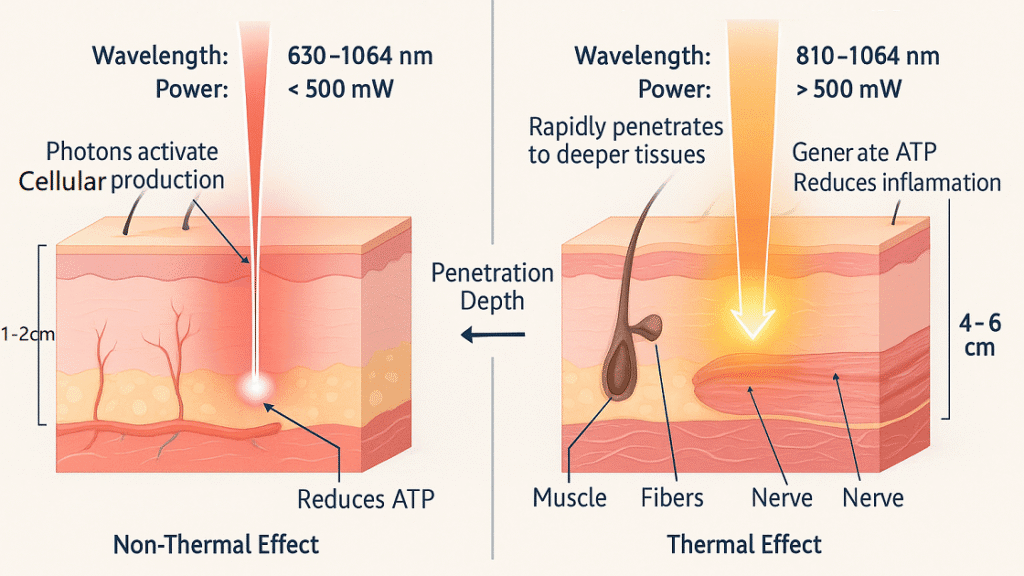
Low-Level Laser Therapy, also known as cold laser therapy or soft laser therapy, is defined as the application of laser light at power densities below 500 milliwatts per square centimeter (mW/cm²). This therapeutic modality operates exclusively through photochemical mechanisms, meaning it does not produce significant thermal effects in treated tissues. LLLT devices typically emit continuous wave or pulsed light at specific wavelengths optimized for cellular absorption and biological response. The hallmark characteristic of LLLT is its ability to stimulate cellular processes without causing tissue heating or damage, making it exceptionally safe for repeated applications. Treatment sessions are generally painless, with patients experiencing no sensation during therapy, which contributes to high patient acceptance and compliance rates.
3.2 Typical Wavelengths and Power Output of LLLT Devices
LLLT devices commonly operate within the red and near-infrared spectrum, specifically at wavelengths of 660nm, 810nm, 830nm, and 904nm, which correspond to optimal absorption by cellular chromophores. Power outputs typically range from 5 to 500 milliwatts, with most clinical devices operating between 50-200 milliwatts for optimal therapeutic effect. The combination of wavelength and power determines the photon density delivered to tissues, which must reach therapeutic thresholds to initiate biological responses. Pulsed LLLT devices often utilize higher peak powers but maintain low average power outputs, allowing for enhanced photon penetration while preserving the non-thermal nature of treatment. These parameters are carefully calibrated to ensure optimal cellular stimulation while maintaining the safety profile that characterizes LLLT applications.
3.3 How LLLT Stimulates Cellular Repair and Reduces Inflammation
The mechanism of action for LLLT centers on the absorption of photons by mitochondrial chromophores, particularly cytochrome c oxidase, which leads to increased ATP production and enhanced cellular metabolism. This process, known as photobiomodulation, triggers a cascade of beneficial cellular responses including increased protein synthesis, enhanced collagen production, and improved cellular proliferation. LLLT also modulates inflammatory processes by influencing the production of pro-inflammatory cytokines such as tumor necrosis factor-alpha (TNF-α) and interleukin-1 (IL-1), while promoting the release of anti-inflammatory mediators. The therapy enhances microcirculation through nitric oxide release, improving oxygen and nutrient delivery to treated tissues. These combined effects result in accelerated tissue repair, reduced pain, and improved functional outcomes in treated conditions.

3.4 Common Conditions Treated with Low-Level Laser Therapy
LLLT has demonstrated clinical efficacy in treating a diverse range of conditions across multiple medical specialties. Musculoskeletal applications include treatment of tendinitis, bursitis, carpal tunnel syndrome, and various forms of arthritis, where the anti-inflammatory and analgesic effects provide significant symptom relief. Wound healing represents another major application area, with LLLT showing particular effectiveness in treating diabetic ulcers, pressure sores, and post-surgical incisions. Neurological conditions such as peripheral neuropathy and certain types of headaches have also responded favorably to LLLT treatment protocols. In dentistry, LLLT is used for post-operative pain management, treatment of temporomandibular joint disorders, and promotion of healing following oral surgery procedures.
3.5 Safety Profile and Side Effects of LLLT
LLLT boasts an exceptional safety profile with minimal reported adverse effects, making it suitable for use in diverse patient populations including children and elderly individuals. The most commonly reported side effects are mild and transient, including temporary skin redness at the treatment site or mild headaches in sensitive individuals. Contraindications for LLLT include direct irradiation over the thyroid gland, treatment during pregnancy (as a precautionary measure), and application over known or suspected malignant lesions. Eye safety requires attention, as direct exposure to laser light can cause retinal damage, necessitating appropriate protective eyewear during treatment sessions. The non-invasive nature of LLLT eliminates risks associated with surgical interventions, and the absence of thermal effects prevents tissue damage, making it an attractive option for patients seeking conservative treatment approaches.
4. What Is Class IV Laser Therapy?
Class IV laser therapy represents the most advanced and powerful form of therapeutic laser treatment currently available in clinical practice. This modality’s ability to deliver high-intensity laser energy safely and effectively has expanded the scope of conditions treatable with photobiomodulation therapy.
4.1 Definition and Characteristics of Class IV Lasers
Class IV laser therapy utilizes high-power laser devices that emit continuous wave energy at power outputs exceeding 500 milliwatts, with many clinical devices operating between 1-15 watts. This classification, established by the International Electrotechnical Commission (IEC), indicates lasers capable of producing both photochemical and photothermal effects in biological tissues. Class IV lasers are characterized by their ability to deliver therapeutic doses of energy in significantly shorter treatment times compared to lower-power alternatives. The high photon density achieved by these devices enables deeper tissue penetration and more robust cellular responses, making them particularly effective for treating conditions involving deeper anatomical structures. Safety protocols for Class IV lasers are more stringent due to their higher power outputs, requiring specialized training for operators and appropriate protective measures during treatment sessions.
4.2 Typical Wavelengths and Power Output of Class IV Lasers
Class IV therapeutic lasers typically operate at wavelengths of 810nm, 830nm, 904nm, and 980nm, selected for their optimal penetration characteristics and cellular absorption properties. Power outputs range from 1 watt to 15 watts or higher, with most clinical applications utilizing 3-10 watts for optimal therapeutic effect. The higher power density of Class IV lasers allows for power densities ranging from 1-10 watts per square centimeter, significantly exceeding the capabilities of LLLT devices. Many Class IV systems incorporate multiple wavelengths simultaneously, allowing for targeted treatment of different tissue types and depths within a single session. The combination of high power and optimized wavelengths enables Class IV lasers to deliver therapeutic energy to tissues at depths of 5-10 centimeters, making them suitable for treating large joints, deep muscle groups, and other anatomical structures previously difficult to address with lower-power alternatives.
4.3 Mechanism of Action: How Class IV Lasers Penetrate Deeper Tissues
The enhanced penetration capabilities of Class IV lasers result from their high photon density and optimized wavelength selection, which overcome the natural attenuation of light as it passes through biological tissues. The high power output allows photons to maintain therapeutic intensity even after passing through skin, subcutaneous tissue, and superficial muscle layers to reach deeper target structures. Class IV lasers produce both photochemical and mild photothermal effects, with the thermal component contributing to increased tissue temperature and enhanced metabolic activity. The deeper penetration achieved by Class IV lasers enables treatment of conditions affecting joints, deep muscle groups, and neural structures that may be beyond the effective range of LLLT devices. This enhanced penetration is particularly beneficial for treating conditions such as hip arthritis, deep muscle strains, and spinal conditions where the pathology exists at significant tissue depths.
4.4 Clinical Applications and Benefits of Class IV Laser Therapy
Class IV laser therapy has demonstrated remarkable clinical versatility, with applications spanning orthopedics, sports medicine, pain management, and rehabilitation. Large joint conditions such as knee osteoarthritis, hip impingement, and shoulder impingement syndrome respond particularly well to Class IV treatment due to the enhanced penetration capabilities. Chronic pain conditions, including fibromyalgia, chronic low back pain, and complex regional pain syndrome, have shown significant improvement with Class IV laser protocols. The ability to treat larger tissue areas efficiently makes Class IV lasers ideal for addressing widespread muscle tension, trigger points, and myofascial pain syndromes. Post-surgical applications include enhanced healing of incision sites, reduced post-operative pain, and improved functional recovery following orthopedic procedures. The time efficiency of Class IV treatments, typically lasting 5-10 minutes compared to 20-30 minutes for LLLT, makes them practical for busy clinical environments.
4.5 Safety Considerations and Contraindications for Class IV Lasers
Class IV laser therapy requires enhanced safety protocols due to the higher power outputs and potential for thermal effects in treated tissues. Proper eye protection is mandatory for both operators and patients, with specific laser safety glasses required for the wavelengths being used. Treatment parameters must be carefully monitored to prevent excessive tissue heating, which could result in burns or thermal damage. Contraindications include treatment over malignant lesions, pregnancy, and areas with impaired sensation where patients cannot provide feedback regarding tissue heating. Patients taking photosensitizing medications may require modified treatment protocols or alternative therapies to prevent adverse reactions. The thermal effects of Class IV lasers require careful consideration of treatment duration and power settings, with most protocols utilizing continuous monitoring of tissue temperature and patient comfort levels to ensure safe and effective treatment delivery.

5. Key Differences Between Class IV and Low-Level Laser Therapy
Understanding the fundamental differences between these two laser therapy modalities is crucial for healthcare providers and patients making informed treatment decisions. Each approach offers distinct advantages and limitations that must be carefully considered in the context of specific clinical applications.
5.1 Power Output and Penetration Depth Comparison
The most significant difference between Class IV and LLLT lies in their power output capabilities and resulting tissue penetration depths. LLLT devices operate at power levels below 500 milliwatts, typically achieving tissue penetration depths of 1-2 centimeters, making them suitable for superficial conditions affecting skin, subcutaneous tissue, and superficial muscle layers. Class IV lasers, operating at power levels from 1-15 watts, can achieve penetration depths of 5-10 centimeters, enabling treatment of deep joint structures, large muscle groups, and anatomical areas previously inaccessible to therapeutic laser energy. This enhanced penetration capability allows Class IV lasers to address conditions such as hip arthritis, deep muscle strains, and spinal pathology that may not respond adequately to LLLT treatment protocols.
5.2 Treatment Duration and Frequency Differences
Treatment protocols for LLLT and Class IV laser therapy differ significantly in both duration and frequency requirements. LLLT sessions typically last 15-30 minutes per treatment area, with treatment frequencies ranging from daily to three times weekly depending on the condition being addressed. The lower power output of LLLT devices necessitates longer exposure times to achieve therapeutic photon doses, often requiring 20-30 treatment sessions for optimal results. Class IV laser therapy, conversely, achieves therapeutic energy levels in 3-10 minutes per treatment area due to higher power density, making sessions more time-efficient for both patients and clinicians. Treatment frequency for Class IV therapy is typically 2-3 times weekly, with many conditions showing significant improvement within 6-12 treatment sessions.
5.3 Types of Conditions Each Therapy Best Addresses
The selection between LLLT and Class IV laser therapy is largely determined by the depth and nature of the condition being treated. LLLT excels in treating superficial conditions such as wound healing, skin disorders, superficial tendinitis, and conditions requiring gentle, non-thermal stimulation. Its excellent safety profile makes it particularly suitable for treating sensitive patient populations, including children and elderly individuals with multiple comorbidities. Class IV laser therapy is optimal for deep tissue conditions including large joint arthritis, chronic muscle pain, deep tendon injuries, and conditions requiring more intensive photobiomodulation effects. The ability to treat larger anatomical areas efficiently makes Class IV lasers particularly effective for addressing widespread musculoskeletal conditions and chronic pain syndromes.
5.4 Equipment Size, Cost, and Accessibility
Significant differences exist between LLLT and Class IV laser systems in terms of equipment specifications, cost considerations, and clinical accessibility. LLLT devices are typically compact, portable units that can be easily transported between treatment rooms or clinical locations, with purchase prices ranging from $2,000-$15,000 depending on specifications and features. Class IV laser systems are generally larger, stationary units requiring dedicated treatment spaces, with purchase prices ranging from $25,000-$75,000 or more for advanced multi-wavelength systems. The higher initial investment for Class IV equipment may limit accessibility for smaller practices, though the increased treatment efficiency and broader clinical applications can justify the cost in appropriate clinical settings.
5.5 Patient Experience and Comfort Levels
Patient experience differs notably between LLLT and Class IV laser therapy, with each modality offering distinct sensory characteristics during treatment. LLLT is completely painless, with patients experiencing no sensation during treatment sessions, which contributes to excellent patient acceptance and compliance rates. Some patients may experience mild relaxation or a sense of improved well-being following LLLT sessions. Class IV laser therapy produces a gentle warming sensation in treated tissues, which many patients find pleasant and therapeutic. The warming effect is carefully controlled to remain within comfortable limits, and patients often report immediate pain relief and improved mobility following treatment sessions. Both modalities are well-tolerated, but patient preferences may influence treatment selection in certain clinical scenarios.
5.6 Recovery Time and Expected Results
Recovery time and treatment outcomes vary between LLLT and Class IV laser therapy based on their different mechanisms of action and treatment intensities. LLLT typically produces gradual, cumulative improvements over multiple treatment sessions, with patients often noticing subtle changes in pain levels and function after 5-10 treatments. The gentle nature of LLLT allows for immediate return to normal activities without any treatment-related restrictions or recovery time. Class IV laser therapy often produces more immediate and noticeable results, with many patients experiencing significant pain relief and improved function within the first few treatment sessions. The higher intensity of Class IV treatment may occasionally result in mild treatment soreness lasting 24-48 hours, though this is generally well-tolerated and indicates therapeutic tissue response.
5.7 Visual Comparison Table: Class IV vs LLLT
| Parameter | LLLT | Class IV |
| Power Output | 5-500 mW | 1-15 W |
| Penetration Depth | 1-2 cm | 5-10 cm |
| Treatment Duration | 15-30 minutes | 3-10 minutes |
| Treatment Frequency | Daily to 3x/week | 2-3x/week |
| Total Sessions | 20-30 | 6-12 |
| Patient Sensation | None | Gentle warming |
| Equipment Cost | $2,000-$15,000 | $25,000-$75,000 |
| Portability | Highly portable | Stationary |
| Recovery Time | None | Minimal (0-48 hours) |
| Best Applications | Superficial conditions | Deep tissue conditions |
6. Research and Clinical Evidence Supporting Both Therapies
The scientific foundation supporting both LLLT and Class IV laser therapy continues to expand, with numerous clinical trials and systematic reviews demonstrating their efficacy across various medical conditions. Understanding the current research landscape helps inform evidence-based treatment decisions and realistic outcome expectations.
6.1 Summary of Key Clinical Trials and Studies on LLLT
Extensive research has been conducted on LLLT over the past four decades, with hundreds of peer-reviewed studies demonstrating its therapeutic benefits across multiple clinical applications. A landmark systematic review by Chung et al. (2012) analyzing 46 randomized controlled trials found significant evidence supporting LLLT for musculoskeletal pain conditions, with effect sizes comparable to conventional treatments. The World Association for Laser Therapy (WALT) has published evidence-based guidelines supporting LLLT use in wound healing, musculoskeletal conditions, and pain management based on Level A evidence from multiple systematic reviews. Recent meta-analyses have confirmed LLLT’s effectiveness in treating lateral epicondylitis, carpal tunnel syndrome, and osteoarthritis, with studies showing significant improvements in pain scores and functional outcomes. Research has also demonstrated LLLT’s cellular mechanisms, including increased ATP production, enhanced protein synthesis, and modulation of inflammatory mediators, providing scientific validation for its therapeutic effects.
6.2 Summary of Key Clinical Trials and Studies on Class IV Laser Therapy
Class IV laser therapy research has grown substantially over the past decade, with numerous studies demonstrating superior outcomes compared to lower-power alternatives for deep tissue conditions. A pivotal study by Alayat et al. (2014) comparing Class IV laser therapy to LLLT for chronic low back pain found significantly greater improvements in pain and functional scores with Class IV treatment. Research by Dundar et al. (2007) demonstrated Class IV laser therapy’s effectiveness in treating knee osteoarthritis, with patients showing significant improvements in pain, stiffness, and functional capacity. Studies investigating Class IV laser therapy for shoulder impingement syndrome have consistently shown superior outcomes compared to placebo treatments, with improvements maintained at 6-month follow-up assessments. The deeper penetration capabilities of Class IV lasers have been validated through tissue modeling studies and thermal imaging, confirming their ability to deliver therapeutic energy to anatomical structures beyond the reach of LLLT devices.
6.3 Effectiveness in Pain Management and Tissue Healing
Both LLLT and Class IV laser therapy have demonstrated significant efficacy in pain management and tissue healing applications, though through different mechanisms and treatment parameters. LLLT’s effectiveness in pain management is attributed to its ability to modulate nociceptive pathways, reduce inflammatory mediators, and enhance endorphin release, with studies showing 30-70% reductions in pain scores across various conditions. Class IV laser therapy achieves pain relief through similar mechanisms but with enhanced penetration and more robust cellular responses, often producing 40-80% improvements in pain scores with fewer treatment sessions. Tissue healing applications show both modalities promoting collagen synthesis, angiogenesis, and cellular proliferation, with LLLT demonstrating particular effectiveness in superficial wound healing and Class IV showing superior results in deep tissue repair. Meta-analyses comparing both modalities consistently show Class IV laser therapy producing faster and more pronounced improvements in pain and function for deep tissue conditions.
6.4 Addressing Controversies and Skepticism in Laser Therapy
Despite growing research, skepticism about laser therapy still exists in some medical communities. This doubt often stems from early studies that used poor methodologies or inadequate dosing protocols. To address these concerns, organizations like WALT have developed evidence-based guidelines. These guidelines standardize dosing and treatment procedures, improving consistency in outcomes. Some critics argue that laser therapy benefits may be due to the placebo effect. However, well-designed sham-controlled trials show clear therapeutic effects beyond placebo. The science behind photobiomodulation has also advanced. Modern research techniques have confirmed the biological basis of laser therapy. Ongoing studies continue to refine treatment protocols and broaden clinical use. Recent research now uses advanced imaging and biomarker analysis to validate how both LLLT and Class IV lasers work.
7. Conclusion
The comprehensive analysis of Class IV and Low-Level Laser Therapy reveals two distinct yet complementary approaches to photobiomodulation therapy, each offering unique advantages for specific clinical applications and patient populations.
7.1 Recap of Class IV vs. Low-Level Laser Therapy Differences
The fundamental differences between Class IV and LLLT center on power output, penetration depth, and resulting clinical applications, with each modality serving distinct roles in contemporary healthcare. LLLT’s gentle, non-thermal approach makes it ideal for superficial conditions, sensitive patient populations, and applications requiring extended treatment protocols with minimal risk of adverse effects. Class IV laser therapy’s enhanced power and penetration capabilities make it optimal for deep tissue conditions, large anatomical areas, and clinical situations requiring rapid therapeutic responses. Treatment efficiency represents another key distinction, with Class IV protocols achieving therapeutic outcomes in significantly fewer sessions compared to LLLT, though both modalities demonstrate excellent safety profiles when used appropriately. The selection between these modalities should be based on careful consideration of condition depth, patient characteristics, treatment goals, and available resources.
7.2 Final Thoughts: Making an Informed Decision for Laser Therapy
The decision between Class IV and LLLT should be made collaboratively between healthcare providers and patients, considering individual clinical presentations, treatment goals, and patient preferences. Both modalities represent evidence-based treatment options with extensive research support and proven clinical efficacy across numerous medical conditions. Healthcare providers should consider factors such as condition depth, treatment efficiency requirements, patient characteristics, and available equipment when selecting appropriate laser therapy protocols. Patients benefit from understanding both options to make informed decisions about their care and maintain realistic expectations regarding treatment outcomes. The continued evolution of laser therapy technology and research will likely expand treatment options and improve outcomes for both modalities, making laser therapy an increasingly valuable component of comprehensive healthcare delivery.
 English
 العربية
 Français
 日本語
日本語 Português
 Español
 Русский
 Deutsch