
Содержание страницы
Введение
A slight hesitation at the canter. A shortened stride on the straightaway. A reluctance to turn as sharply as before. Suspensory ligament desmitis is a common, serious injury in performance horses, affecting the fetlock support and shock absorption during high-speed exertion. It occurs frequently in racehorses and athletes due to repetitive intense work. Traditional treatments—rest, anti-inflammatories, or surgery—often have high recurrence rates and many horses fail to return to prior form. Лазерная терапия класса IV offers a non‑invasive, drug‑free alternative that targets underlying tissue damage, providing a promising option for owners and veterinarians.
1. Understanding the Suspensory Ligament and Why It Matters
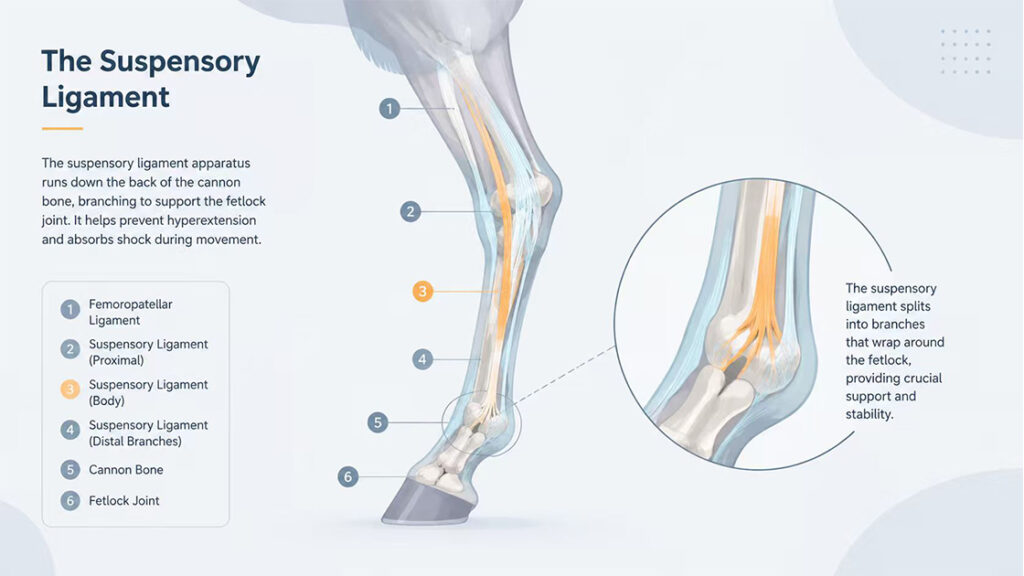
The suspensory ligament apparatus is a complex structure that runs down the back of the cannon bone, branching to support the fetlock joint. It plays an essential role in preventing hyperextension of the fetlock during weight-bearing and propulsion. When this ligament becomes strained, partially torn, or degenerated, the result is suspensory desmitis—a condition that can range from mild inflammation to complete disruption of the ligament fibers.
1.1 Why Suspensory Injuries Are So Challenging
Unlike muscle injuries that heal relatively quickly due to abundant blood supply, ligaments have limited vascularity. The suspensory ligament, particularly its proximal portion near the origin on the cannon bone, receives poor blood flow, making healing slow and often incomplete. This poor vascularity means that even with extended rest, the ligament may not regain its original strength and elasticity. The repetitive loading of athletic activity places constant stress on the healing tissue, and many horses experience recurrence of symptoms when they return to work. The career-limiting nature of suspensory desmitis has made it one of the most frustrating conditions in equine veterinary practice.
1.2 Recognizing the Signs Early
Early recognition of suspensory ligament injury can significantly improve outcomes. Affected horses often present with lameness that worsens with exercise and improves with rest. The lameness may be subtle at first—a slight shortening of stride, a mild head bob at the trot, or a reluctance to work on hard ground or circles. Swelling or heat may be palpable over the affected area, and the horse may react to palpation of the ligament. In some cases, the lameness may be more pronounced after strenuous exercise or the day following intense work. Diagnostic imaging, including ultrasound, is essential for confirming the diagnosis and assessing the severity of the injury.
2. The Limitations of Traditional Approaches
Historically, the management of suspensory desmitis has relied on a combination of rest, controlled exercise, anti-inflammatory medications, and in some cases, surgical interventions or regenerative therapies such as stem cell injections or platelet-rich plasma.
2.1 The Problem with Rest Alone
Prolonged rest remains a cornerstone of conservative management, but it has significant drawbacks. Extended periods of stall rest can lead to muscle atrophy, joint stiffness, and loss of conditioning. Furthermore, many horses experience recurrence of lameness when training resumes, as the ligament tissue that formed during rest may be disorganized and weaker than the original structure. The frustration of a lengthy recovery followed by reinjury is a common experience for owners and trainers.
2.2 The Need for a Tissue-Healing Approach
The limitations of conventional approaches have driven the search for therapies that actively promote tissue repair rather than simply managing symptoms. This is where Class IV laser therapy enters the picture, offering a non-invasive modality that stimulates cellular activity and supports the body’s natural healing processes.
3. How Class IV Laser Therapy Works
Class IV laser therapy, also known as high-intensity laser therapy, represents the most powerful category of therapeutic lasers approved for medical use. Unlike lower-class lasers that primarily affect superficial tissues, Class IV devices deliver photon energy exceeding 500 milliwatts, with many therapeutic units operating between 5 to 60 watts of continuous power output. This higher power capacity enables deeper tissue penetration and more substantial photobiological effects.
3.1 Photobiomodulation at the Cellular Level
The therapeutic mechanism of Class IV laser therapy operates through photobiomodulation, a sophisticated biological process whereby photons of specific wavelengths interact with cellular chromophores, particularly cytochrome c oxidase located within mitochondrial membranes. When laser light in the near-infrared spectrum, typically ranging from 800 to 1000 nanometers, penetrates equine tissue, it triggers a cascade of cellular events. These photons stimulate adenosine triphosphate synthesis, enhance mitochondrial respiration, and modulate reactive oxygen species production. Subsequently, this increases cellular metabolism, promotes vasodilation through nitric oxide release, reduces pro-inflammatory cytokines, and accelerates protein synthesis necessary for tissue repair and regeneration.
3.2 Effects on Ligament Healing
For the suspensory ligament, these cellular effects translate into tangible benefits for healing. Enhanced adenosine triphosphate production provides the energy needed for fibroblasts to synthesize new collagen fibers. Improved circulation delivers oxygen and nutrients to the poorly vascularized ligament tissue, supporting the repair process. The reduction in pro-inflammatory cytokines helps modulate the inflammatory environment, preventing excessive inflammation from delaying healing while still allowing the beneficial inflammatory signals necessary for tissue repair to proceed. The therapy also promotes collagen synthesis, which is essential for restoring the tensile strength of the ligament.
3.3 Pain Relief and Return to Function
Beyond tissue healing, Class IV laser therapy provides immediate analgesic effects through endorphin release and nerve signal modulation. This pain relief allows horses to move more comfortably during rehabilitation, facilitating the gradual return to controlled exercise without the need for systemic medications that may mask symptoms or carry side effects.
4. Clinical Evidence for Laser Therapy in Suspensory Desmitis
A growing body of evidence supports the use of high-intensity laser therapy in equine tendon and ligament injuries, including suspensory desmitis.
4.1 What the Research Shows
Appraised studies report positive effects of high-intensity laser therapy on equine tendon and ligament injuries as measured by pain to palpation, lameness, swelling, and ultrasonographic and magnetic resonance imaging evaluation of treated lesions. Horses receiving laser therapy show improvement in lameness scores, reduction in swelling, and enhanced tissue appearance on imaging studies. The positive outcomes observed across multiple studies suggest that laser therapy can play a meaningful role in the rehabilitation of suspensory ligament injuries.
4.2 Comparing Outcomes
Clinical experience demonstrates that horses treated with Class IV laser therapy often show more rapid improvement than those managed with rest alone. The therapy’s ability to stimulate cellular repair and reduce inflammation may help shorten the overall recovery period and reduce the risk of reinjury when the horse returns to athletic activity. While laser therapy does not replace the need for appropriate rest and controlled exercise, it can complement these measures by supporting the tissue healing process at the cellular level.
5. Integrating Laser Therapy into a Comprehensive Treatment Plan
Class IV laser therapy works most effectively as part of a comprehensive approach to managing suspensory desmitis.
5.1 Timing and Frequency
The timing of laser therapy sessions can influence outcomes. Many veterinarians recommend beginning treatment early in the rehabilitation process to support tissue healing from the outset. Sessions are typically brief, lasting between fifteen and thirty minutes, and can be administered in the familiar environment of the stable, minimizing stress for the horse. A typical course of treatment may involve multiple sessions over several weeks, with the exact frequency and duration tailored to the individual horse’s response.
5.2 Combining with Rehabilitation Exercises
Laser therapy does not replace the need for a structured rehabilitation program but supports it. Controlled exercise, including walking and gradually increasing trot work, remains essential for encouraging proper fiber alignment and restoring strength to the healing ligament. By reducing pain and inflammation, laser therapy may allow the horse to participate more comfortably in these rehabilitation activities, potentially improving overall outcomes.
5.3 Monitoring Progress
Regular assessment of the horse’s response to treatment is essential. Improvement in lameness, reduction in swelling, and favorable changes on ultrasound imaging can guide adjustments to the treatment protocol and rehabilitation plan. Owners and veterinarians should work together to monitor the horse’s progress and make informed decisions about the timing of return to full work.
FAQ
Q1: Is Class IV laser therapy painful for the horse?
No. The treatment is non-invasive and pain-free. Most horses tolerate it well and may even find the warmth of the laser soothing.
Q2: How many sessions does a horse typically need?
The number varies depending on the severity of the injury and the horse’s response to treatment. A typical course may involve multiple sessions over several weeks, with adjustments based on progress.
Q3: Can laser therapy be used alongside other treatments?
Yes. Laser therapy is often used in conjunction with other modalities, including controlled exercise, physical therapy, and regenerative treatments, for optimal results.
Q4: How soon will I see improvement in my horse?
Some owners notice reduced lameness and improved comfort within a few sessions. The most significant improvement often becomes apparent over several weeks as tissue healing progresses.
Q5: Does laser therapy prevent recurrence of suspensory injuries?
Laser therapy supports tissue healing and may reduce the risk of reinjury by promoting stronger, more organized collagen repair. However, appropriate rehabilitation and gradual return to work remain important for long-term success.
Заключение
Suspensory ligament desmitis can feel like a career-ending diagnosis for a performance horse. The long recovery times, high recurrence rates, and uncertainty about returning to previous form create significant frustration for owners, trainers, and veterinarians alike. Class IV laser therapy offers a non-invasive, drug-free approach that addresses the underlying tissue damage rather than simply masking symptoms. By stimulating cellular energy production, enhancing circulation, reducing inflammation, and promoting collagen synthesis, photobiomodulation supports the body’s natural healing processes and may help horses overcome this challenging injury. When integrated into a comprehensive treatment plan that includes appropriate rest, controlled exercise, and regular monitoring, Class IV laser therapy can help many horses return to the work they love—and the careers they were meant to have.
References
10 Conditions That Respond Best to Class IV Laser Therapy in Horses. Rheinlaser.
https://smartlasertherapy.com/10-conditions-that-respond-best-to-class-iv-laser-therapy-in-horses/
How Equine Laser Therapy Elevates Horse Wellness. Rheinlaser.
https://smartlasertherapy.com/how-equine-laser-therapy-elevates-horse-wellness/
Laser Therapy for Horses. Rheinlaser.
https://smartlasertherapy.com/laser-therapy-for-horses/
High power laser therapy can be safely used on injured equine tendons and ligaments. ScienceDirect.
Evidence for high-intensity laser therapy in equine tendon and ligament injuries. Veterinary Evidence.
 English
 العربية
 Français
 日本語
日本語 Português
 Español
 Русский
 Deutsch