
Page Contents
1. Introduction to Torn Meniscus
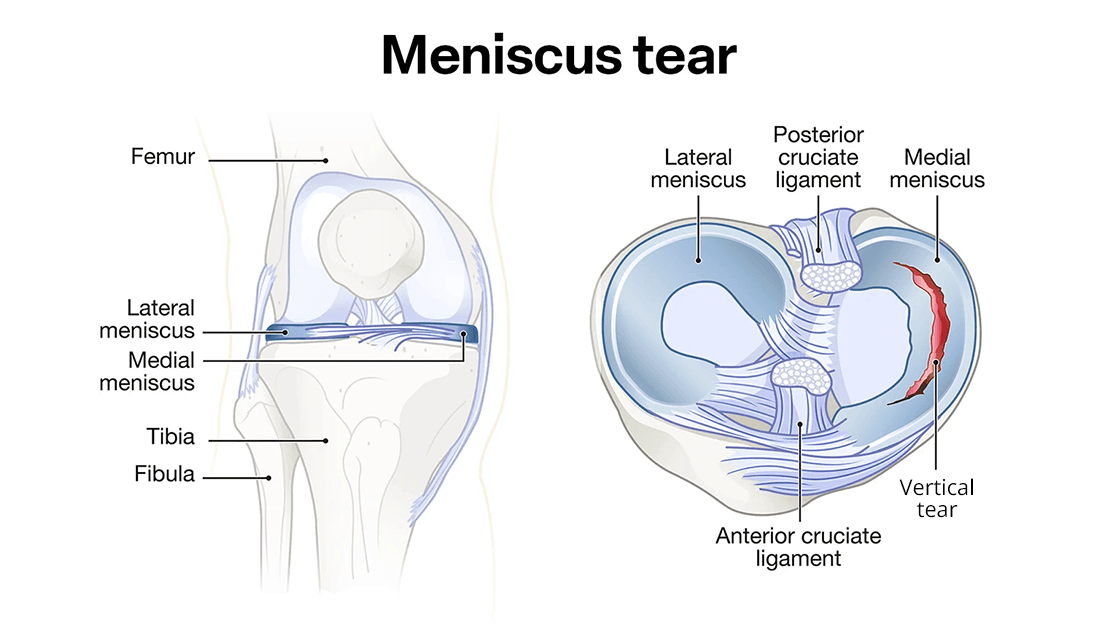
The meniscus is a C-shaped fibrocartilaginous structure within the knee joint that plays a critical role in load distribution, shock absorption, joint stability, and proprioception. Each knee has two menisci—medial and lateral—positioned between the femoral condyles and tibial plateau. A meniscus tear refers to a disruption in this cartilage, commonly resulting from trauma or degeneration. Tears vary in type (e.g., longitudinal, radial, horizontal, bucket handle) and location, and these factors directly impact the healing potential and treatment strategy.
1.1 What Is a Meniscus Tear?
A torn meniscus occurs when the fibrocartilage that cushions the knee joint is damaged. This damage can be acute or chronic and typically affects either the medial (more commonly injured) or lateral meniscus. Anatomically, the outer third of the meniscus—the “red zone”—is well-vascularized and has a higher chance of healing, whereas the inner two-thirds—the “white zone”—has limited blood supply and poorer healing outcomes.
1.2 Symptoms of a Torn Meniscus
Clinical signs of a meniscus tear include:
- Joint line pain, particularly during twisting or squatting.
- Swelling, often delayed by 24–48 hours due to synovial effusion.
- Mechanical symptoms such as locking, clicking, catching, or a sensation of knee instability.
- Loss of full extension or flexion, leading to functional limitations.
- In chronic tears, symptoms may fluctuate and mimic other intra-articular knee pathologies.
MRI remains the diagnostic gold standard, with sensitivity and specificity rates above 85% for clinically significant tears.
1.3 Causes of Meniscus Tears in the Knee
Sports-Related Injuries (Pivoting, Twisting):
Meniscal tears frequently occur during sports involving sudden deceleration, pivoting, or twisting—commonly in soccer, basketball, and skiing. These activities can impose high shear forces on the meniscus, especially if the foot is planted while the knee is rotating. Athletes under 40 are particularly at risk for traumatic tears.
Age-Related Degeneration and Wear:
Degenerative meniscal tears are common in middle-aged and older adults. The collagen matrix in the meniscus loses its tensile strength and water content over time, making it vulnerable to injury even from minor movements. Such tears are typically horizontal and are associated with knee osteoarthritis.
Sudden Trauma vs. Repetitive Stress:
While acute trauma leads to identifiable injuries, repetitive microtrauma—from occupational kneeling, stair climbing, or squatting—can degrade the meniscal tissue over time. This is particularly relevant in professions such as carpentry, firefighting, or gardening.
Risk Factors: Obesity, Poor Conditioning, Aging:
Obesity increases the axial load transmitted through the knee joint, accelerating meniscal degeneration. Muscle weakness in the quadriceps and hamstrings reduces dynamic joint stability, while aging reduces vascularization and intrinsic healing potential. All these factors contribute to higher susceptibility and poorer outcomes after a tear.
2. Standard Treatment Options for Meniscus Tears
2.1 Conservative Management
Initial management often involves non-surgical protocols, especially for stable or degenerative tears. This typically includes:
- RICE protocol (Rest, Ice, Compression, Elevation)
- NSAIDs to reduce inflammation and discomfort
- Physical therapy focused on strengthening periarticular muscles and restoring joint mobility
- Activity modification, avoiding deep squats or pivot-heavy sports
Studies suggest that up to 70% of degenerative tears can be managed successfully with conservative therapy, particularly in patients without mechanical symptoms.
2.2 Invasive and Surgical Approaches
When symptoms persist or mechanical locking occurs, arthroscopic intervention may be warranted:
- Partial meniscectomy involves removing the torn fragment and is widely performed but may predispose the knee to early osteoarthritis.
- Meniscal repair is preferable in younger, active individuals and for tears in the red zone. Repair has shown better long-term outcomes in joint preservation but requires longer rehabilitation.
- Meniscal allograft transplantation is an option for patients with a previous total meniscectomy and persistent pain but is typically reserved for select candidates under 50.
Recent meta-analyses indicate that arthroscopic meniscectomy provides short-term relief but may not outperform physical therapy in long-term functional improvement for degenerative tears.
2.3 Why Alternative Therapies Are Gaining Interest
Due to the limitations of surgery and prolonged recovery, regenerative and non-invasive therapies are increasingly explored:
- Platelet-rich plasma (PRP) offers concentrated growth factors to stimulate healing and modulate inflammation.
- Stem cell therapy, particularly using mesenchymal stem cells (MSCs), shows potential in cartilage regeneration but remains under investigation.
- Laser therapy (Photobiomodulation) is gaining attention for its anti-inflammatory and regenerative effects. By modulating cellular mitochondria and enhancing ATP production, Class IV lasers may accelerate meniscal healing and pain relief without the risks associated with surgery.
3. Introduction to Laser Therapy
Laser therapy, also known as Photobiomodulation (PBM), is a non-invasive treatment that uses light to accelerate healing, reduce pain, and improve function in damaged tissues. The primary mechanism behind laser therapy is the stimulation of cellular processes through light absorption, which enhances tissue repair and modulates inflammation. Laser therapy is particularly beneficial for soft tissue injuries such as meniscus tears, tendinopathy, and ligament sprains.
3.1 What Is Laser Therapy?
Laser therapy involves the application of specific wavelengths of light, usually in the infrared spectrum, to targeted areas. The light energy penetrates the skin and tissues, reaching the mitochondria of cells. This stimulates the production of ATP (adenosine triphosphate), the cellular energy required for tissue regeneration and healing.
3.1.1 Overview of Photobiomodulation
Photobiomodulation (PBM) refers to the process by which light, typically from lasers or light-emitting diodes (LEDs), interacts with the cells in the body to promote healing. This process helps to:
- Enhance cellular metabolism and function.
- Promote angiogenesis (formation of new blood vessels), improving blood flow.
- Stimulate fibroblast activity, increasing collagen production for tissue repair.
Scientific studies have demonstrated that PBM can reduce inflammation and accelerate tissue recovery by increasing ATP production in mitochondria, the powerhouse of cells. This leads to improved cellular energy, which in turn enhances the body’s natural healing processes.
3.1.2 Class IV Laser vs Cold Laser Therapy
Class IV laser therapy is a high-powered laser (typically between 500mW and 60W), which allows for deeper tissue penetration and more significant biological effects compared to cold laser therapy (Class III or lower). Cold lasers operate at lower power levels (5mW to 500mW), which are generally used for superficial injuries. Class IV lasers have the capability to treat deep-seated issues, such as meniscus tears, and provide faster pain relief, increased blood circulation, and enhanced tissue healing. Cold lasers, while still effective for certain conditions like superficial skin injuries, are less suited for deeper tissue penetration and repair.
3.1.3 Cellular-Level Mechanisms
At the cellular level, laser therapy functions primarily by stimulating mitochondrial activity, increasing ATP production. ATP is the energy currency of the cell, vital for all cell processes. Additionally, laser therapy enhances:
- Cytokine production, which regulates inflammation.
- Fibroblast activity, crucial for collagen synthesis and tissue repair.
- Chondrocyte activity (cartilage cells), supporting the regeneration of cartilage and the repair of meniscal tissue.
These processes culminate in faster healing, reduced pain, and improved tissue integrity, which are especially beneficial in treating meniscus tears.
4. How Laser Therapy Helps Repair Meniscus Tears
Laser therapy provides a multi-faceted approach to managing meniscus tears by reducing inflammation, alleviating pain, and stimulating tissue regeneration. The benefits are primarily achieved through anti-inflammatory mechanisms, pain relief without medications, and accelerated tissue healing.

4.1 Targeted Anti-Inflammatory Action
One of the key benefits of laser therapy is its ability to modulate the inflammatory response that accompanies meniscus tears.
Reduction in Pro-Inflammatory Cytokines:
Laser therapy has been shown to reduce pro-inflammatory cytokines (such as TNF-alpha and IL-1beta), which play a central role in initiating the inflammatory cascade. By inhibiting these molecules, laser therapy helps control inflammation, preventing further damage to the meniscus and surrounding tissues.
Decreased Swelling and Joint Effusion:
In addition to reducing cytokine levels, laser therapy increases lymphatic drainage and improves blood circulation, which helps reduce swelling and joint effusion. This results in a more comfortable knee joint with improved range of motion.
4.2 Pain Reduction Without Medications
Laser therapy is particularly advantageous for patients who wish to avoid medications, such as NSAIDs or opioids, which can have long-term side effects.
Modulating Nerve Sensitivity:
Laser therapy affects nociceptors, the nerve endings responsible for pain sensation. By promoting the release of endorphins (natural painkillers) and altering nerve signal transmission, laser therapy can effectively reduce the sensation of pain, even in cases of severe meniscus tears.
Stimulating Natural Endorphin Release:
The increased ATP production and improved blood circulation also stimulate the release of endorphins—the body’s natural analgesics. This not only reduces pain but also enhances mood and well-being, offering a holistic approach to pain management.
4.3 Accelerated Healing and Tissue Regeneration
Laser therapy plays a crucial role in stimulating cellular regeneration and supporting tissue repair processes, particularly in the meniscus, a tissue with limited regenerative capacity.
Stimulating Collagen Production:
Laser therapy enhances the synthesis of collagen—a key structural protein in cartilage and connective tissue. Increased collagen production helps repair the damaged meniscal fibers and supports the formation of a stable, functional meniscal structure.
Enhancing Blood Flow and Oxygen Delivery:
By promoting vasodilation, laser therapy increases blood flow to the injured area. This enhances oxygen delivery and nutrient supply to the damaged tissues, which is crucial for cell survival and effective repair. In meniscus tears, improved circulation accelerates recovery by providing the necessary components for tissue regeneration.
Supporting Cartilage Cell (Chondrocyte) Activity:
Laser therapy also stimulates chondrocytes (cartilage cells), promoting their activity in cartilage regeneration. This is especially important in degenerative meniscal tears where cartilage breakdown is a contributing factor. By supporting chondrocyte function, laser therapy aids in cartilage repair and potentially reduces the risk of osteoarthritis development.
4.4 Functional Benefits for Knee Recovery
Laser therapy not only accelerates healing at the cellular level but also provides significant functional benefits for knee recovery, including:
Improved Range of Motion:
By reducing swelling and pain, and promoting tissue healing, laser therapy helps restore normal joint mobility, which is often compromised in the presence of a meniscus tear.
Restoring Strength and Flexibility:
Laser therapy supports the rehabilitation process by enhancing muscle strength and joint stability. This is important for avoiding compensatory patterns and restoring normal function to the knee.
Minimizing Downtime in Rehabilitation:
Due to its ability to accelerate healing, laser therapy reduces overall downtime during rehabilitation, allowing patients to return to their regular activities and sports sooner, with minimal risk of reinjury.
5. Clinical Evidence and Real-World Results
Laser therapy is a proven treatment for various musculoskeletal conditions, including meniscus tears. Clinical studies, combined with real-world patient experiences, validate the effectiveness of Photobiomodulation (PBM) for knee injuries, including meniscal tears.
5.1 What Studies Say
Emerging research supports the use of laser therapy—particularly Class IV laser systems—as a promising adjunct treatment for meniscal injuries. Multiple clinical studies have shown that laser therapy can reduce inflammation, alleviate pain, and enhance tissue repair in knee-related pathologies.
Meta-analyses and controlled trials have demonstrated that laser therapy helps regulate pro-inflammatory cytokines and stimulates the production of collagen and fibroblasts—two critical components of soft tissue healing. These effects contribute to improved joint function and a decrease in joint effusion (fluid accumulation). In several trials, patients who received laser therapy reported significantly faster reductions in pain and swelling compared to those treated with conventional physiotherapy alone.
Moreover, studies have highlighted improvements in gait mechanics and range of motion among individuals with meniscus-related knee dysfunction after undergoing structured laser therapy programs. These effects were more pronounced in individuals who received high-power Class IV treatments, which penetrate deeper tissues and accelerate cellular regeneration via photobiomodulation.
5.2 Real Patients, Real Relief

In clinical practice, laser therapy has shown encouraging results in a broad spectrum of patients dealing with meniscal injuries—ranging from athletes and active adults to older individuals with degenerative knee conditions. Patients often report reduced knee stiffness and discomfort after a short series of laser treatments. Many note being able to return to light physical activity or physical therapy exercises with greater ease. Clinicians have also observed reductions in joint swelling and improvements in mobility, even in cases where conservative measures like rest and medication had offered limited relief. Laser therapy appears particularly beneficial for individuals aiming to avoid or delay surgical intervention. When combined with targeted rehabilitation programs, it contributes to a more comfortable and faster return to daily function. While outcomes vary depending on the severity of the tear and the patient’s overall health, the consistency of these functional improvements continues to support the clinical adoption of laser therapy in managing meniscus-related knee issues.
5.3 How to Find a Certified Laser Therapy Provider
When considering laser therapy for a meniscus tear, it is essential to select a provider who is both certified and experienced in Photobiomodulation Therapy (PBMT). Proper training ensures that the practitioner can tailor treatment protocols—including wavelength, energy density, and session frequency—to support safe and effective recovery.
To identify a qualified provider, consider the following:
- Verify certification: Look for credentials from recognized bodies such as the American Physical Therapy Association (APTA), National Certification Board for Therapeutic Massage & Bodywork (NCBTMB), or the World Association for Laser Therapy (WALT).
- Assess clinical experience: Ideal providers should have expertise in musculoskeletal rehabilitation, particularly with knee joint pathologies like meniscus injuries.
- Ask about technology: Not all lasers are created equal. Class IV laser devices, known for their high power and deeper tissue penetration, are considered more effective for orthopedic conditions than low-level (Class III) lasers.
- Research patient feedback: Online reviews and testimonials can offer real-world insights into treatment success and patient satisfaction.
To ensure the best possible care, inquire directly about the provider’s laser equipment, therapeutic protocols, and clinical outcomes. For professionals and clinics seeking to integrate a high-quality, FDA-cleared Class IV laser system into their practice, Rhein Laser offers cutting-edge technology designed for precision, deep tissue healing, and user-friendly operation. Learn more about its features, safety standards, and clinical applications here.
6. FAQs: Laser Therapy for Meniscus Tear
Q1. What is the difference between Class IV laser and cold laser therapy?
Class IV lasers are more powerful and penetrate deeper into tissues, making them more effective for treating deeper injuries like meniscus tears. Cold lasers are typically used for more superficial injuries.
Q2. How many sessions of laser therapy are needed for a meniscus tear?
Most patients benefit from 6-12 sessions, depending on the severity of the tear. Sessions are typically scheduled 2-3 times per week.
Q3. Is laser therapy painful?
No, laser therapy is non-invasive and pain-free. Most patients experience a warm sensation, but it should not cause discomfort.
Q4. Can laser therapy replace surgery for a torn meniscus?
Laser therapy may reduce pain and improve function but is not a replacement for surgery in severe cases. It is often used as a complementary treatment for rehabilitation.
Q5. How long does it take to see results from laser therapy?
Most patients notice pain relief and improvements in mobility within 2-3 weeks of starting treatment, although full healing may take longer.
Q6. Are there any side effects of laser therapy?
Laser therapy is generally safe with few side effects. However, some individuals may experience mild redness or warmth in the treated area, which resolves quickly.
Q7. Can laser therapy be combined with other treatments for a meniscus tear?
Yes, laser therapy can be combined with physical therapy, medications, or even surgery to enhance recovery and reduce downtime.
Q8. Is laser therapy covered by insurance for meniscus tears?
Coverage for laser therapy varies by insurance provider. It is advisable to check with your insurance company to see if laser therapy is included under physical therapy or injury rehabilitation plans.
7. References
Effectiveness of High Intensity Laser Therapy for Reduction of Pain in Knee Osteoarthritis:
https://pmc.ncbi.nlm.nih.gov/articles/PMC5206453
Photobiomodulation and its clinical efficacy in the treatment of musculoskeletal injuries: A systematic review. American Journal of Physical Medicine & Rehabilitation:
 English
 العربية
 Français
 日本語
日本語 Português
 Español
 Русский
 Deutsch