

Page Contents
Introduction
Recovery after orthopedic procedures often involves a structured rehabilitation process designed to support mobility, physical function, and overall comfort. As rehabilitation technology continues to develop, healthcare professionals are exploring supportive approaches that can complement traditional recovery programs. Class IV Laser Therapy, also known as high-power therapy, uses concentrated light energy to support photobiomodulation processes in targeted areas. When incorporated into rehabilitation settings, this technology may provide additional support for individuals recovering from orthopedic procedures by focusing on tissue comfort, circulation response, and functional recovery goals. This article explores the role of Class IV Laser Therapy in orthopedic rehabilitation environments, its connection with recovery programs, and how professionals can integrate advanced technology into modern care approaches.
1. Understanding Class IV Laser Therapy in Orthopedic Rehabilitation
Orthopedic rehabilitation focuses on helping individuals regain movement, strength, and confidence after procedures involving muscles, joints, bones, and soft tissues. Advanced supportive technologies have become increasingly important in creating comprehensive recovery programs.
1.1 What Is Class IV Laser Therapy?
Class IV Laser Therapy is a high-power photobiomodulation technology that delivers therapeutic energy to targeted body areas. Compared with lower-power laser systems, Class IV devices can provide deeper energy penetration, allowing professionals to focus on larger treatment areas and deeper tissues.
The technology works through specific wavelengths of light energy that interact with biological tissues. These interactions may influence cellular activity and support the body’s natural recovery processes.
1.2 The Role of Laser Therapy in Orthopedic Recovery Settings
After orthopedic procedures, rehabilitation professionals often focus on restoring movement, improving flexibility, and supporting functional performance. This therapy can be considered as a complementary tool within these recovery environments.
By providing targeted light energy to selected areas, therapy may support tissue comfort and help create a more comprehensive rehabilitation approach when combined with exercise programs and professional guidance.
1.3 Why Rehabilitation Centers Explore Advanced Laser Technology
Modern rehabilitation centers continue to search for technologies that can improve patient experiences and support personalized recovery plans.
Class IV Laser Therapy offers rehabilitation professionals another option for addressing different recovery needs, especially when combined with physical techniques, movement training, and individualized rehabilitation strategies.
2. How Class IV Laser Therapy Supports Post-Orthopedic Rehabilitation
Orthopedic recovery involves multiple stages, including early recovery, mobility improvement, and return-to-activity preparation. Each stage may require different supportive approaches depending on individual recovery goals.
2.1 Supporting Tissue Recovery After Orthopedic Procedures
Orthopedic procedures may affect muscles, tendons, ligaments, or surrounding soft tissues. During rehabilitation, professionals often focus on supporting tissue function and improving comfort during movement.
Class IV Laser Therapy provides targeted light energy that may support cellular responses and circulation around specific areas involved in recovery.
2.2 Supporting Mobility and Functional Rehabilitation
Regaining mobility is an important part of many orthopedic rehabilitation programs. Limited movement can affect daily activities and overall physical performance.
This therapy can be incorporated into rehabilitation plans as a supportive technology that works alongside stretching, strengthening exercises, and movement-based therapies.
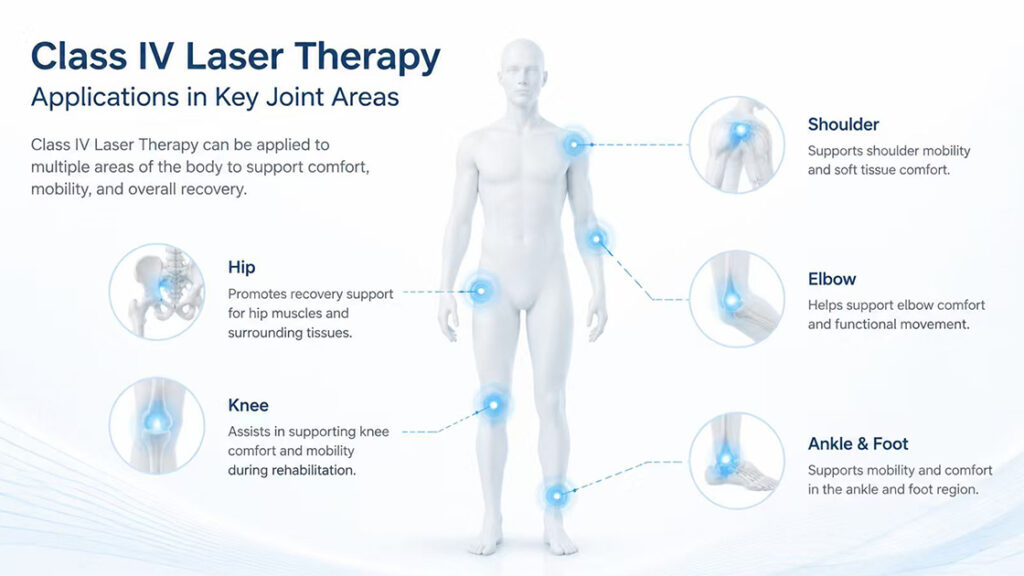
2.3 Supporting Recovery After Joint-Related Procedures
Joint procedures often require careful rehabilitation strategies to restore normal movement patterns. Common areas may include:
- Knee joints
- Shoulder joints
- Hip regions
- Elbow areas
- Ankle and foot regions
Class IV Laser Therapy may be used by professionals as part of a broader recovery approach focused on comfort and functional improvement.
3. The Science Behind Class IV Laser Therapy in Recovery Support
Understanding the biological principles behind this therapy helps rehabilitation professionals evaluate how this technology fits into orthopedic recovery environments.
3.1 Photobiomodulation and Cellular Activity
Class IV Laser Therapy uses light energy to stimulate biological responses through a process known as photobiomodulation.
During this process, specific wavelengths of light interact with cells and may influence cellular functions related to energy production and tissue response.
3.2 The Relationship Between Laser Energy and Circulation Response
Circulation plays an important role in tissue health and recovery processes. Laser energy may influence local biological responses associated with blood flow and tissue environment.
By targeting specific areas, professionals can customize applications according to rehabilitation goals and individual needs.
3.3 Supporting Muscle and Soft Tissue Comfort
Orthopedic recovery often involves addressing changes in surrounding muscles and soft tissues. These structures play an important role in movement and stability.
Class IV Laser Therapy can provide additional support by focusing on areas where individuals experience temporary discomfort or stiffness during rehabilitation.
4. Applications of Class IV Laser Therapy in Rehabilitation Clinics
Rehabilitation clinics work with individuals recovering from different orthopedic procedures and movement-related challenges. The flexibility of Class IV Laser Therapy allows professionals to consider various applications within rehabilitation programs.
4.1 Supporting Recovery After Knee Procedures
Knee-related procedures often require progressive rehabilitation focused on movement, strength, and stability.
Class IV Laser Therapy may be incorporated into rehabilitation routines to support comfort around the knee area while individuals participate in guided recovery exercises.
4.2 Supporting Shoulder Rehabilitation Programs
Shoulder rehabilitation can involve restoring range of motion and improving muscle coordination. Because the shoulder contains complex structures, rehabilitation programs often require personalized approaches.
This therapy may provide additional support during recovery-focused sessions by targeting specific areas around the shoulder.
4.3 Supporting Sports-Related Orthopedic Recovery
Many active individuals undergo orthopedic procedures related to sports activities. Their rehabilitation goals often include returning to previous activity levels while maintaining proper movement patterns.
Class IV Laser Therapy can be included as part of a comprehensive sports rehabilitation program that combines technology, exercise, and professional assessment.
5. Choosing Class IV Laser Therapy Technology for Rehabilitation Settings
Selecting appropriate technology is an important consideration for rehabilitation clinics. Professionals need solutions that match their workflow, treatment goals, and patient care strategies.
5.1 Important Features of Professional Laser Therapy Systems
Rehabilitation professionals often consider several factors when evaluating laser technology, including:
- Adjustable treatment parameters
- Targeted energy delivery
- User-friendly operation
- Consistent performance
- Adaptability for different treatment areas
These features help clinics provide more flexible rehabilitation support.
5.2 Integrating Laser Technology Into Modern Recovery Programs
Technology works best when combined with professional knowledge and structured rehabilitation plans.
Class IV Laser Therapy is not designed to replace rehabilitation exercises or clinical evaluation. Instead, it can serve as a complementary option within a broader recovery strategy.
5.3 The Future of Laser-Assisted Orthopedic Rehabilitation
As rehabilitation continues to become more personalized, advanced technologies will play an increasingly important role in supporting patient-centered care.
Class IV Laser Therapy represents one example of how professionals can combine technology with rehabilitation expertise to create more comprehensive recovery environments.
FAQ
What is Class IV Laser Therapy after orthopedic procedures?
Class IV Laser Therapy is a high-power technology used as a supportive approach in rehabilitation settings after orthopedic procedures.
Can Class IV Laser Therapy replace physical therapy?
No. This therapy works as a complementary technology and does not replace professional rehabilitation programs or exercise-based recovery.
What areas can Class IV Laser Therapy be used for?
It may be applied to areas such as knees, shoulders, hips, elbows, and other regions involved in orthopedic recovery.
How does Class IV Laser Therapy support rehabilitation?
It uses light energy to support biological responses and may help improve comfort during recovery programs.
Is Class IV Laser Therapy suitable for every orthopedic recovery situation?
Treatment approaches vary depending on individual conditions, recovery goals, and professional assessment.
Conclusion
Class IV Laser Therapy provides rehabilitation professionals with an advanced supportive technology that can complement orthopedic recovery programs. Through high-power photobiomodulation, this approach focuses on targeted light energy application to support tissue comfort, mobility goals, and rehabilitation experiences. When combined with professional evaluation, exercise programs, and personalized recovery strategies, this therapy can become a valuable tool within modern orthopedic rehabilitation environments. As healthcare technology continues to advance, laser-assisted recovery approaches may offer professionals additional options for creating comprehensive and patient-focused rehabilitation programs.
References
Photobiomodulation Therapy in Tissue Healing and Recovery: Mechanisms and Clinical Applications
https://www.ncbi.nlm.nih.gov/pmc/articles/PMC4743666
Low-Level and High-Power Laser Therapy in Musculoskeletal Rehabilitation
https://www.ncbi.nlm.nih.gov/pmc/articles/PMC4921524
Photobiomodulation: A Review of Biological Effects and Clinical Applications
https://www.ncbi.nlm.nih.gov/pmc/articles/PMC4126803
Physical Medicine and Rehabilitation
https://www.ncbi.nlm.nih.gov/books/NBK279659
Effects of Photobiomodulation on Musculoskeletal Conditions
 English
 العربية
 Français
 日本語
日本語 Português
 Español
 Русский
 Deutsch