

Page Contents
Introduction
Functional mobility—the ability to move independently and efficiently in daily activities—is critical to maintaining quality of life. Limitations in mobility can result from chronic joint conditions, muscular injuries, post-surgical recovery, or neurological impairments. Restricted movement can significantly affect independence, daily routines, and overall well-being. Traditional treatments often focus on medications, physical therapy, or surgery, but these approaches may have limited efficacy or prolonged recovery times. Class IV laser therapy, a high-powered photobiomodulation treatment, has emerged as a promising intervention for enhancing functional mobility. By targeting deep tissues, reducing inflammation, and promoting cellular repair, this therapy offers a non-invasive option to improve joint function, muscle performance, and overall physical activity. In this article, we explore how Class IV laser therapy works, its mechanisms, clinical applications, benefits, and limitations in improving functional mobility.
1. Understanding Functional Mobility and Its Challenges
1.1 What is Functional Mobility?
Functional mobility refers to a person’s ability to move effectively and independently during daily activities, including walking, climbing stairs, standing up, or performing household tasks. It relies on the coordinated function of muscles, joints, and the nervous system. Limitations in mobility can lead to reduced independence, increased risk of falls, and diminished quality of life.
1.2 Common Causes of Impaired Mobility
Several conditions can impair functional mobility:
- Joint Disorders: Osteoarthritis and rheumatoid arthritis cause stiffness, pain, and reduced range of motion.
- Muscular and Tendon Injuries: Strains, tears, or inflammation reduce strength and flexibility.
- Post-Surgical Recovery: Surgical procedures, particularly orthopedic surgeries, often temporarily limit mobility due to pain and tissue healing.
- Neurological Issues: Peripheral neuropathy, spinal injuries, or stroke can impair nerve function, resulting in weakness or limited coordination.
1.3 Consequences of Reduced Mobility
Limited mobility can have widespread effects:
- Increased dependency in daily activities
- Progressive muscle atrophy and joint stiffness
- Higher risk of falls and secondary injuries
- Psychological impact, including anxiety and depression
2. Introduction to Class IV Laser Therapy
2.1 What is Class IV Laser Therapy?
Class IV laser therapy refers to high-power lasers, typically exceeding 500 milliwatts, that penetrate deeper into tissues compared to low-level laser therapy (LLLT). These lasers are capable of delivering sufficient energy to muscles, tendons, ligaments, and joints, allowing for therapeutic effects in deep structures without invasive procedures.
Compared to low-power lasers, Class IV lasers provide:
- Greater tissue penetration
- Shorter treatment times
- More pronounced anti-inflammatory and analgesic effects
2.2 Mechanisms of Action
Class IV laser therapy works primarily through photobiomodulation:
- Cellular Energy Enhancement: Light energy stimulates mitochondria, increasing ATP production, which fuels cellular repair and function.
- Microcirculation Improvement: Laser energy dilates blood vessels, improving oxygenation and nutrient delivery to tissues.
- Inflammation Modulation: Reduces pro-inflammatory cytokines, promoting tissue healing.
- Collagen and Tissue Repair: Stimulates fibroblasts, enhancing collagen synthesis for joint and soft tissue recovery.
2.3 Clinical Evidence Supporting Mobility Improvement
Research indicates that Class IV lasers can:
- Reduce pain and stiffness in osteoarthritis
- Improve muscle and tendon healing after injury
- Enhance post-surgical rehabilitation outcomes
- Support nerve function recovery in peripheral neuropathy
The combination of deep tissue penetration, pain reduction, and cellular stimulation makes Class IV laser therapy particularly effective for mobility enhancement.
3. How Class IV Laser Therapy Improves Functional Mobility
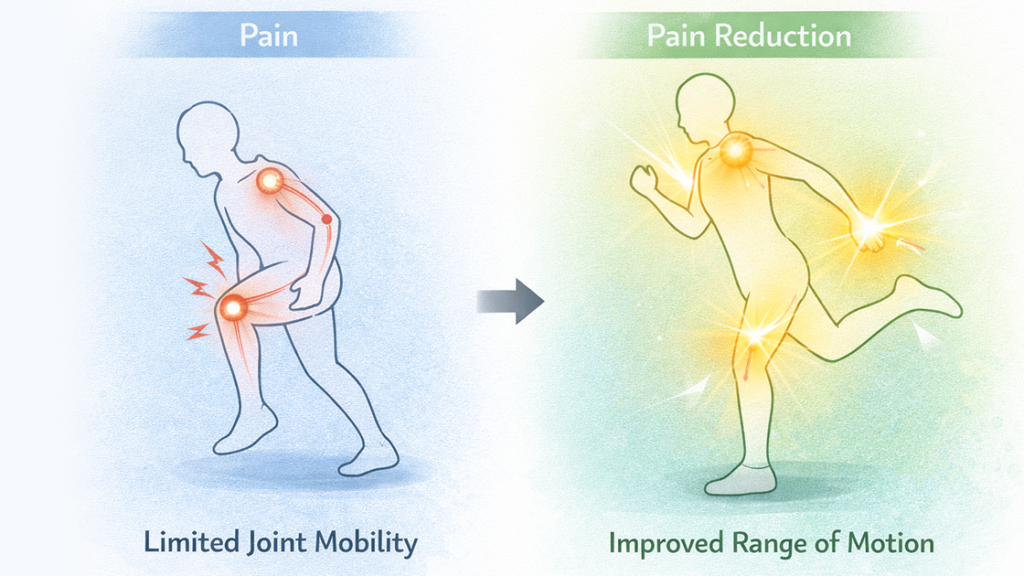
3.1 Pain Reduction and Muscle Relaxation
Pain is a primary barrier to functional mobility. Class IV laser therapy alleviates pain through:
- Reduction of inflammation and edema
- Modulation of nociceptive signals
- Relaxation of hypertonic muscles
By decreasing discomfort, patients can move more freely and perform daily activities with less effort.
3.2 Enhancing Joint Flexibility and Range of Motion
Laser therapy improves joint function by:
- Increasing tissue elasticity
- Reducing stiffness in muscles, tendons, and ligaments
- Supporting gradual restoration of normal range of motion
This is particularly beneficial for patients with arthritis or post-injury joint limitations.
3.3 Supporting Post-Surgical and Injury Recovery
Class IV laser therapy accelerates tissue repair:
- Promotes faster healing of surgical sites
- Minimizes post-operative edema and bruising
- Complements physical therapy for more efficient rehabilitation
3.4 Neurological Benefits for Movement
For patients with nerve impairments:
- Improved local blood flow supports nerve regeneration
- Enhanced mitochondrial function restores energy supply to neurons
- Reduces neuropathic pain, improving coordination and balance
4. Treatment Planning and Protocols
4.1 Pre-Treatment Assessment
Before therapy:
- Assess functional mobility through gait analysis, joint range of motion, and pain scoring
- Review medical history, prior treatments, and lifestyle factors
- Determine target tissues and treatment parameters
4.2 Laser Treatment Procedure
Treatment involves:
- Directing laser energy to affected muscles, joints, or tendons
- Adjusting wavelength, power, and duration based on patient condition
- Typical sessions last 15–30 minutes, with multiple sessions per week
Therapy is non-invasive, well-tolerated, and does not require anesthesia.
4.3 Post-Treatment Care and Rehabilitation
- Encourage gentle exercises and stretching
- Monitor pain and mobility progress
- Integrate with physical therapy for optimal outcomes
5. Advantages and Limitations
5.1 Benefits of Class IV Laser for Functional Mobility
- Non-invasive and safe
- Reduces pain without medication dependence
- Enhances rehabilitation outcomes
- Improves independence and overall quality of life
5.2 Limitations and Considerations
- Multiple sessions may be required for significant improvement
- Effectiveness depends on accurate diagnosis and proper treatment protocol
- Limited benefit for severe structural damage or complete nerve loss
FAQs
What types of mobility issues can Class IV laser help?
It is effective for joint stiffness, muscular injuries, post-surgical recovery, and mild neuropathic impairments.
Is the therapy painful?
No, treatments are generally well-tolerated; mild warmth may be felt.
How long does it take to see improvement?
Some patients notice changes after 2–3 sessions, with maximum improvement over several weeks.
Can it be combined with physical therapy?
Yes, combining laser therapy with rehabilitation exercises maximizes functional gains.
Are there any risks or side effects?
Side effects are rare when performed by trained professionals. Mild redness or warmth may occur.
Conclusion
Class IV laser therapy offers a scientifically backed, non-invasive approach to improving functional mobility. By reducing pain, enhancing joint flexibility, supporting tissue repair, and promoting nerve function, it can significantly improve daily activity performance and quality of life. When integrated with assessment, personalized protocols, and physical therapy, it becomes a powerful tool for rehabilitation and mobility enhancement.
References
SmartLaserTherapy. Class IV Laser Therapy and Mobility Improvement.
https://smartlasertherapy.com/class-iv-laser-therapy-helps-reduce-inflammation-and-boost-mobility
Baxter, G. D., et al. Class IV Laser Therapy in Rehabilitation: A Review. Lasers Med Sci, 2014; 29(3): 1031–1041.
https://pubmed.ncbi.nlm.nih.gov/24292142
Chow, R. T., et al. Photobiomodulation and Pain Management in Musculoskeletal Disorders. Pain Med, 2017; 18(2): 267–279.
https://pubmed.ncbi.nlm.nih.gov/27992864
Hashmi, J. T., et al. Role of Class IV Laser in Tissue Repair and Rehabilitation. Photomed Laser Surg, 2010; 28(3): 321–327.
 English
 العربية
 Français
 日本語
日本語 Português
 Español
 Русский
 Deutsch