

Page Contents
Introduction
For many dog owners, the moment their beloved pet suddenly cries out in pain, struggles to stand, or drags its hind legs is a moment of pure fear. Intervertebral disc disease, or IVDD, is one of the most common and devastating neurological conditions affecting dogs, particularly breeds with long backs and short legs such as Dachshunds, French Bulldogs, and Corgis. The condition occurs when the cushioning discs between the vertebrae rupture or degenerate, pressing against the spinal cord and causing pain, nerve damage, and in severe cases, paralysis. For years, the standard treatment options have been stark: surgery or conservative management with strict crate rest and medication. But a growing number of veterinary neurologists and rehabilitation specialists are now embracing a third approach. Class IV laser therapy, also known as high-power photobiomodulation, is emerging as a powerful non-invasive tool for managing IVDD in dogs. By reducing spinal cord swelling, promoting nerve repair, and helping to calm inflammation, this therapy offers hope for dogs who are not surgical candidates or for owners seeking less invasive options.
1. Understanding IVDD and Its Impact on Dogs
Intervertebral disc disease is not simply a case of back pain. It is a complex neurological condition that requires a clear understanding of spinal anatomy and how the disease progresses.
1.1 What Happens in IVDD
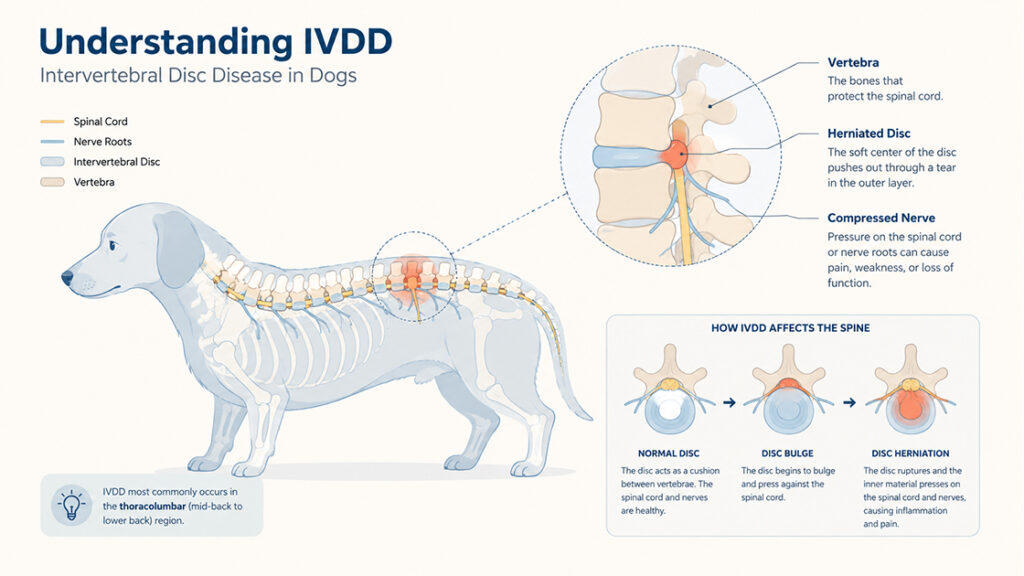
The canine spine is made up of individual vertebrae separated by intervertebral discs. These discs act as shock absorbers, cushioning the bones during movement. Each disc has a tough outer layer and a soft, gel-like center. In IVDD, the disc material degenerates and can either bulge or rupture. When the soft center extrudes from the disc, it impacts the spinal cord. This creates primary mechanical damage, but the secondary damage from swelling, reduced blood flow, and chemical irritation is what often determines the permanent neurological deficit.
1.2 Recognizing the Signs
The symptoms of IVDD vary depending on the location and severity of the disc problem. Early signs may include reluctance to jump or climb stairs, a hunched back, and crying out in pain when touched. As the condition progresses, owners may notice weakness or incoordination in the hind legs. In more severe cases, dogs may drag their paws or lose the ability to walk entirely. Deep pain perception may still be present in milder cases, but loss of deep pain is a serious sign that often necessitates emergency surgical intervention.
2. The Limitations of Traditional Treatment
Historically, the management of IVDD has been split between two distinct paths, each with significant drawbacks.
2.1 The Surgical Option
Surgical decompression involves removing a portion of the bone over the spinal cord to relieve pressure on the compressed nerves. While highly effective for severe cases, surgery is expensive and carries risks of anesthesia, infection, and post-operative complications. Not all owners can afford the cost of neurosurgery. Additionally, some dogs are poor surgical candidates due to age or other health conditions.
2.2 Conservative Management with Crate Rest
The non-surgical approach involves strict crate rest for a period of weeks, combined with anti-inflammatory medications and pain relievers. The goal is to reduce inflammation and allow the disc material to shrink away from the spinal cord. However, this approach requires near-complete restriction of movement, which can be challenging for owners to enforce, especially with active dogs. The results are also often unpredictable, and many dogs experience recurrence of symptoms.
2.3 The Gap Between Surgery and Rest
There exists a significant middle ground of patients for whom surgery is too risky or expensive, yet conservative management alone has proven insufficient. These are often cases where the dog is in pain and has some neurological impairment but has not lost the ability to walk. For these patients, and for those recovering from surgery, a third option is increasingly being sought.
3. How Class IV Laser Therapy Works on the Spine
Class IV laser therapy is fundamentally different from the low-power lasers often marketed for home use. To effectively treat the spinal cord, sufficient power is required to penetrate the thick muscles and bone that encase the spine.
3.1 Overcoming the Bone Barrier
The canine spinal cord is encased in a biological fortress of bone and dense muscle. Low-power lasers, often called cold lasers, lose most of their energy within the first centimeter or two of tissue. In a larger breed dog, the spinal cord lies much deeper. High-power Class IV lasers provide the necessary energy to maintain a therapeutic effect at depth, ensuring that the nerve roots receive enough energy to trigger a healing response.
3.2 Reducing Spinal Cord Swelling
One of the most immediate threats to the spinal cord after a disc problem is swelling within the fixed bony canal. This swelling compresses the nerve tissue and leads to secondary cell death. Class IV lasers help improve fluid drainage and regulate membrane function. This action reduces the pressure that damages neurons, providing a rapid non-invasive decompression effect.
3.3 Promoting Nerve Repair
Beyond reducing swelling, photobiomodulation actively promotes the repair of damaged nerve tissue. Specific wavelengths stimulate the cells responsible for producing myelin, the insulating sheath around nerve fibers. Research indicates that photobiomodulation can increase the production of growth factors that are essential for nerve regrowth and reconnection after injury. By targeting the energy centres of damaged neurons, laser therapy helps restore cellular function and inhibit the pathways that lead to further spinal cord damage.
3.4 Supporting Healthy Scar Formation
When the spinal cord is injured, the body’s natural response is to form scar tissue around the damaged area. While this process can help contain the injury, excessive scarring can also physically block nerve reconnection. By modulating the activity of certain cells, Class IV laser therapy can help support healthier scar formation, allowing for better nerve regeneration and functional recovery.
4. Clinical Application in Veterinary Practice
The use of Class IV laser therapy for IVDD is supported by clinical experience and practical protocols used in veterinary neurology.
4.1 A Supportive Approach for Conservative Management
For cases where surgery is not being pursued, Class IV laser therapy can be integrated into the conservative management plan. The treatment is designed to reduce localized swelling and provide neuro-regenerative support. The veterinarian applies the laser along the back, targeting the specific area affected. The use of specific wavelengths helps navigate through the vertebral bone to deliver energy directly to the site of the disc problem.
4.2 Supporting Neurological Recovery
Dogs receiving laser therapy as part of their IVDD management often show encouraging progress. Many owners report that their dogs show reduced spinal pain and improved standing stability within the first few sessions. Over time, dogs may return to walking short distances unaided and, with continued therapy, achieve normal mobility with no remaining neurological deficits. The therapy works gradually, supporting the body’s own healing processes.
4.3 Beyond Pain Relief
The goal of Class IV laser therapy in IVDD management is not merely to mask pain but to actively work toward the restoration of function. It addresses the underlying cellular processes that contribute to nerve damage and slow recovery. For dogs with chronic spinal conditions, the surrounding muscles often enter a state of protective tightness. Laser therapy helps relax these muscles, reducing trigger points and increasing tissue flexibility, which supports better movement and comfort.
5. Integrating Laser Therapy into a Comprehensive Plan
Class IV laser therapy is most effective when it is part of a broader, multi-modal rehabilitation strategy.
5.1 Strict Activity Restriction
Even with laser therapy, strict crate rest remains the cornerstone of conservative IVDD management. The laser helps reduce inflammation and promote healing, but the disc itself needs time to stabilize. Dogs should be confined to a crate, with movement limited to short, leashed bathroom breaks for the recommended period.
5.2 Supporting Muscle Health
During periods of crate rest, muscles can become weak. Laser therapy helps maintain muscle health by improving blood flow and reducing inflammation. Once the acute phase has passed, physical therapy, hydrotherapy, and other supportive measures can be integrated with laser sessions to rebuild strength and coordination.
5.3 A Non-Invasive Alternative
For owners who are unable or unwilling to pursue surgery, Class IV laser therapy provides a scientifically grounded, non-invasive approach to managing IVDD. It does not replace the need for surgical intervention in severe cases, but for milder to moderate cases, it offers a meaningful chance at recovery without the risks and costs associated with the operating table.
FAQ
Q1: Is Class IV laser therapy safe for dogs with IVDD?
Yes. When administered by a trained veterinarian, Class IV laser therapy is safe and does not cause tissue damage.
Q2: How many sessions does a dog need?
The number varies, but a typical protocol involves multiple sessions per week for several weeks, depending on the severity of the condition.
Q3: Can laser therapy replace surgery for IVDD?
No. In severe cases where a dog has lost deep pain perception or is paralyzed, emergency surgery is still the recommended treatment.
Q4: Will my dog need crate rest if they receive laser therapy?
Yes. Strict activity restriction remains essential to allow the disc to heal.
Q5: How soon will I see improvement in my dog?
Some owners notice reduced pain and improved stability within the first few sessions, with more significant neurological recovery often occurring over several weeks.
Conclusion
Intervertebral disc disease is a frightening diagnosis for any dog owner, but it is not always a sentence to surgery or lifelong disability. Class IV laser therapy offers a powerful, non-invasive tool that can reduce spinal cord swelling, promote nerve repair, and support neurological recovery. By targeting the underlying causes of secondary spinal cord damage, photobiomodulation provides a middle path for dogs who fall between surgery and conservative rest. When combined with strict crate rest, appropriate medication, and a comprehensive rehabilitation plan, Class IV laser therapy can help many dogs regain their mobility and return to a pain-free life.
References
Neurological Salvage: The Role of Class IV Laser in Canine IVDD Management. FotonMedix.
Bio-Optic Standards for Canine Neurological Recovery: Overcoming the Trans-Vertebral Barrier in IVDD Management. FotonMedix.
Advanced Photobiomodulation and High-Precision Surgical Protocols for Canine Intervertebral Disc Disease (IVDD). FotonMedix.
Managing Chronic Intervertebral Disc Disease (IVDD) and Spinal Pain in Canines. FotonMedix.
Laser Therapy Dogs Benefit From: A Clinical Perspective on Neurological Disorders and Pain Management. FotonMedix.
 English
 العربية
 Français
 日本語
日本語 Português
 Español
 Русский
 Deutsch