

Содержание страницы
Введение
Dental pain and temporomandibular joint (TMJ) disorders are among the most common complaints in dental clinics worldwide. Patients suffering from these conditions often experience severe discomfort, limited jaw mobility, headaches, and referred pain to the neck or face. Causes can range from tooth decay, pulp inflammation, periodontal disease, bruxism (teeth grinding), malocclusion, or trauma. While conventional treatments such as analgesics, occlusal splints, or physical therapy provide temporary relief, they often fail to address the underlying tissue inflammation or promote effective long-term healing. Лазерная терапия класса IV, a high-power, deep-penetrating light therapy, has emerged as a non-invasive and effective solution for dental professionals to manage both acute and chronic dental pain. By stimulating cellular processes, reducing inflammation, and promoting tissue repair, Class IV laser therapy offers patients faster relief, improved jaw mobility, and enhanced post-procedural recovery. This article delves into the mechanisms, clinical applications, benefits, and treatment protocols of Class IV laser therapy for dental pain and TMJ disorders.
1. Understanding Dental Pain and TMJ Disorders
To understand how Class IV laser therapy provides relief, it is essential to examine the causes, symptoms, and challenges associated with dental pain and TMJ disorders. Jaw and facial pain are complex, involving muscles, ligaments, nerves, and the temporomandibular joint, which connects the lower jaw to the skull. Chronic dysfunction can result in significant discomfort and long-term structural issues if untreated.
1.1 Common Causes of Dental Pain
Dental pain primarily arises from conditions such as tooth decay, pulpitis, abscess formation, periodontal disease, or post-surgical inflammation. Bruxism, often stress-related, and malocclusion can contribute to excessive strain on the TMJ, resulting in referred pain to surrounding facial and neck muscles. Trauma from injuries or dental procedures can further exacerbate discomfort. The cumulative effect of these conditions leads to inflammation in both hard and soft tissues, which amplifies nociceptive signaling and prolongs pain. Understanding these underlying causes highlights why a targeted, cellular-level therapy such as Class IV laser is advantageous.
1.2 TMJ Disorders Related to Dental Issues
TMJ disorders frequently co-occur with dental problems. Patients may present with jaw stiffness, limited mouth opening, facial tenderness, clicking or popping sounds, and tension headaches. Bruxism, malocclusion, or post-extraction adaptations can overload the joint, leading to inflammation in the articular capsule and surrounding masticatory muscles. Chronic TMJ stress may cause secondary complications, including neck pain, ear discomfort, and cervical muscular tension. Addressing both joint mechanics and soft tissue inflammation is crucial for effective management.
1.3 Limitations of Traditional Treatments
Conventional approaches such as analgesics, non-steroidal anti-inflammatory drugs (NSAIDs), occlusal splints, or physiotherapy focus mainly on symptom management. While they may temporarily reduce discomfort, they rarely promote long-term tissue healing at the cellular level. Patients with chronic TMJ dysfunction or persistent dental pain require interventions that can directly reduce inflammation, improve circulation, and accelerate repair, which is where Class IV laser therapy demonstrates unique advantages.
2. How Class IV Laser Therapy Works in Dentistry
Лазерная терапия класса IV differs from low-level laser therapy (LLLT) due to its higher power output, which allows deeper penetration into tissues, including muscles, ligaments, and joint capsules. The therapy leverages photobiomodulation to induce cellular changes that reduce inflammation, modulate pain signals, and stimulate tissue repair.
2.1 Механизм действия
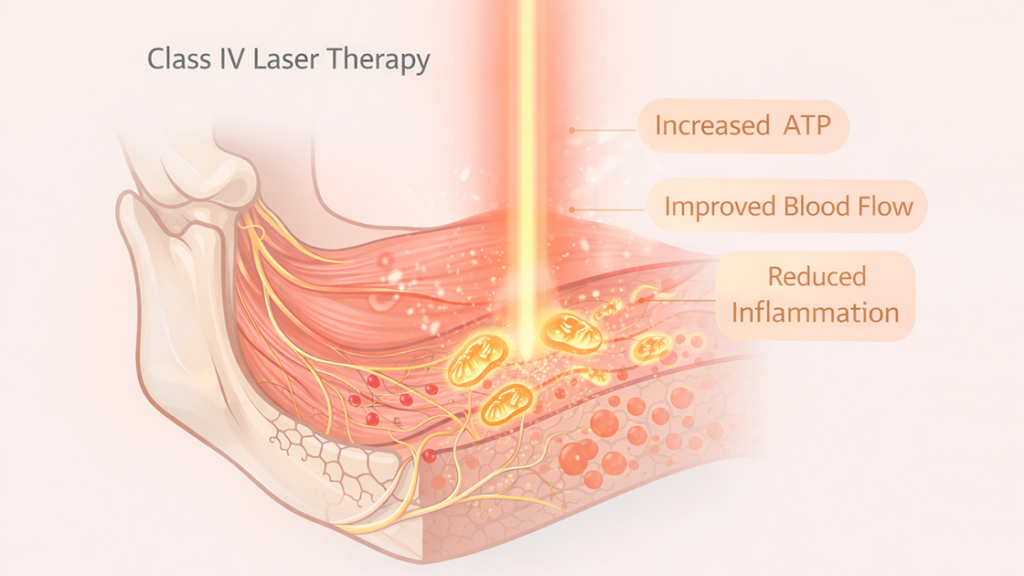
Class IV lasers emit concentrated light energy absorbed by chromophores in cellular mitochondria. This absorption enhances ATP production, improves mitochondrial function, and stimulates fibroblast activity. Increased cellular metabolism accelerates tissue repair while promoting angiogenesis and improving local microcirculation. The therapy also reduces reactive oxygen species and inflammatory cytokines, which are key mediators of pain and tissue degradation in dental and TMJ disorders. This combination of effects targets the root causes of pain, unlike conventional methods that only mask symptoms.
2.2 Pain Relief for Teeth and Jaw Muscles
Pain reduction from Class IV laser therapy occurs through multiple mechanisms. The laser modulates nociceptor activity, reducing transmission of pain signals to the central nervous system. Simultaneously, the therapy relaxes the masseter, temporalis, and pterygoid muscles, alleviating tension associated with bruxism and TMJ stress. Patients often report diminished toothache, facial muscle soreness, and tension headaches within a few sessions, demonstrating both local and systemic pain modulation.
2.3 Tissue Healing and Anti-Inflammatory Effects
Beyond pain relief, Class IV laser therapy accelerates tissue healing by promoting fibroblast proliferation, collagen synthesis, and angiogenesis. In dental procedures, this means faster soft tissue repair in the gums, enhanced periodontal regeneration, and reduced post-surgical edema. In TMJ disorders, improved blood flow and reduced inflammatory mediators accelerate joint capsule healing, supporting long-term functional recovery and preventing recurrent flare-ups.
3. Dental Applications of Class IV Laser Therapy
Class IV laser therapy has multiple clinical applications in dentistry, offering benefits for both patients and dental practitioners. Its versatility makes it suitable for acute pain, chronic TMJ disorders, post-surgical recovery, and periodontal maintenance.
3.1 TMJ and Facial Pain Management
Laser therapy effectively treats TMJ disorders arising from bruxism, malocclusion, or chronic joint inflammation. Targeted irradiation of masticatory muscles and joint capsules reduces pain, improves jaw mobility, and diminishes associated headaches. Regular treatments can prevent progression of joint degeneration and improve overall oral comfort.
3.2 Post-Dental Procedure Recovery
Following tooth extractions, root canal therapy, or periodontal surgeries, patients often experience swelling, inflammation, and discomfort. Class IV laser therapy accelerates healing by enhancing microcirculation, reducing edema, and stimulating tissue repair. This results in faster recovery, less post-operative pain, and improved patient satisfaction.
3.3 Gum and Periodontal Therapy
In cases of gingival inflammation or periodontal disease, laser therapy reduces local inflammation, enhances blood flow, and promotes collagen deposition. It is particularly useful after scaling and root planing procedures, supporting tissue regeneration, minimizing post-procedure discomfort, and improving long-term periodontal health.
4. Treatment Protocols in Dental Practice
Proper application protocols ensure optimal results while maintaining safety for patients.
4.1 Session Duration and Frequency
A typical session lasts 5–15 minutes per quadrant or per affected joint, depending on the severity of pain and inflammation. Acute conditions may require 2–3 sessions per week initially, while chronic cases often necessitate 6–8 sessions. Maintenance treatments every few weeks help prevent recurrence and maintain tissue health.
4.2 Target Areas in Dentistry
Key treatment areas include the temporomandibular joint, masseter and temporalis muscles, pterygoid muscles, periodontal tissues, and inflamed gums. Precise targeting ensures adequate penetration to the affected tissues while protecting surrounding structures. Dentists use hand-held laser probes, adjusting parameters according to tissue depth and condition.
4.3 Integration with Other Dental Treatments
Class IV laser therapy complements occlusal splints, physical therapy exercises, and standard post-surgical care. Combining therapies enhances outcomes, reduces recovery time, and promotes long-term oral and joint health. For example, post-extraction laser therapy combined with analgesics and splint therapy improves patient comfort and functional recovery.
5. Benefits for Dental Patients
Class IV laser therapy provides advantages that extend beyond traditional dental interventions.
5.1 Non-Invasive and Drug-Free Pain Relief
Unlike medications or injections, laser therapy is non-invasive and avoids systemic side effects. Patients can continue normal activities, including eating, speaking, and working, with minimal disruption. Its safety profile makes it suitable for a wide range of patients, including those with contraindications for certain medications.
5.2 Rapid Relief and Improved Jaw Function
Many patients experience significant pain reduction after just a few sessions, with improved range of motion in the jaw and relaxed masticatory muscles. This allows for more comfortable chewing, speaking, and daily activities, enhancing overall quality of life.
5.3 Long-Term Tissue Health and Prevention
Regular treatments can prevent chronic inflammation, promote periodontal regeneration, and reduce TMJ flare-ups. By targeting tissue repair at the cellular level, laser therapy supports long-term oral and joint health, decreasing the likelihood of future dental or TMJ complications.
FAQ
Q1: Is Class IV laser therapy safe for dental use?
A: Yes, it is FDA-cleared and non-invasive, with minimal side effects such as temporary warmth or mild redness.
Q2: Can it replace traditional dental procedures?
A: No, laser therapy complements standard dental treatments, enhancing healing and pain management.
Q3: How soon does pain relief occur?
A: Some patients report relief after the first session, while chronic conditions may require multiple treatments for optimal results.
Q4: Can laser therapy be used after dental surgery?
A: Yes, it reduces swelling, accelerates healing, and minimizes post-operative discomfort.
Q5: Are there risks for sensitive teeth or gums?
A: Adverse effects are rare; mild warmth or temporary redness may occur but typically resolve quickly.
Заключение
Class IV laser therapy is a safe, effective, and non-invasive solution for dental pain and TMJ disorders. By addressing inflammation, promoting tissue repair, and relaxing jaw muscles, it improves patient comfort and accelerates recovery from dental procedures. When integrated with conventional dental treatments such as occlusal splints, physiotherapy, and post-operative care, Class IV laser therapy provides long-term relief, enhances functional outcomes, and supports overall oral and joint health.
References
American Dental Association. Laser Applications in Dentistry.
https://www.ada.org/resources/research
Chow, R. et al. High-Power Laser Therapy for TMJ and Dental Pain. Lasers Med Sci. 2018;33(3): 621–629.
https://pubmed.ncbi.nlm.nih.gov/29424289/
Bjordal, J.M. et al. Laser Therapy in Dentistry: A Systematic Review. Photomed Laser Surg. 2006;24(5): 551–558.
https://pubmed.ncbi.nlm.nih.gov/17054127/
Smart Laser Therapy. Class IV Laser Applications for Dental Pain.
 English
 العربية
 Français
 日本語
日本語 Português
 Español
 Русский
 Deutsch