

Conteúdo da página
Introdução
Every athlete knows the feeling. A few reps into a heavy set, the muscles start to burn. Power fades. Form breaks down. The mind is willing, but the body cannot keep up. This is muscle fatigue, and it is one of the most persistent obstacles to peak performance. For decades, athletes have relied on warm-ups, hydration, and nutrition to delay its onset. But a new approach is emerging. Terapia laser de classe IV, applied before exercise, is being investigated as a potential tool to prevent muscle fatigue before it even begins. This is not about treating an injury after it happens. It is about preparing the muscles to perform better and resist fatigue longer.
1. Understanding Muscle Fatigue and Its Impact
Muscle fatigue is more than just feeling tired. It is a complex physiological process that involves the depletion of energy stores, the accumulation of metabolic byproducts, and the gradual decline of nerve signals to the muscle fibers. During intense exercise, the demand for energy outstrips the supply. The muscle cells produce adenosine triphosphate, or ATP, to fuel contractions. But ATP stores are limited. As they deplete, the muscle cannot contract as forcefully or as quickly. At the same time, metabolic waste products like lactate and hydrogen ions accumulate. These byproducts interfere with the muscle’s ability to generate force and send signals from the nervous system. The result is a decline in power output, reduced endurance, and an increased risk of injury.
For athletes, the consequences of muscle fatigue are immediate and measurable. A sprinter loses speed in the final meters of a race. A weightlifter fails to complete a rep. A cyclist cannot sustain the pace on a climb. Beyond the immediate performance loss, fatigue also contributes to poor form and technique, which can lead to injury. For those who train intensely day after day, the cumulative effects of fatigue can slow recovery and limit progress.
2. Como funciona a terapia laser de classe IV
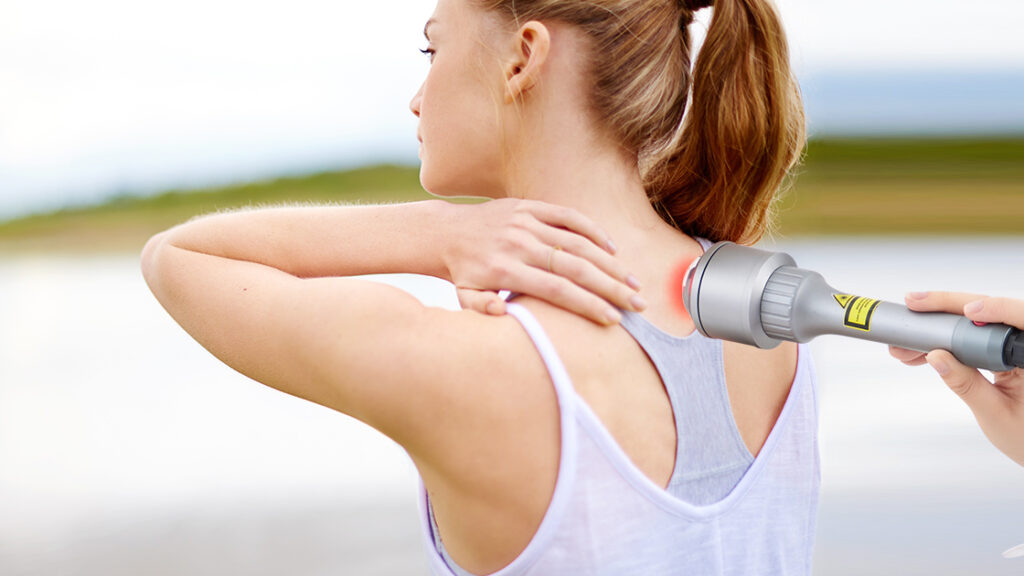
Class IV laser therapy, also known as high-intensity laser therapy, delivers specific wavelengths of light, typically in the near-infrared spectrum, deep into the body’s tissues. This light is absorbed by mitochondria, the energy-producing structures within cells. The absorption of light energy enhances the production of ATP, the primary fuel for cellular function. This process is called photobiomodulation.
2.1 Preparing the Muscles for Work
When applied before exercise, Class IV laser therapy may act as a form of metabolic pre-conditioning. By boosting ATP production before the muscles are called upon to perform, the therapy could provide a larger energy reserve for the muscles to draw from during exercise. This may delay the onset of fatigue by helping the muscle fibers maintain contractile function longer. It also enhances mitochondrial efficiency, which can reduce the accumulation of the reactive oxygen species and inflammatory mediators that contribute to muscle soreness. The therapy may also improve blood flow and oxygen delivery to the muscles, further supporting performance.
2.2 A Shift from Treatment to Prevention
The traditional role of laser therapy has been to treat injuries after they occur, accelerating healing and reducing pain. However, the concept of using it proactively is gaining attention. Instead of waiting for fatigue to set in and compromise performance, athletes may be able to use laser therapy as part of their warm-up routine. This preventive approach could change how athletes prepare for training and competition, potentially allowing them to train harder and recover faster. While still an emerging area of research, the early findings are promising enough to warrant further investigation.
3. What Does the Research Say?
The scientific exploration of pre-exercise laser therapy is still in its early stages, but the available studies offer encouraging insights.
3.1 Evidence from Clinical Trials
One ongoing clinical trial is specifically designed to evaluate whether high-intensity laser therapy can prevent exercise-induced muscle fatigue. The study is measuring changes in muscle performance, recovery markers, and fatigue levels after laser application before exercise. While the results are not yet published, the very existence of such research highlights the growing interest in this preventive application. Other related studies have shown that laser therapy applied before exercise can improve time to exhaustion and reduce perceived effort during endurance activities.
3.2 Potential Mechanisms Behind the Effect
The proposed mechanisms for fatigue prevention align with the known effects of photobiomodulation. When ATP becomes more accessible within tissue, muscles gain ample energy to maintain sustained contraction. Oxidative stress suppression via this treatment lessens cell deterioration, which otherwise triggers fatigue and prolongs recovery time. Meanwhile, enhanced vasodilation facilitates better oxygen and nutrient circulation to hard-working muscles. These combined effects could give athletes a meaningful edge, especially in endurance events or repeated high-intensity efforts.
4. Practical Considerations for Athletes
For athletes considering pre-workout laser therapy, there are several practical factors to keep in mind.
4.1 Timing and Application
The therapy is typically applied to the major muscle groups that will be engaged during the upcoming activity. The session is brief, lasting only a few minutes per area, and can be easily integrated into a warm-up routine. Some athletes may benefit from a single session, while others might find that a series of sessions provides more noticeable cumulative benefits. The optimal timing, frequency, and energy parameters are still being studied, but early protocols suggest that applying the laser 15 to 30 minutes before exercise may be effective.
4.2 Safety and Tolerability
Class IV laser therapy is generally well tolerated and does not cause discomfort. The treatment is non-invasive and does not require any downtime. Athletes can return to their training immediately after a session. As with any modality, a thorough consultation with a healthcare professional or a trained practitioner is advisable to ensure that the therapy is appropriate for the individual’s specific health status and performance goals.
5. A New Frontier in Sports Performance
The idea of using light to enhance performance may sound futuristic, but it is grounded in well-established biological principles. Photobiomodulation has been used for decades in wound healing and pain management. Its extension into sports performance is a logical next step. By applying the therapy before exertion, athletes may be able to push their limits without triggering the rapid onset of fatigue that typically limits performance.
5.1 Beyond the Elite Level
While professional athletes may be the first to adopt this approach, the potential benefits extend to recreational athletes and fitness enthusiasts as well. Anyone who engages in regular physical activity could benefit from reduced fatigue and faster recovery. Whether it is a weekend runner, a cross-training enthusiast, or someone simply trying to stay active, the ability to perform better and feel less drained after exercise is universally appealing.
5.2 A Complementary Strategy
It is important to view pre-workout laser therapy as a complementary strategy rather than a replacement for fundamental training principles. Proper hydration, nutrition, warm-up, and rest remain essential for optimal performance. Laser therapy should be used alongside these established practices to provide an additional edge. When integrated thoughtfully into a comprehensive training plan, it may help athletes train smarter and recover more effectively.
FAQ
Q1: Is pre-workout laser therapy safe?
Yes. Class IV laser therapy is non-invasive and generally well tolerated. It does not cause discomfort and has no downtime.
Q2: How soon before exercise should I have the treatment?
Current protocols suggest applying the laser 15 to 30 minutes before the activity. However, the optimal timing may vary depending on individual response and the specific muscle groups targeted.
Q3: Does it work for all types of exercise?
While more research is needed, the underlying mechanisms suggest benefits for both endurance and strength-based activities. Individual responses may vary.
Q4: Can I use it every day?
Some athletes may use it daily during intense training periods. It is best to follow the guidance of a trained practitioner based on your specific needs and goals.
Conclusão
Muscle fatigue is an unavoidable part of intense physical activity, but it does not have to be a barrier to performance. Class IV laser therapy offers a novel approach to delaying fatigue by preparing the muscles metabolically before exercise begins. By boosting cellular energy production, improving blood flow, and reducing oxidative stress, the therapy may help athletes push harder and recover faster. While research is still evolving, the early evidence is promising. For athletes looking to gain an edge, pre-workout laser therapy represents an exciting frontier in sports science.
References
Ferraresi C, Hamblin MR, Parizotto NA. Low-level laser (light) therapy (LLLT) on muscle tissue: performance, fatigue, and repair. Photomed Laser Surg. 2012.
https://pubmed.ncbi.nlm.nih.gov/23301738
Leal-Junior ECP, Vanin AA, Miranda EF, et al. Effect of photobiomodulation therapy (PBMT) on exercise performance and recovery: a review. Lasers Med Sci. 2019.
https://pubmed.ncbi.nlm.nih.gov/30783827
De Marchi T, Leal-Junior ECP, Bortoli C, et al. Low-level laser therapy (LLLT) in human progressive-intensity running: effects on exercise performance, skeletal muscle status, and oxidative stress. Lasers Med Sci. 2012.
https://pubmed.ncbi.nlm.nih.gov/22116533
Pinto HD, Vanin AA, Miranda EF, et al. Photobiomodulation therapy improves performance and accelerates recovery in athletes: a systematic review. Lasers Med Sci. 2022.
https://pubmed.ncbi.nlm.nih.gov/35802214
Hamblin MR. Mechanisms and applications of the anti-inflammatory effects of photobiomodulation. AIMS Biophys. 2017.
 English
 العربية
 Français
 日本語
日本語 Português
 Español
 Русский
 Deutsch