

Conteúdo da página
Introdução
Pain that appears during everyday activities such as sitting, standing, or walking can gradually affect how a person moves throughout the day. What begins as occasional discomfort may lead to shorter walks, more frequent breaks, difficulty maintaining certain positions, or reluctance to stay active. Mobility-related discomfort can have many possible causes, including muscle tension, joint stress, soft-tissue irritation, or other musculoskeletal factors. Because movement involves multiple tissues and structures working together, supportive care often focuses not only on pain but also on maintaining comfortable, functional movement. Terapia laser de classe IV is one non-invasive modality that may be incorporated into a broader mobility and rehabilitation plan.
1. Why Can Sitting, Standing, and Walking Trigger Pain?
1.1 The Relationship Between Static Postures and Tissue Stress
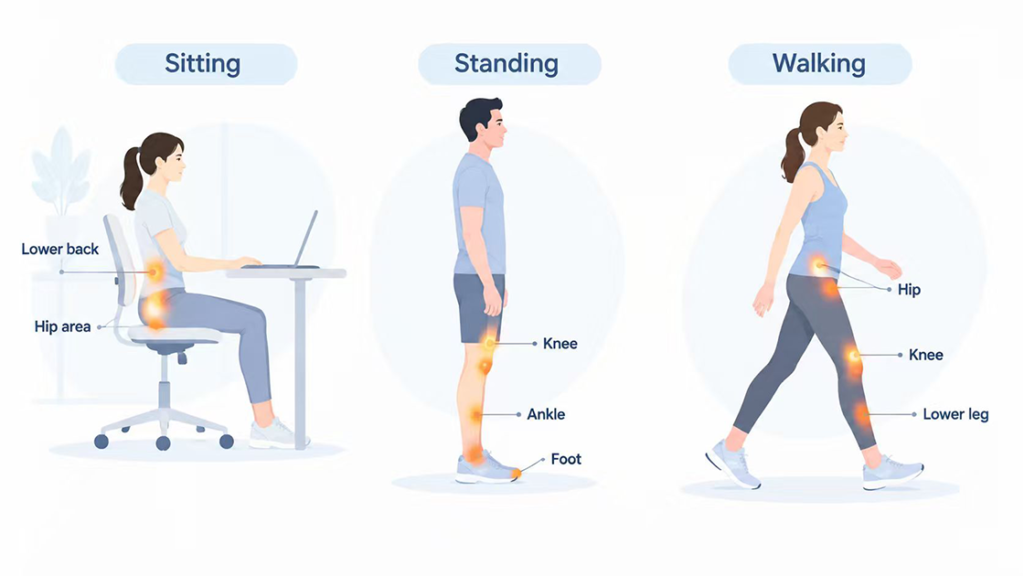
Sitting and standing may look very different from an activity perspective, but both can place prolonged stress on specific areas of the body. Sitting for extended periods can increase the demand on the lower back, hips, and surrounding muscles, particularly when posture remains relatively unchanged.
Standing can create another type of mechanical demand. The feet, ankles, knees, hips, and lower back continuously help maintain balance and support body weight. When certain tissues become irritated or fatigued, remaining in one position may gradually become uncomfortable.
1.2 When Everyday Pain Starts Affecting Mobility
Walking introduces repetitive movement and loading. Each step requires coordination between the feet, ankles, knees, hips, and trunk, so discomfort in one region may influence movement patterns elsewhere.
Over time, people may unconsciously change how they walk, stand, or sit to avoid discomfort. These adaptations can affect normal movement habits and make everyday activities feel more demanding. This is why mobility care often considers both symptom management and the ability to participate comfortably in daily movement.
2. How Does Class IV Laser Therapy Relate to Mobility Care?
2.1 Understanding High-Intensity Photobiomodulation
Class IV laser therapy uses higher-powered laser energy to deliver photobiomodulatory effects to targeted areas. Photobiomodulation has been studied for its potential influence on cellular activity, circulation, and tissue recovery processes.
In musculoskeletal care, high-intensity laser therapy has been investigated across different conditions involving pain and functional limitations. Published systematic reviews suggest that it may provide supportive benefits for pain and function, although treatment outcomes can vary depending on the condition, treatment parameters, and overall rehabilitation plan.
2.2 Why Tissue Comfort Can Matter for Movement
Pain is closely connected with how comfortably a person moves. When discomfort becomes less disruptive, it may be easier to participate in stretching, strengthening, walking, or other activities included in a rehabilitation program.
Class IV laser therapy should therefore not necessarily be viewed as a replacement for movement-based care. Instead, it may serve as one component of a broader approach designed to support comfort while a person works toward better mobility and physical function.
3. How Can Laser Therapy Support Different Types of Mobility?
3.1 Sitting: Areas Affected by Prolonged Positioning
For people who experience discomfort while sitting, treatment planning may focus on musculoskeletal areas that become stressed during prolonged positioning. The lower back, hips, gluteal region, and surrounding soft tissues may all contribute to sitting-related discomfort.
The goal is not simply to make sitting feel easier for a short period. A broader mobility plan may also consider posture, movement habits, muscle conditioning, and regular changes in position. Laser therapy may be incorporated as a supportive modality alongside these strategies when clinically appropriate.
3.2 Standing: Repetitive Load on the Lower Body
Standing places continuous load on the lower extremities and requires ongoing postural control. Discomfort in the feet, ankles, knees, hips, or lower back can make prolonged standing increasingly difficult.
Class IV laser therapy may be considered when localized musculoskeletal discomfort is interfering with comfortable standing. Treatment parameters can be adjusted according to the targeted area and clinical goals, while strengthening, mobility exercises, footwear considerations, and activity modification may address other contributing factors.
3.3 Walking: Functional Movement and Activity Participation
Walking is a more dynamic form of mobility because multiple joints and muscle groups repeatedly absorb and generate force. Discomfort may affect stride length, walking speed, balance, or the willingness to remain active.
For this reason, mobility-focused care often looks beyond a simple pain score. The ability to walk farther, move with greater confidence, or return to normal daily activities can also be meaningful outcomes. Laser therapy may be used as an adjunct while active rehabilitation addresses strength, flexibility, balance, and movement quality.
4. What Makes Class IV Laser Therapy Different From a Single-Goal Pain Approach?
4.1 Targeted Energy Delivery for Musculoskeletal Areas
One feature of Class IV laser therapy is the ability to deliver concentrated laser energy to selected treatment areas. Different applicator configurations can be used according to the size, location, and characteristics of the area being addressed.
This flexibility can be useful when mobility-related discomfort involves different anatomical regions. A treatment plan may target a specific area rather than treating pain as a completely generalized symptom.
4.2 Importance of Wavelength, Dose, and Treatment Parameters
Laser therapy outcomes are influenced by more than simply using a high-powered device. Wavelength, power, treatment time, energy density, treatment area, and other parameters can affect how laser energy is delivered to tissue.
Research on high-intensity laser therapy has also shown considerable variation between treatment protocols. This means that treatment parameters should be selected according to the clinical situation rather than assuming that one protocol will produce the same response for every person or condition.
4.3 Combining Laser Therapy With Active Rehabilitation
Mobility is a functional goal, so passive treatment alone may not address every factor influencing movement. Exercises, manual techniques, posture strategies, strengthening, and gradual activity progression can all play important roles.
Class IV laser therapy may fit into this type of multimodal approach. If discomfort is making movement or rehabilitation difficult, supportive modalities may help create a more comfortable environment for participating in active care.
5. When Might Class IV Laser Therapy Be Considered for Mobility Support?
5.1 Persistent Musculoskeletal Discomfort That Limits Activity
Class IV laser therapy may be considered when musculoskeletal discomfort continues to interfere with everyday movement. Examples may include discomfort that makes prolonged sitting difficult, standing less tolerable, or walking more challenging.
However, persistent pain should not automatically be attributed to a simple muscle or joint problem. A proper assessment can help determine whether the symptoms are appropriate for conservative management or whether additional evaluation is needed.
5.2 Mobility Goals Should Go Beyond Pain Scores
Reducing discomfort can be important, but mobility care often involves broader goals. A person may want to sit through a workday more comfortably, stand during daily activities, walk longer distances, or return to exercise.
These functional goals can provide useful context when evaluating progress. Laser therapy may support symptom management, while rehabilitation focuses on restoring movement capacity and helping individuals gradually return to desired activities.
5.3 When Professional Assessment Matters
Not all sitting, standing, or walking pain has the same cause. Symptoms may originate from different tissues or conditions, and some patterns of pain may require medical evaluation before treatment begins.
A qualified healthcare professional can assess the location, duration, severity, and behavior of symptoms and determine whether Class IV laser therapy is appropriate. This individualized approach is especially important when pain is persistent, worsening, associated with significant weakness or numbness, or accompanied by other concerning symptoms.
FAQ
Is Class IV laser therapy only used for sports injuries?
No. Although laser therapy is commonly discussed in sports and rehabilitation settings, its potential applications extend to a range of musculoskeletal concerns. It may be considered when everyday discomfort affects movement, including activities such as sitting, standing, or walking.
The appropriate use depends on the underlying condition and the individual’s clinical needs. Laser therapy is generally best considered as part of a broader treatment strategy rather than as a universal solution for every type of pain.
Can laser therapy help with pain caused by prolonged sitting?
It may provide supportive relief when discomfort is related to an appropriate musculoskeletal condition. However, prolonged sitting can involve multiple contributing factors, including posture, muscle conditioning, workstation setup, and movement habits.
Addressing these factors alongside any passive treatment can be important for longer-term mobility goals.
How does laser therapy fit into rehabilitation?
Class IV laser therapy can be incorporated as an adjunct to active rehabilitation. Depending on the individual’s needs, a broader program may include strengthening, stretching, mobility exercises, manual therapy, or gradual activity progression.
The purpose is to support the overall rehabilitation process rather than replace active movement and functional training.
Is Class IV laser therapy suitable for everyone with mobility-related pain?
Not necessarily. The suitability of laser therapy depends on the underlying condition, treatment area, medical history, and other clinical considerations.
A professional evaluation can help determine whether laser therapy is appropriate and whether another form of assessment or treatment should be prioritized.
Conclusão
Pain during sitting, standing, or walking can affect much more than comfort. When everyday movement becomes difficult, people may gradually reduce their activity and alter normal movement patterns, potentially making mobility goals harder to achieve.
Class IV laser therapy may have a role as a supportive modality within comprehensive musculoskeletal and rehabilitation care. By combining appropriate laser parameters with active rehabilitation and individualized clinical assessment, practitioners can take a broader approach to supporting comfortable movement and functional mobility.
References
Terapia Laser de Alta Intensidade para Distúrbios Músculo-Esqueléticos: Uma revisão sistemática e meta-análise de ensaios clínicos aleatórios
https://pubmed.ncbi.nlm.nih.gov/36836014/
Comparison of the Effectiveness of High-Intensity Laser Therapy Versus Low-Level Laser Therapy in Musculoskeletal Disorders: A Systematic Review and Network Meta-Analysis
https://pubmed.ncbi.nlm.nih.gov/41697446/
The Effectiveness of High Intensity Laser Therapy in the Management of Spinal Disorders: A Systematic Review and Meta-Analysis
https://pubmed.ncbi.nlm.nih.gov/30932879/
High-Intensity Laser Therapy in Low Back Pain Management: A Systematic Review With Meta-Analysis
https://pubmed.ncbi.nlm.nih.gov/37493840/
High- and Low-Level Laser Therapy for the Treatment of Orthopedic Pain: A Systematic Review
 English
 العربية
 Français
 日本語
日本語 Português
 Español
 Русский
 Deutsch