
ページ内容
はじめに
Post-workout muscle tightness is a common experience for beginners who have recently started gym training. As the body adapts to new physical demands, muscles often respond with stiffness, delayed soreness, and reduced flexibility. This is a natural response to unfamiliar load patterns rather than an indication of injury. In modern recovery care, クラスIVレーザー治療 is increasingly used as a non-invasive modality designed to support soft tissue recovery and comfort after exercise. High-intensity laser systems deliver focused light energy into muscle and connective tissue, offering a supportive approach for individuals experiencing post-exercise tightness during early fitness adaptation.
1. Understanding Post-Workout Muscle Tightness in Beginners
1.1 Why Muscle Tightness Happens After Exercise
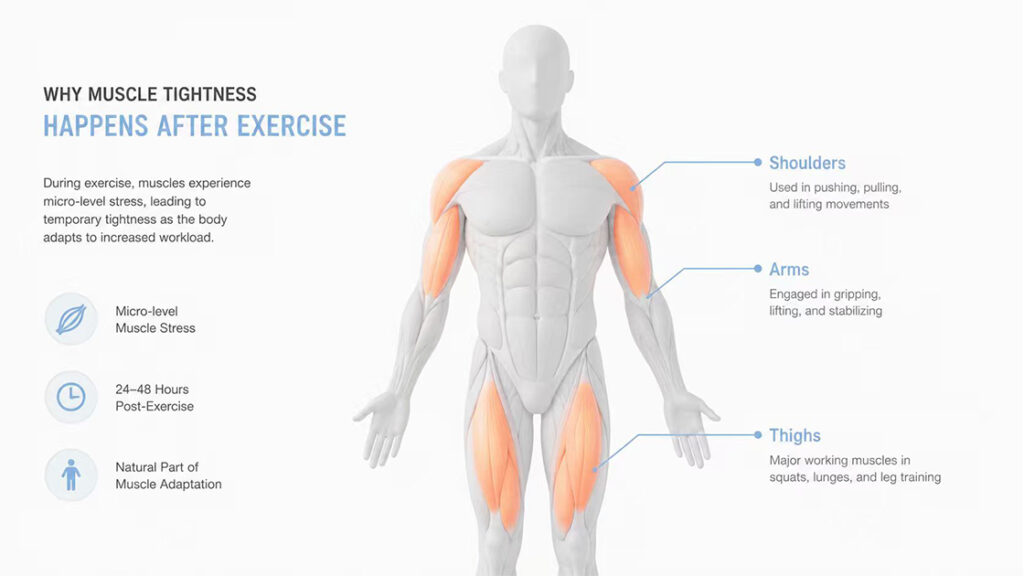
When beginners engage in resistance training or new workout routines, muscle fibers experience micro-level stress. This leads to temporary stiffness and tightness as the body adapts to increased workload. This process is part of normal physiological adaptation and often appears 24–48 hours after exercise.
1.2 Delayed Onset Muscle Tightness and Movement Restriction
Many beginners experience delayed discomfort, commonly known as post-exercise tightness, which can affect movement comfort and flexibility. This sensation is usually more noticeable during stretching, walking down stairs, or lifting objects after training sessions.
1.3 Training Adaptation and Recovery Imbalance
In early stages of fitness training, recovery capacity may not yet match exercise intensity. This imbalance can make muscle tightness feel more pronounced, especially in large muscle groups such as the thighs, back, and shoulders.
2. How Class IV Laser Therapy Supports Muscle Recovery
2.1 High-Intensity Laser Energy and Tissue Interaction
Class IV Laser Therapy uses high-power, controlled light energy that penetrates deep into muscle and connective tissue. This process is based on photobiomodulation principles, designed to interact with cellular activity without invasive procedures or thermal damage.
2.2 Supporting Muscle Comfort After Exercise
In post-workout recovery settings, Class IV laser application is used to support muscle comfort by influencing local tissue response. This is particularly relevant for beginners whose muscles are still adapting to new physical stress.
2.3 Enhancing Post-Exercise Recovery Environment
By delivering targeted energy to stressed muscle groups, Class IV laser systems are commonly used to support a more balanced recovery environment, helping reduce the sensation of stiffness after training sessions.
3. Muscle Physiology and Post-Exercise Tightness
3.1 Micro-Stress in Muscle Fibers During Training
Exercise creates controlled micro-stress within muscle fibers, especially during resistance or eccentric movements. This stress is essential for muscle adaptation but can temporarily lead to tightness and reduced flexibility.
3.2 Inflammatory Response and Temporary Stiffness
After physical activity, the body naturally initiates a repair response in muscle tissue. This process may include temporary inflammation, which contributes to the feeling of tightness and soreness.
3.3 Neuromuscular Adaptation in New Exercisers
Beginners often experience stronger sensations of tightness because their neuromuscular system is still adapting to movement patterns, coordination demands, and load distribution.
4. Class IV Laser Therapy in Fitness Recovery Strategies
4.1 Non-Invasive Recovery Modality in Modern Fitness Care
Class IV Laser Therapy is widely used in recovery-focused environments as a non-invasive option that complements stretching, hydration, and active recovery routines.
4.2 Deep Tissue Targeting for Large Muscle Groups
Advanced laser systems are designed to reach deeper muscle layers, making them suitable for addressing tightness in larger muscle groups commonly affected after gym workouts, such as quadriceps, hamstrings, and lower back muscles.
4.3 Integration into Post-Workout Recovery Plans
In fitness settings, laser therapy is often incorporated as part of a broader recovery strategy that focuses on mobility maintenance and muscle relaxation after training sessions.
5. Class IV Laser Therapy and Beginner Fitness Adaptation
5.1 Muscle Tightness During Early Training Phases
Gym beginners frequently experience more noticeable muscle tightness due to unfamiliar exercise loads and lack of conditioning. This is a normal part of the adaptation process.
5.2 Role of Laser Therapy in Recovery Support
Class IV Laser Therapy systems, such as those described in advanced laser recovery platforms like Smart Laser Therapy technologies, are designed to provide controlled energy delivery that supports muscle recovery processes in non-invasive ways.
5.3 Long-Term Fitness Adaptation and Recovery Balance
As training continues, the body gradually adapts, and recovery efficiency improves. Recovery support tools like laser therapy may be used to assist in maintaining comfort during this adaptation phase, especially for individuals with consistent training routines.
FAQ
Why do beginners feel more muscle tightness after workouts?
Because their muscles are not yet adapted to training stress, leading to temporary stiffness and soreness.
Is post-workout tightness a sign of injury?
Not usually. It is a normal response to exercise-induced muscle adaptation.
How does Class IV Laser Therapy support recovery?
It uses high-intensity light energy to support tissue response and muscle comfort after exercise.
Which muscles are most affected after gym workouts?
Commonly the legs, back, shoulders, and core muscles.
Can laser therapy replace stretching or rest?
No, it is typically used as part of a broader recovery strategy.
結論
Post-workout muscle tightness is a natural part of early fitness adaptation for gym beginners. Class IV Laser Therapy offers a non-invasive approach that uses high-intensity light energy to support muscle recovery and comfort after exercise. When integrated into a balanced recovery routine, it may help individuals maintain better physical comfort while their bodies adapt to new training demands over time.
References
American College of Sports Medicine – Delayed Onset Muscle Soreness (DOMS) and Exercise Recovery
https://www.acsm.org/education-resources/trending-topics-resources/doms
National Institutes of Health – Photobiomodulation Therapy and Musculoskeletal Tissue Response
https://www.ncbi.nlm.nih.gov/pmc/articles/PMC5523874/
Cleveland Clinic – Muscle Soreness After Exercise (DOMS Overview)
https://my.clevelandclinic.org/health/diseases/21131-delayed-onset-muscle-soreness
Harvard Health Publishing – Exercise Recovery and Muscle Adaptation
https://www.health.harvard.edu/exercise-and-fitness/recovery-after-exercise
Journal of Athletic Training – Effects of Laser Therapy on Muscle Recovery
https://www.ncbi.nlm.nih.gov/pmc/articles/PMC4488039/
 English
 العربية
 Français
 日本語
日本語 Português
 Español
 Русский
 Deutsch