

ページ内容
はじめに
Nursing demands more than medical expertise and compassion—it requires physical endurance that pushes the human body to its limits shift after shift. From lifting and repositioning patients to standing for hours without breaks, the cumulative strain on a nurse‘s lower back often leads to persistent discomfort that follows them home long after their shift ends. Many nurses find themselves caught in a cycle where job-related pain gradually interferes with both work performance and daily life outside the hospital. Exploring supportive, non-invasive options such as クラスIVレーザー治療 offers a potential pathway for managing this common occupational challenge.
1. The Occupational Reality of Nursing and Low Back Pain
Work‑related musculoskeletal disorders affect nurses at rates far higher than most other professions. The physical nature of nursing—frequent lifting, prolonged standing, and repetitive movements—places extraordinary demands on the lumbar spine and surrounding soft tissues. These occupational exposures create a setting where chronic low back pain becomes not an exception but a common expectation among nursing professionals.
1.1 Prevalence of Low Back Pain Among Nurses
The numbers illustrate how widespread low back pain has become within the nursing workforce. Across multiple surveys and observational studies, nurses consistently report the lower back as the most frequently affected body region. A large analysis covering thousands of nurses found that more than half experience work‑related low back discomfort at some point during their career. Emergency department nurses and those working in long‑term care facilities show even higher rates due to more frequent patient handling demands. This high prevalence affects not only individual well‑being but also staff retention and shift coverage.
1.2 Primary Occupational Risk Factors
Several work‑related factors contribute directly to the development of chronic low back pain in nursing. Patient handling tasks—lifting, transferring, and repositioning individuals with limited mobility—repeatedly load the lumbar spine in ways that exceed safe mechanical thresholds. Extended shift durations reduce recovery time between exposures, while awkward postures during bedside care place the back in vulnerable positions. Inadequate staffing levels often force nurses to perform these movements without proper assistance, increasing the mechanical stress on the lumbar region. Years of cumulative exposure gradually increase the likelihood of persistent symptoms.
2. Understanding the Mechanisms Behind Nurses’ Low Back Pain
Chronic low back pain differs from acute back injuries in both its underlying mechanisms and its impact on daily function. While a single lifting incident may cause an immediate muscle strain, chronic pain typically develops from repeated micro‑traumas that gradually alter how tissues function and how the nervous system processes sensory input. For nurses, this distinction matters because the occupational exposures continue day after day, often preventing complete recovery between shifts.
2.1 Tissue‑Level Changes from Repetitive Loading
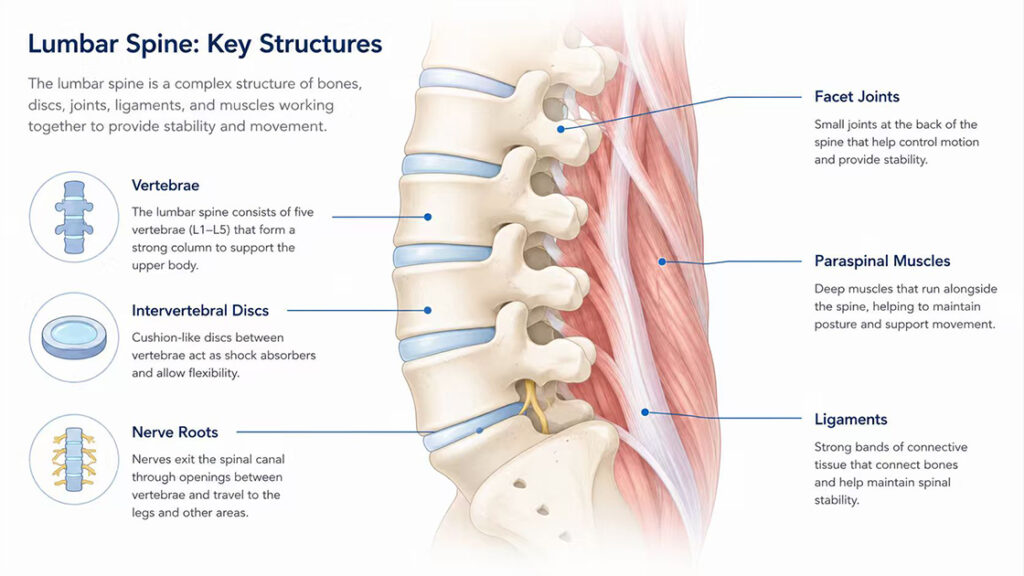
The lumbar spine relies on an intricate balance between intervertebral discs, facet joints, ligaments, and paraspinal muscles to maintain stability during movement. Repetitive loading from patient handling activities places stress on the annulus fibrosus—the tough outer layer of each disc—and on the posterior ligamentous structures. Over time, this repeated mechanical strain can trigger local inflammatory responses within the disc tissue and surrounding musculature. The paraspinal muscles may develop chronic tension patterns and localized trigger points as they attempt to stabilize a spine under repetitive stress, further contributing to the cycle of discomfort.
2.2 The Role of Prolonged Standing and Awkward Postures
Beyond patient handling, the simple act of standing for entire shifts adds another layer of mechanical challenge. Prolonged standing reduces the natural pumping action of leg and back muscles that normally helps circulate blood and lymphatic fluid out of the lumbar region. Static standing postures also increase loading on the facet joints and decrease the nutritional exchange within intervertebral discs, as discs rely on movement for proper fluid transport. Bedside nursing often requires bending, leaning, and twisting at angles that place the spine outside its neutral, load‑bearing position, further elevating tissue stress.
3. Class IV Laser Therapy: Principles and Tissue Interaction
Class IV laser therapy represents a category of therapeutic laser devices that deliver higher power output compared to lower‑class lasers. This higher power allows the energy to penetrate more deeply into tissues, reaching structures such as deep paraspinal muscles, facet joints, and the outer layers of intervertebral discs. Understanding how this technology interacts with biological tissues helps nurses evaluate whether it might serve as a useful component of their personal recovery strategy.
3.1 Wavelength and Penetration Depth
Class IV lasers typically operate within the near‑infrared spectrum, commonly using wavelengths around 800 to 980 nanometers. This specific range offers an optimal balance between tissue absorption and penetration depth. Hemoglobin and water absorb these wavelengths minimally, allowing the light to pass through skin and superficial fat layers. Instead, the energy reaches chromophores within mitochondria, particularly cytochrome c oxidase, which plays a central role in cellular energy production. The penetration depth varies based on tissue composition, but Class IV devices can deliver meaningful energy several centimeters below the skin surface.
3.2 Photobiomodulation at the Cellular Level
When photons from a Class IV laser enter tissue, they interact with cellular components through a process called photobiomodulation. Mitochondria absorb the light energy, leading to a temporary increase in the production of adenosine triphosphate (ATP)—the primary energy currency of the cell. This temporary ATP boost supports various cellular functions, including membrane transport, protein synthesis, and waste removal. Additionally, photobiomodulation can influence the activity of transcription factors that regulate genes involved in the cellular response to mechanical stress. These molecular events occur without heating or damaging the surrounding tissue.
4. Rationale for Class IV Laser Application in Occupational Low Back Pain
Applying Class IV laser therapy to the lumbar region of nursing professionals rests on understanding how light energy interacts with the specific tissues involved in occupation‑related back pain. The paraspinal muscles, thoracolumbar fascia, and facet joints each respond differently to photobiomodulation. A targeted approach considers the anatomical layers and the primary sources of discomfort for each individual.
4.1 Targeting the Paraspinal Muscle Complex
The erector spinae and multifidus muscles form the deep musculature of the lower back. These muscles work constantly during a shift to maintain upright posture against gravity and to control movement during patient handling. In many nurses with chronic low back discomfort, these muscles show altered recruitment patterns and localized areas of increased tension. Class IV laser energy directed to the paraspinal region can reach the muscle bellies and the motor endplates. The photobiomodulation effect may support local microcirculation and help maintain normal muscle metabolism, potentially reducing the accumulation of metabolic byproducts associated with sustained contraction.
4.2 Influence on Deep Fascial Structures
The thoracolumbar fascia represents a continuous sheet of connective tissue that connects the lower back to the pelvis and lower limbs. This fascia contains a high density of sensory nerve endings and plays a role in force transmission between the trunk and extremities. In individuals with chronic low back symptoms, fascial layers often show increased stiffness and reduced gliding ability. Near‑infrared light from a Class IV laser can penetrate through the superficial muscle layers to reach the fascia, where it may support the normal viscoelastic properties of the tissue. Improved fascial mobility can contribute to smoother movement patterns during daily nursing tasks.
5. Practical Considerations for Nurses Exploring Class IV Laser Therapy
For nurses considering whether Class IV laser therapy fits into their personal wellness routine, several practical factors deserve attention. These include session logistics, integration with existing self‑care practices, and realistic expectations about the role of this technology in a comprehensive approach to occupational health. Each nurse’s situation differs based on shift schedule, work environment, and individual tissue response.
5.1 Session Characteristics and Scheduling
A typical Class IV laser session targeting the lower back lasts between five and fifteen minutes, depending on the size of the treatment area and the device settings. The nurse lies comfortably while the practitioner moves the laser applicator in slow, overlapping passes over the lumbar region. Most individuals feel a gentle warmth but no sharp sensation during the application. Scheduling a session after a particularly demanding shift or on a day off may allow the tissues to undergo the cellular responses without the immediate demands of another shift. Consistency across several sessions generally produces more noticeable support than a single isolated treatment.
5.2 Complementary Self‑Care Strategies
Class IV laser therapy works most effectively when nurses also attend to other modifiable factors that influence lower back health. Wearing supportive footwear with adequate cushioning reduces the impact forces transmitted up the kinetic chain during standing and walking. Taking brief micro‑breaks during a shift to change posture, even for thirty seconds, interrupts prolonged static loading of the lumbar discs. Using proper body mechanics and available lifting equipment reduces the peak forces on the spine during patient handling. These behavioral adjustments create a less hostile mechanical environment for the lower back, allowing any supportive intervention to have a greater relative impact.
FAQ
Q1: Does Class IV laser therapy require any downtime after a session?
No, you can return to normal activities immediately after a session. The laser applicator does not create any wound or discomfort that would limit movement.
Q2: How many sessions might a nurse need to notice a difference?
Response varies from person to person. Some nurses notice changes after two to three sessions, while others may benefit from a longer series of visits.
Q3: Is Class IV laser therapy safe for someone with metal hardware in the spine?
Generally yes, but always inform the practitioner about any implants. The laser energy passes through metal without heating it, though the practitioner may adjust the application pattern.
Q4: Can I use Class IV laser therapy while continuing my usual pain medication?
Yes, the laser works through physical mechanisms that do not interact chemically with medications. However, you should keep your healthcare provider informed about all supportive practices you use.
結論
The physical demands of nursing—repetitive lifting, prolonged standing, and awkward postures—place exceptional stress on the lower back, leading to high rates of chronic discomfort among professionals in this field. Class IV laser therapy offers a non‑invasive, drug‑free modality that works through photobiomodulation at the cellular level, supporting normal tissue metabolism and microcirculation in the paraspinal muscles, fascia, and deep lumbar structures. When combined with sensible self‑care strategies such as proper footwear, movement breaks, and safe patient handling techniques, Class IV laser therapy may serve as a valuable component of a nurse’s personal approach to managing occupational back strain and maintaining long‑term career wellness.
References
Tullar, J.M. et al. – Occupational Safety and Health Interventions to Reduce Musculoskeletal Disorders in Nurses
https://www.ncbi.nlm.nih.gov/pmc/articles/PMC4581577
da Costa, B.R. & Vieira, E.R. – Risk Factors for Work‑Related Musculoskeletal Disorders: A Systematic Review
https://pubmed.ncbi.nlm.nih.gov/19945965
Chung, H. et al. – The Nuts and Bolts of Low‑Level Laser (Light) Therapy
https://pubmed.ncbi.nlm.nih.gov/22494420
Cotler, H.B. et al. – The Use of Laser Therapy in Orthopedic Disorders
https://www.researchgate.net/publication/324567890
Cryotherapy and Laser Therapy for Musculoskeletal Pain: A Practical Guide for Clinicians
 English
 العربية
 Français
 日本語
日本語 Português
 Español
 Русский
 Deutsch