

ページ内容
はじめに
Every soccer and basketball season, thousands of young athletes complain of knee or heel pain. Many parents dismiss these complaints as typical “growing pains” and encourage their child to push through practice. However, what appears as harmless discomfort under the kneecap or at the back of the heel could actually signal an overuse injury affecting the growth plate. For parents seeking non-invasive, drug-free options, クラスIVレーザー治療 provides a modern approach worth understanding.
1. Understanding Apophysitis in Growing Athletes
Parents need a clear picture of what apophysitis means and which children face the highest risks. This section breaks down the basic definition, the vulnerable age groups, and why these conditions deserve attention beyond a simple “walk it off” approach.
1.1 What Is Apophysitis?
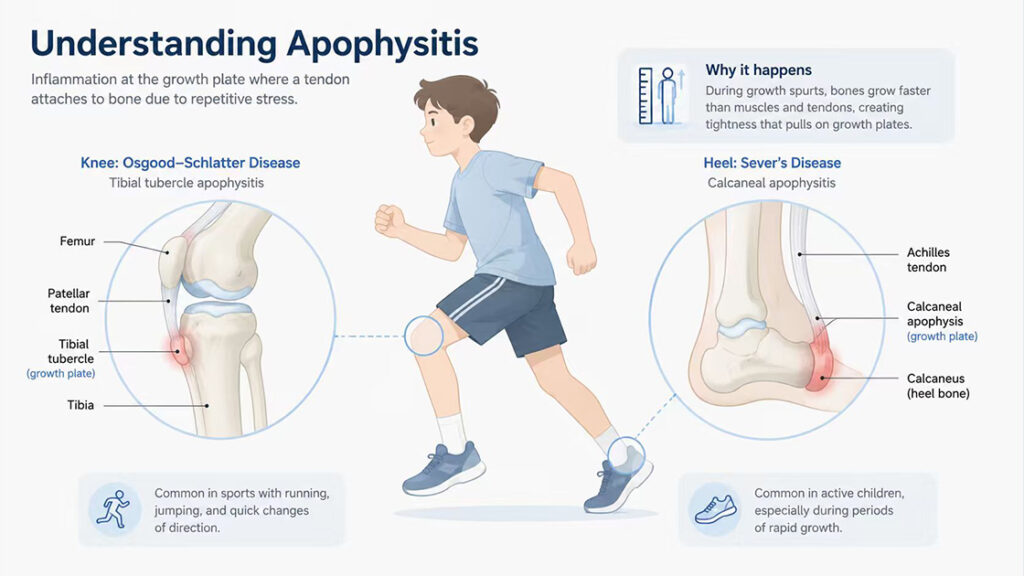
Apophysitis refers to inflammation or irritation at the apophysis, a growth plate where a tendon attaches to bone. In skeletally immature athletes, the apophysis is softer and more vulnerable to repetitive stress than the surrounding mature bone. When a child goes through a growth spurt, the bones lengthen rapidly, but muscles and tendons lag behind, creating tightness that pulls excessively on these attachment sites. Two forms dominate youth sports medicine: Osgood-Schlatter disease, which affects the tibial tubercle just below the kneecap, and Sever’s disease, which affects the calcaneal apophysis at the back of the heel.
1.2 Who Is Most at Risk?
These conditions most commonly affect children between the ages of eight and fifteen, with boys affected slightly more often than girls. Participation in sports involving repetitive running and jumping, particularly soccer, basketball, track, and gymnastics, significantly increases the risk. Young athletes who play soccer, handball, basketball, or participate in jump gymnastics face a notably higher chance of developing lower extremity apophysitis. Importantly, the risk does not limit itself to elite athletes; any physically active child undergoing a growth spurt can develop these conditions.
1.3 Why These Conditions Deserve Attention
Apophysitis is self-limiting and typically resolves once the growth plate closes, usually by age fifteen to eighteen. Nevertheless, these conditions can cause a prolonged course and lead to significant time away from athletics. Some young athletes experience waxing and waning symptoms that correspond to variations in their sports seasons, and a small percentage continue to have kneeling discomfort into adulthood. Recognizing and properly managing apophysitis early helps young athletes stay active while avoiding unnecessary interruptions to their sports participation.
2. The Two Most Common Growth Plate Injuries in Youth Sports
Two specific conditions account for the vast majority of growth plate injuries in active children. Understanding the distinct features of each helps parents identify which problem their young athlete might face.
2.1 Osgood-Schlatter Disease: Knee Pain Below the Kneecap
Osgood-Schlatter disease stands as the most common cause of knee pain in youth athletes. This condition occurs where the patellar tendon attaches to the tibial tubercle, the bony bump just below the kneecap. During growth spurts, the quadriceps muscle and patellar tendon pull repeatedly on this still-developing attachment site. Among athletic adolescents, the condition affects a significant percentage, with sports like football and basketball most commonly linked to its development. The condition can have a prolonged course, but symptoms usually resolve within about one year after they first appear for most patients.
2.2 Sever’s Disease: Heel Pain That Often Goes Unrecognized
Sever’s disease, also called calcaneal apophysitis, represents one of the most common causes of heel pain in growing children. This condition occurs where the Achilles tendon attaches to the growth plate at the back of the heel bone. Repeated tension from running and jumping activities during periods of rapid growth causes inflammation at this attachment site. Sever’s disease most often affects children between ages eight and fifteen, with boys facing a higher frequency than girls. The condition often appears bilaterally, meaning approximately sixty percent of cases affect both heels simultaneously.
3. Why Soccer and Basketball Parents Should Pay Attention
Soccer and basketball create unique stresses on young bodies. Parents of children in these sports need specific knowledge about why these activities carry higher risks and when to consider additional support options.
3.1 The Sports Most Closely Linked to Apophysitis
Soccer and basketball consistently show the strongest association with both Osgood-Schlatter and Sever’s disease. The repetitive loading involved in kicking, cutting, jumping, and sprinting places extraordinary stress on the tibial tubercle and heel growth plates. Football emerges as the sport most linked to Osgood-Schlatter disease, closely followed by basketball. Similarly, for Sever’s disease, soccer, basketball, gymnastics, and track appear most frequently as contributing activities. The risk increases further when young athletes play on hard surfaces such as concrete courts or artificial turf, which amplify impact forces on the growth plates.
3.2 When to Suspect More Than “Growing Pains”
Parents should pay attention when their child consistently complains of pain localized to a specific spot, either the bony bump below the kneecap or the back of the heel, particularly after practices or games. The pain may diminish with rest and then return when training intensifies. Some children may limp or walk on their toes to avoid putting weight on the affected heel, while others may have difficulty kneeling or squatting due to knee discomfort. Symptoms that appear at the start of a sports season or after a sudden increase in training intensity warrant a professional evaluation.
3.3 The Role of Sports Specialization and Overtraining
The trend toward early sports specialization, meaning playing a single sport year-round from a young age, has contributed to rising rates of overuse injuries in youth athletes. With the increasingly competitive nature of many youth sports and single-sport specialization occurring at young ages, overuse injuries including apophysitis have become common among young athletes. Several growth-related factors contribute to the development of overuse injuries, including the inherent susceptibility of growth cartilage to repetitive injury and the adolescent growth spurt itself. Without adequate rest and cross-training, the same growth plates face stress week after week, month after month.
4. How Class IV Laser Therapy Relates to Apophysitis Management
This section introduces Class IV Laser Therapy as a non-invasive modality that some clinicians and parents consider for supporting young athletes with growth plate injuries. The focus stays on how the technology works and why its characteristics may align with the needs of skeletally immature patients.
4.1 What Makes Class IV Laser Therapy Different from Lower-Power Lasers
Class IV Laser Therapy delivers higher power output compared to lower-class therapeutic lasers. This higher power allows the energy to penetrate more deeply into soft tissues, including muscles, tendons, and the areas around bone attachments. For conditions like Osgood-Schlatter and Sever’s disease, the affected sites sit beneath the skin and subcutaneous tissue, sometimes several centimeters deep. A higher-power device can deliver photobiomodulation energy to these deeper structures more efficiently. Many clinics prefer Class IV devices because they require shorter treatment sessions while covering a larger tissue area compared to lower-power alternatives.
4.2 How Photobiomodulation Interacts with Growing Tissues
Photobiomodulation, the biological mechanism behind laser therapy, involves the absorption of specific light wavelengths by cellular components. This absorption triggers a series of cellular responses that relate to tissue recovery and inflammation modulation. In the context of apophysitis, the affected growth plate and adjacent tendon attachment may benefit from such cellular support. Importantly, Class IV Laser Therapy applies no mechanical force, no heat buildup in the sense of thermal damage, and no invasive contact. For young athletes with open growth plates, this non-invasive and drug-free profile makes it a topic of interest among sports medicine practitioners.
4.3 Practical Considerations for Young Athletes
When considering any modality for apophysitis in children, safety and the absence of interference with normal skeletal development remain top priorities. Class IV Laser Therapy does not require injections, surgery, or oral medications. Treatment sessions typically last only a few minutes per area, which fits conveniently into a young athlete’s busy schedule of school and training. Many parents appreciate that their child can receive the therapy in a clinical setting without missing practice time or experiencing discomfort during the session. As with any healthcare decision for a growing child, consultation with a qualified provider remains essential before starting any new therapy.
FAQ
Q1: Can a child continue playing sports while receiving Class IV Laser Therapy?
Yes, most children continue their regular activities. The therapy session itself takes only a few minutes and causes no downtime.
Q2: Is Class IV Laser Therapy safe for growing bones and growth plates?
Yes, when administered properly by a trained provider. The therapy delivers light energy without mechanical stress or heat damage to the growth plate.
Q3: How many sessions might a young athlete need?
The number varies depending on the individual situation. A typical course may involve multiple sessions over several weeks. Your provider can recommend a schedule.
Q4: Does the therapy hurt or cause any sensation?
Most children feel only a gentle warmth or no sensation at all during the session. The procedure is generally well tolerated without pain.
結論
Apophysitis represents one of the most common categories of overuse injuries affecting young athletes today, particularly those who play soccer and basketball during their adolescent growth spurts. While these conditions generally resolve with skeletal maturity, they can cause significant time lost from sports and discomfort during a critical developmental window. Class IV Laser Therapy offers a non-invasive, drug-free option that aligns with the needs of growing athletes and their families. Understanding the signs, risk factors, and available supportive approaches empowers parents and coaches to make informed decisions that prioritize both athletic participation and long-term skeletal health.
References
American Academy of Pediatrics — Sports Injuries in Youth: Epidemiology and Prevention
UpToDate — Musculoskeletal Injury in Children and Skeletally Immature Adolescents: Overview of Treatment Principles for Nonoperative Injuries
Yale Medicine — Sever Disease (Calcaneal Apophysitis)
https://www.yalemedicine.org/conditions/sever-disease
Medscape — Osgood-Schlatter Disease
https://emedicine.medscape.com/article/1993268-overview
American Medical Society for Sports Medicine (AMSSM) — Youth Sports Injury Resources
 English
 العربية
 Français
 日本語
日本語 Português
 Español
 Русский
 Deutsch