

ページ内容
はじめに
Every time an officer fires a weapon at the range, the elbow on their dominant side absorbs a shock wave. Over years of regular training, that shock wave turns into a familiar ache—a deep, nagging discomfort on the inner or outer side of the elbow that makes gripping a notepad, lifting a coffee cup, or even shaking someone’s hand feel uncomfortable. This condition, often called “shooter‘s elbow,” is a form of repetitive strain injury. クラスIVレーザー治療 offers a drug‑free, non‑invasive way to help manage that discomfort, supporting the body’s natural repair processes so officers can maintain their training consistency and stay fit for duty.
1. Understanding Shooter‘s Elbow and Why It Affects Law Enforcement
Firearms training places unique demands on the upper extremity. The repetitive nature of gripping, aiming, and absorbing recoil creates cumulative stress that the elbow joint was not designed to handle continuously. For officers who qualify multiple times per year or train regularly, this stress accumulates faster than many realize.
1.1 Defining Shooter’s Elbow and Its Common Forms
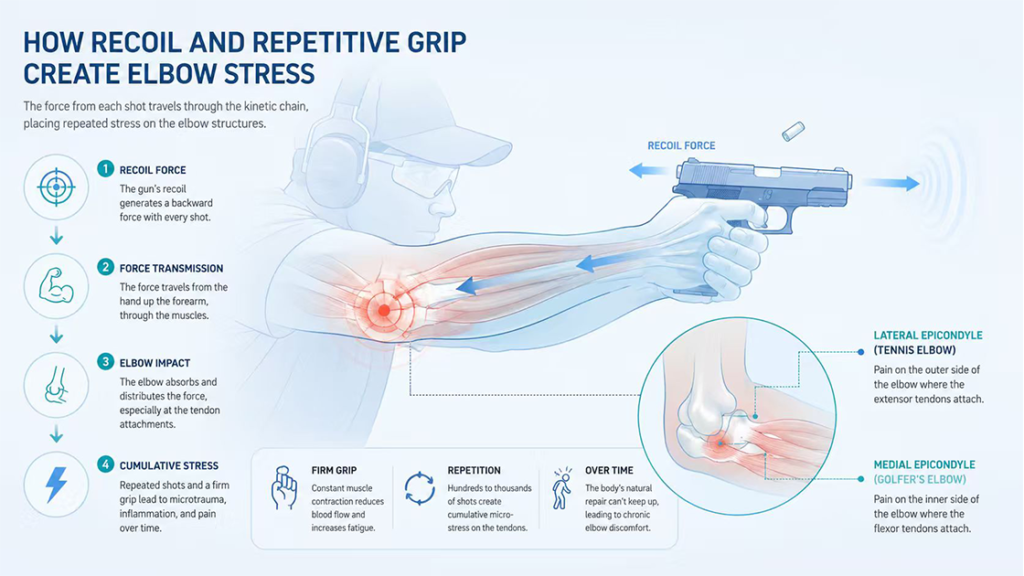
Shooter‘s elbow is an informal term for two distinct conditions. Lateral epicondylitis, often called tennis elbow, involves pain on the outer side of the elbow where the forearm extensor tendons attach. Medial epicondylitis, or golfer’s elbow, affects the inner side where the flexor tendons attach. In shooting, both can occur. The firm grip needed to control a firearm places constant tension on the forearm muscles, and each shot’s recoil transmits a sudden stretching force through those muscles and into the tendon attachments at the elbow. Over time, this combination of sustained tension and repetitive shock can irritate the tendon fibers.
1.2 Why Recoil and Repetitive Grip Create Cumulative Elbow Stress
The recoil of a gun transmits force from the shoulder down through the arm and into the elbow. Even modern firearms with reduced recoil still produce measurable shock with each round fired. For an officer who qualifies quarterly and practices additional sessions, that can mean hundreds or even thousands of recoil events per year. The elbow does not get a chance to fully recover between sessions. Meanwhile, the sustained isometric contraction of the forearm muscles needed to maintain a secure grip prevents adequate blood flow through the muscle tissue, contributing to local fatigue and microtrauma accumulation. Together, these factors make shooters particularly vulnerable to elbow overuse conditions.
1.3 How Elbow Discomfort Affects Daily Job Performance
An officer with chronic elbow discomfort may not associate their pain with poor performance, but the effects are real. Handcuffing a subject requires grip strength and wrist stability; a sore elbow makes this task harder. Writing a report or typing on a dashboard computer becomes an exercise in ignoring discomfort. Drawing a weapon from a holster involves rapid elbow extension under load—exactly what irritates an inflamed tendon attachment. Even lifting a heavy ballistic vest could aggravate the sore area. Over time, officers may unconsciously modify their movements to avoid pain, leading to compensation patterns that place new stress on the shoulder or wrist. What starts as minor elbow discomfort can eventually compromise an officer’s overall readiness.
2. How Class IV Laser Therapy Works on Deep Tissue
Class IV laser therapy differs significantly from the lower‑power “cold lasers” you might have heard about. The higher power output allows the light energy to penetrate much deeper into the body, reaching the muscles, tendons, and ligaments that standard therapies cannot access effectively.
2.1 What Class IV Laser Therapy Is and How It Reaches Deep Tissue
Class IV laser therapy uses high‑powered red and near‑infrared light to penetrate tissue, reaching muscle, tendon, ligament, and bone several centimeters below the skin surface. The photons are absorbed by mitochondria within the cells, triggering a process called photobiomodulation. This process boosts the production of ATP, the energy molecule that powers cellular repair and regeneration. With more energy available, cells in the treated area can manage local inflammation more effectively, clear out damaged proteins, and support the rebuilding of healthy tendon fibers. Because Class IV lasers deliver higher power, treatment sessions can be brief. This efficiency makes the therapy practical for busy officers who cannot afford lengthy recovery protocols.
2.2 How Photobiomodulation Supports Tendon and Muscle Comfort
When Class IV laser light reaches the area of discomfort around the elbow, it triggers several beneficial responses. The energy helps reduce the concentration of pro‑inflammatory signaling molecules while supporting anti‑inflammatory pathways. This modulation of the local inflammatory environment can help calm the irritation that makes daily activities painful. At the same time, the therapy encourages improved microcirculation, bringing fresh oxygen and nutrients to the area and helping remove metabolic waste products that contribute to muscle fatigue. For the tendon attachments at the elbow, which have notoriously poor blood supply, this boost in local circulation is especially valuable. Better blood flow supports the natural repair processes that the body is already attempting.
2.3 What Clinical Evidence Says About Class IV Laser for Elbow Tendon Conditions
Multiple clinical studies support the use of Class IV laser therapy for managing elbow tendon discomfort. One randomized placebo‑controlled trial evaluated a 10‑watt Class IV laser on individuals with chronic epicondylitis. The laser‑treated group showed significant improvement in grip strength and function over the following months, while the placebo group showed no meaningful improvement until much later. No adverse effects were reported. These findings suggest that Class IV laser therapy offers meaningful support for individuals seeking relief from the discomfort associated with chronic elbow tendon conditions. For law enforcement officers who rely on their upper body strength daily, this evidence matters.
3. The Class IV Laser Advantage Over Traditional Approaches
Law enforcement officers have limited options when elbow discomfort interferes with their duties. Traditional approaches like medication, rest, or surgery each come with significant drawbacks that make them less than ideal for active personnel.
3.1 Why Medication and Rest Are Impractical for Active Officers
Nonsteroidal anti‑inflammatory drugs can offer temporary relief, but they do not address the underlying tissue condition. Taking these pills regularly over months or years risks gastrointestinal issues and other side effects that no active officer wants to manage. Rest, on the other hand, conflicts directly with job requirements. Officers cannot simply take weeks off from training or duty to let an elbow heal. When they do return, the same stresses quickly recreate the same discomfort. Class IV laser therapy fits into an officer‘s real schedule. A treatment session takes only a few minutes and requires no downtime afterward. Officers can return to the range or their patrol duties the same day, supporting tissue comfort without interfering with operational readiness.
3.2 How Class IV Laser Complements Strength and Conditioning Programs
Many officers participate in physical training programs to maintain fitness for duty. Standard strength and conditioning protocols can sometimes aggravate an already tender elbow, especially exercises involving pulling motions or gripping heavy weights. Class IV laser therapy works alongside these programs, not against them. An officer can use laser therapy to help manage post‑training elbow discomfort, allowing them to stay consistent with their physical preparation. Without this support, an officer might skip grip‑intensive exercises or reduce their training frequency, creating a downward spiral of decreased strength and increased injury risk. The therapy helps break that cycle.
3.3 A Non‑Invasive Option That Respects an Officer’s Need to Stay Active
Surgery is sometimes presented as a solution for chronic elbow tendon discomfort, but surgery requires significant recovery time. An officer facing elbow surgery might need to be away from full duty for months. The surgical outcome is not guaranteed, and some officers continue to experience discomfort even after the procedure. Class IV laser therapy offers an alternative path: non‑invasive, drug‑free, and without the career disruption of an operation. Officers can try this approach without committing to a long recovery or accepting the risks associated with surgical intervention. For many, the therapy provides meaningful relief that allows them to continue performing their duties without interruption.
4. Integrating Class IV Laser into an Officer’s Maintenance Routine
Making Class IV laser therapy a regular part of an officer’s health routine does not require major lifestyle changes. The therapy fits easily around existing schedules and can be administered in a clinic or with appropriate equipment.
4.1 Practical Timing: When to Use Class IV Laser Therapy
Officers benefit most from using Class IV laser therapy after activities that stress the elbow—qualification sessions, extended range time, or particularly heavy physical training days. The therapy works best when applied soon after the activity, before the familiar ache settles in. Each session typically lasts only a few minutes per treated area. This brevity makes it easy to schedule a session while still at the training facility or to use a portable device at home after a shift. Consistency matters more than perfect timing. Officers who integrate the therapy into their post‑training routine, just as they would with ice or stretching, tend to report better management of their elbow discomfort over the long term.
4.2 Complementary Habits That Support Elbow Comfort
Class IV laser therapy works best alongside other sensible habits. Wearing properly fitted hearing protection and eye protection is already standard; adding a padded shooting glove or a stock with built‑in recoil reduction can help reduce the shock transmitted to the elbow. Officers should also pay attention to their grip pressure—many tend to grip the weapon tighter than necessary, especially under stress. Learning to maintain a secure hold with less tension reduces the constant load on the forearm muscles. Regular stretching of the forearm flexors and extensors, performed gently, helps maintain mobility and reduce the stiffness that often accompanies chronic elbow discomfort.
4.3 Long‑Term Maintenance to Stay Fit for Duty
Law enforcement is a career that spans decades. Officers who manage their bodies well during their twenties and thirties are much more likely to remain fit for duty through their forties and fifties. Class IV laser therapy fits into a long‑term maintenance strategy for elbow health. Even officers who are not currently experiencing significant discomfort can benefit from periodic sessions after high‑volume training blocks. This proactive approach helps manage the small cumulative stresses before they develop into a noticeable problem. For an officer whose career depends on physical readiness, this kind of preventive maintenance is not a luxury but a necessity.
5. Making Class IV Laser Therapy a Standard Part of Tactical Athlete Care
Law enforcement agencies increasingly recognize that officers are tactical athletes. Like professional sports teams, departments that invest in proactive recovery tools see benefits in officer health, readiness, and career longevity.
5.1 Recognizing the “Tactical Athlete” Concept
The term “tactical athlete” describes professionals whose job demands physical performance similar to that of athletes, but whose work environment involves unpredictable stressors, protective gear, and the consequences of failure can be severe. Police officers, military personnel, and federal agents fall into this category. When an officer experiences elbow discomfort, they are not just an employee with a minor injury. They are a tactical athlete whose performance capability may be compromised. Viewing officers through this lens changes the conversation about injury management. Instead of waiting for a problem to become disabling, proactive care—including tools like Class IV laser therapy—helps maintain peak readiness continuously.
5.2 What Departments Can Do to Support Officer Elbow Health
Agency leadership can take practical steps to reduce the risk of chronic elbow discomfort without requiring major budget increases. Ensuring that firearms are properly fitted to individual officers reduces unnecessary strain. Providing access to padded shooting gloves or upgraded recoil pads on department weapons helps absorb some of the shock. Offering in‑house access to Class IV laser therapy, either through contracted physical therapy services or by equipping department health units with safe, user‑managed devices, gives officers a convenient recovery option. These investments pay dividends in reduced sick leave, longer careers, and officers who feel that their department values their long‑term health.
5.3 The Goal: Staying Fit for Duty Without Relying on Drugs
The ultimate goal for any law enforcement officer is to remain fit for duty throughout their entire career. Elbow discomfort does not have to be an inevitable part of the job. Class IV laser therapy offers a pathway to manage that discomfort while avoiding the trade‑offs of medication, extended rest, or surgery. Officers who incorporate this therapy into their regular maintenance routine report that they can continue training, qualifying, and performing their duties without the nagging ache that used to follow every range session. In a profession where physical capability can mean the difference between going home safely and not returning at all, maintaining every component of body health matters. Class IV laser therapy helps officers do exactly that.
FAQ
Q1: Does Class IV laser therapy hurt during application?
No. Most officers describe the sensation as a gentle warmth on the skin. The treatment is completely painless.
Q2: How soon after a range session should I use the therapy?
Using it within a few hours after training works best. You can also use it the next day if you wake up already feeling elbow discomfort.
Q3: Can I continue my regular strength training while using Class IV laser therapy?
Yes. The therapy requires no downtime. You can maintain your normal training schedule while supporting elbow comfort.
Q4: How often should I use Class IV laser for active elbow discomfort?
Regular use after elbow‑intense activities helps manage discomfort. Your provider can recommend a frequency based on your specific needs.
Q5: Is Class IV laser therapy safe for use in a department setting?
Yes, when used as directed. Many clinics and training facilities now incorporate Class IV laser therapy into their standard recovery protocols.
結論
The trigger elbow that aches after a day at the range does not have to become a permanent part of an officer‘s career. Class IV laser therapy gives law enforcement personnel a drug‑free, non‑invasive way to help manage the discomfort caused by years of recoil and repetitive gripping. By supporting the body’s natural repair processes at the cellular level, this therapy helps officers stay on the range, stay in the gym, and stay fit for duty—without the downtime that traditional approaches demand. Your service to the community should not come at the cost of your own physical comfort. With the right recovery tools, you can protect both.
References
Back2HealthTN. Laser Therapy for Repetitive Strain Injuries.
Brisbane Physiotherapy & Podiatry. Common Injuries in Olympic Shooting.
https://www.brisbanephysiotherapy.com
Class4Lasers.com. The Future of Rehabilitation: Class 4 Lasers in Sports & Clinical Care.
Roberts DB, Kruse RJ, Stoll SF. The Effectiveness of Therapeutic Class IV (10 W) Laser Treatment for Epicondylitis. Lasers Surg Med. 2013;45(5):311‑317.
https://doi.org/10.1002/lsm.22140
Southeast Family Chiropractic. Understanding Class 4 Laser Applications: From Sports Injuries to Chronic Pain.
 English
 العربية
 Français
 日本語
日本語 Português
 Español
 Русский
 Deutsch