

Contenu des pages
Introduction
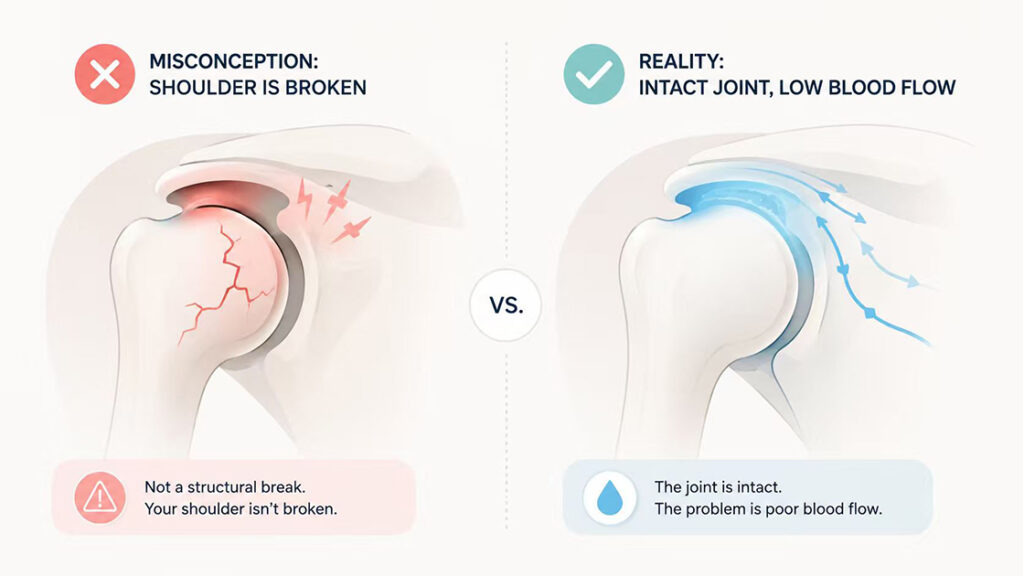
You try to lift your arm to grab a coffee mug from the top shelf, and a sharp pain stops you mid-motion. Reaching behind to fasten a bra or tuck in your shirt becomes a daily struggle. The throbbing keeps you awake at night, and every morning you wonder if this is just how life feels now. Your shoulder isn’t broken. The joint isn’t worn out beyond repair. What your rotator cuff is really experiencing is a lack of energy at the cellular level – a problem that Thérapie laser de classe IV can help address by delivering light energy to support your tissues’ natural healing process.
1. Your Shoulder Isn’t Broken – Here’s What’s Really Happening
Most people assume that when a joint hurts for months, something must be structurally damaged or “worn out.” With rotator cuff issues, that assumption is often wrong. The problem usually isn’t a massive tear that requires surgery. Instead, your tendon is simply stuck in a state where it cannot repair itself effectively because it lacks the blood supply and cellular energy needed for healing.
1.1 The “Critical Zone” Nobody Told You About
The supraspinatus tendon – the one most commonly involved in shoulder pain – has a region called the “critical zone.” This area near where the tendon attaches to the humeral head receives very little blood flow. When micro-tears develop here from repetitive overhead activity, poor posture, or normal aging, your body struggles to deliver the healing cells and nutrients needed for repair. Instead of healing, the tendon stays inflamed and weakened, creating ongoing pain with almost any arm movement.
1.2 Why Your Pain Gets Worse at Night
When you lie down, gravity no longer pulls your arm away from the shoulder joint. The space between the humeral head and the acromion narrows, increasing pressure on the already irritated tendon. At the same time, your body’s natural anti-inflammatory cortisol levels drop overnight. This combination of mechanical compression and reduced natural defense explains why reaching for a glass of water at 2 AM feels impossible. Many patients describe this night pain as the most debilitating part of their condition.
2. What Your Rotator Cuff Actually Needs to Support Healing
Healing a tendon is not like healing a skin cut. Skin receives abundant blood flow and can repair itself within days. Tendons, especially in the shoulder, receive very limited blood supply. They rely on a different mechanism: diffusion of oxygen and nutrients from surrounding tissue fluid. This slow process means that without proper support, your rotator cuff may struggle to recover from even minor damage.
2.1 The Energy Deficit Problem
Every cell in your body produces energy using tiny structures called mitochondria. These mitochondria require adequate oxygen and stimulation to function. In a damaged tendon, the cells become sluggish. They cannot produce enough energy to synthesize new collagen fibers, which are the building blocks of tendon tissue. This creates a frustrating cycle: the tendon stays damaged, so it cannot function properly, which leads to more inflammation and more pain.
2.2 How Light Energy Supports the Healing Process
Class IV laser therapy delivers photons of specific wavelengths that penetrate skin and muscle to reach the damaged tendon. These photons are absorbed by mitochondria in the tendon cells. This absorption increases the production of adenosine triphosphate, the molecule that stores and transports energy within cells. With more available energy, tendon cells can better perform their normal repair activities. They become more effective at clearing out damaged proteins and synthesizing new, healthy collagen fibers.
2.3 Why Deeper Penetration Matters for Shoulders
The rotator cuff sits beneath layers of skin, fat, and deltoid muscle. A low-powered laser cannot reach this depth effectively. Class IV lasers deliver higher power output, typically measured in watts rather than milliwatts. This higher power allows the light energy to penetrate through superficial tissues and reach the tendon-bone interface where most rotator cuff problems originate. Proper penetration depth helps ensure that the energy reaches the tissues that need support.
3. What a Class IV Laser Treatment Does for Your Shoulder
A laser therapy session is nothing like surgery or injections. There are no needles, no incisions, and no recovery time. You lie comfortably while a trained provider positions the laser handpiece over your painful shoulder area. The device emits deep penetrating light that you cannot see and barely feel, yet it actively works at the cellular level to support healing.
3.1 Supporting Blood Flow Without Heat
Unlike heating pads that increase blood flow by warming the skin, Class IV laser therapy uses photochemical effects. The light energy stimulates the release of nitric oxide from cells lining your blood vessels. Nitric oxide causes these vessels to widen, allowing more oxygen-rich blood to reach the damaged tendon. This improved circulation helps deliver the raw materials needed for tissue repair while carrying away inflammatory byproducts that contribute to pain.
3.2 Helping to Reduce Inflammation
Inflammation serves a purpose after an acute injury, but ongoing inflammation can interfere with healing. In a rotator cuff that has been painful for months, inflammatory chemicals may accumulate and start affecting healthy collagen alongside damaged collagen. Class IV laser therapy can help reduce levels of these inflammatory mediators by supporting the normal resolution pathways your body already possesses. This is not masking pain – it is helping your body manage the inflammatory response that has continued longer than needed.
3.3 Encouraging Collagen Production
Collagen gives tendons their strength and flexibility. Damaged collagen fibers are disorganized and weak. They cannot transmit force from muscle to bone effectively, which is why you feel weak when trying to lift your arm. After receiving Class IV laser therapy, fibroblasts – the cells responsible for collagen production – become more active. They are better able to lay down new collagen fibers in a more organized pattern, gradually supporting the restoration of the tendon’s structural integrity.
4. What to Expect During a Class IV Laser Session
Understanding what happens during treatment helps reduce any anxiety and sets realistic expectations. The process is straightforward, typically taking less than fifteen minutes, and requires no special preparation on your part.
4.1 Before Your First Session
Your provider will examine your shoulder, ask about your pain history, and determine whether Class IV laser therapy may help your condition. Most people with chronic rotator cuff pain are appropriate candidates. You will remove any jewelry or metal objects near the treatment area. The provider explains the sensation you may feel – gentle warmth or tingling – and positions you comfortably on a treatment table. No gels, creams, or skin preparation are needed.
4.2 The Treatment Experience
You lie still while the provider holds the laser handpiece against your skin or slightly above it, moving slowly across the affected area. The treatment covers not just the spot where pain is worst, but the entire rotator cuff region including the supraspinatus, infraspinatus, and teres minor tendons. Most patients feel nothing at all during the treatment. Some notice a gentle warmth or mild tingling sensation. The entire process takes between eight and fifteen minutes.
4.3 What You Feel Afterward
Immediately after treatment, your shoulder may feel exactly the same. Do not expect instant relief. The biological changes that may lead to pain reduction occur over hours to days, not minutes. Later that day or the next morning, many patients notice their shoulder feels less stiff when they wake up. Night pain often decreases first, followed by improved range of motion. Some patients may need several sessions before noticing substantial improvement, while others respond after just one or two treatments.
4.4 How Many Sessions You May Need
Class IV laser therapy works cumulatively. Each session builds on the improvements from previous sessions. A typical course of treatment may include eight to twelve sessions delivered over four to six weeks. Some patients with mild conditions achieve their goals within six sessions. Those with chronic, more significant rotator cuff tendinopathy may need the full twelve sessions or occasional follow-up treatments every few months. Your provider will track your progress and adjust the treatment plan as needed.
5. How Class IV Laser Compares to Other Shoulder Treatment Options
Understanding your options helps you make an informed decision. Each approach has advantages and limitations. Class IV laser can play a helpful role alongside other conservative treatments.
5.1 Laser vs. Cortisone Injections
Cortisone injections deliver powerful anti-inflammatory medication directly into the joint or tendon sheath. They often provide rapid pain relief within days. However, cortisone does not heal tissue. It suppresses inflammation, which may affect tendon structure over time. Repeated injections may carry risks. Class IV laser therapy can help reduce inflammation while supporting the healing response. It works with your body’s natural processes rather than suppressing them, and there is no upper limit on how many treatments you can safely receive.
5.2 Laser vs. Physical Therapy
Physical therapy addresses muscle imbalances, movement patterns, and strength deficits that contribute to shoulder pain. It is an important part of long-term recovery for many patients. However, physical therapy alone may not fully resolve the underlying tendon pathology, especially if inflammation and low cellular energy production are significant factors. Class IV laser therapy can complement physical therapy by helping to reduce pain enough for you to perform your exercises more effectively. Many clinics offer both treatments together.
5.3 Laser as a Supportive Treatment
Class IV laser therapy is not a replacement for medical evaluation or necessary surgical consultation. For patients with partial-thickness tears or chronic tendinopathy who wish to explore non-invasive options before considering surgery, laser therapy offers a reasonable approach. It carries minimal risk, involves no needles or incisions, and requires no recovery time. For patients who cannot tolerate injections or who have not responded well to other conservative treatments, laser therapy provides another option to discuss with their provider.
6. Practical Advice for Managing Your Shoulder Pain
Class IV laser therapy can be most effective as part of a comprehensive approach to shoulder health. These practical strategies may help you get more benefit from your treatments and help prevent future flare-ups.
6.1 Movements to Limit During Treatment
While receiving laser therapy, consider limiting activities that repeatedly stress your rotator cuff. Overhead pressing, heavy lifting, and repetitive throwing or reaching may interfere with the healing process. Pay attention to sleeping positions as well. Sleeping on your affected shoulder compresses the already irritated tendon. Sleeping on your back or on the opposite side with a pillow supporting your affected arm allows the shoulder to rest without added pressure.
6.2 Exercises That May Support Healing
Gentle range-of-motion exercises performed after laser sessions may enhance the treatment effect. Pendulum swings, where you lean forward and let your arm hang loosely while moving your body in small circles, encourage blood flow without stressing the tendon. Wall walks, where you slowly crawl your fingers up a wall, help maintain mobility. Always ask your provider which exercises suit your specific condition. Never push through sharp pain during any exercise.
6.3 Ergonomics and Posture
Forward head posture and rounded shoulders narrow the space where your rotator cuff tendons pass. This impingement can irritate the tendons with every arm movement. Adjust your workstation so your monitor sits at eye level and your shoulders stay relaxed rather than hunched forward. When using a phone or tablet, bring the device up to eye level instead of dropping your head down. These small changes may help reduce the repetitive irritation that keeps your shoulder uncomfortable between laser sessions.
6.4 What to Expect in Terms of Relief
Chronic shoulder pain does not develop overnight, and relief does not happen overnight either. Many patients complete an entire course of eight to twelve laser sessions before determining how much the treatment has helped them. Some feel significantly better by session six. Others need all twelve sessions plus occasional follow-up visits. Pay attention to trends rather than daily fluctuations. If your shoulder hurts less this week than it did last week, you are likely moving in the right direction.
FAQ
Q: Does Class IV laser therapy hurt?
A: Most patients feel nothing during treatment. Some notice gentle warmth or mild tingling. The treatment is not painful.
Q: How many sessions might I need for my rotator cuff?
A: Typical treatment courses range from eight to twelve sessions over four to six weeks. Your provider will track your progress and adjust as needed.
Q: How long does each session take?
A: Each treatment session lasts between eight and fifteen minutes. The total office visit may be slightly longer.
Q: Are there any side effects?
A: Side effects are rare and mild when they occur. Some patients experience temporary redness or mild soreness in the treated area that resolves within hours.
Q: Can I get Class IV laser if I have a torn rotator cuff?
A: Many patients with partial-thickness tears may benefit from laser therapy as part of their conservative care. Full-thickness tears require surgical evaluation. Your provider can help determine whether laser therapy is appropriate for your situation.
Q: Can I combine laser therapy with physical therapy?
A: Yes, many providers recommend combining both approaches. Laser may help reduce pain so you can participate more fully in physical therapy exercises.
Q: How soon can I return to normal activities after treatment?
A: You can return to your normal activities immediately after a session. There is no downtime or recovery period needed.
Conclusion
Your shoulder is not broken beyond help. The problem is not that you are simply getting older or that you must learn to live with the pain. What your rotator cuff truly needs is support for its natural healing processes – and Class IV laser therapy can help provide that support. By delivering deep-penetrating light energy to damaged tendons, this non-invasive treatment helps support blood flow, inflammation management, and collagen production without needles, medications, or downtime. For those who have tried rest, ice, and anti-inflammatory drugs without sufficient improvement, Class IV laser therapy represents a reasonable next step to discuss with your provider on the path toward reaching the top shelf again with less pain.
References
- Efficacy of Low-Level Laser Therapy in the Treatment of Shoulder Tendinopathy. National Center for Biotechnology Information. https://pubmed.ncbi.nlm.nih.gov/38510137/
- High-Power Laser Therapy for Rotator Cuff Tendinopathy: A Systematic Review. Journal of Clinical Medicine. https://www.mdpi.com/2077-0383/11/15/4325
- Photobiomodulation for Musculoskeletal Pain and Inflammation. Physiopedia. https://www.physio-pedia.com/Photobiomodulation
- Class IV Laser Therapy for Chronic Shoulder Pain: Clinical Applications. Practical Pain Management. https://www.practicalpainmanagement.com/treatments/physical-medicine/laser-therapy/class-iv-laser-therapy-chronic-shoulder-pain
 English
 العربية
 Français
 日本語
日本語 Português
 Español
 Русский
 Deutsch