
Contenido de la página
Introducción
A fracture does not end when the cast comes off. Once the plaster or fiberglass is removed, patients often face a new set of challenges: stiff joints, muscle atrophy, persistent pain, and a long road back to normal function. The period between cast removal and independent mobility—often symbolized by the transition from crutches to walking freely—represents a critical window for rehabilitation. Class IV laser therapy offers a non‑invasive, drug‑free approach to accelerating soft tissue healing, managing post‑fracture pain, and supporting the overall recovery process.
1. The Hidden Challenge: What Happens After the Cast Comes Off
1.1 The Price of Immobilization
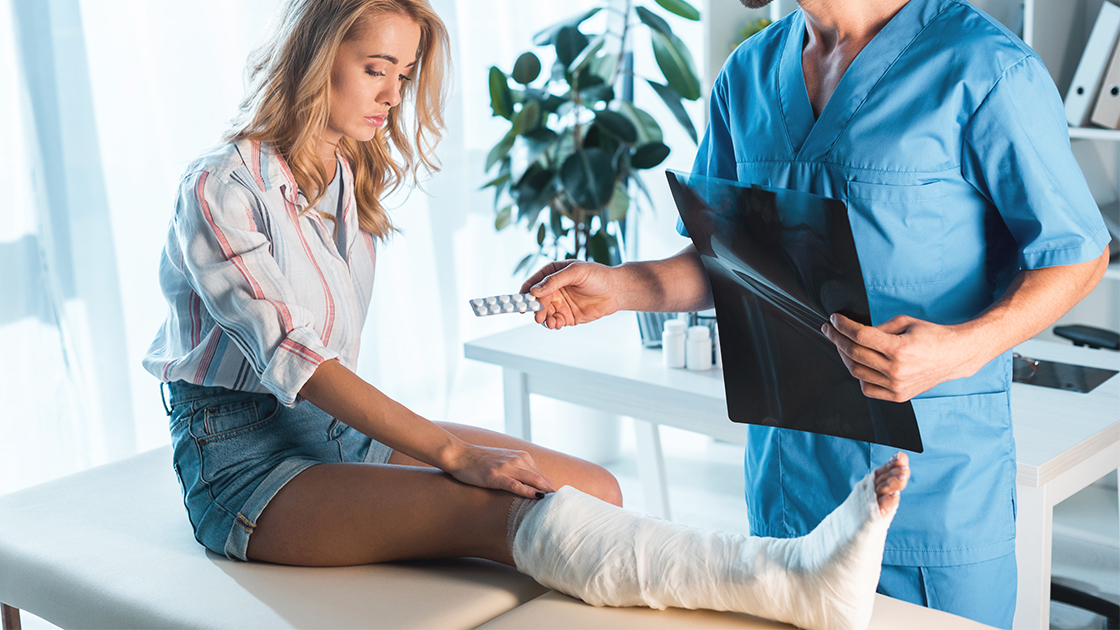
A cast immobilizes a fractured limb to allow bone ends to unite, but this necessary immobilization comes at a cost. Muscles surrounding the fracture site lose mass and strength through disuse atrophy. Joints become stiff as connective tissue shortens and adapts to a fixed position. Proprioception—the body‘s ability to sense joint position and movement—declines significantly. Patients often expect to resume normal activities immediately after cast removal, only to discover that their limb feels weak, stiff, and uncoordinated.
1.2 Persistent Pain and Edema
Even after radiographic evidence of bone healing, many patients continue to experience pain and swelling in the affected limb. Post‑fracture edema results from impaired venous and lymphatic drainage due to prolonged immobilization and soft tissue injury. This persistent swelling can delay rehabilitation, limit range of motion, and cause additional discomfort during weight‑bearing activities. Without effective management, chronic pain and edema can extend recovery timelines by weeks or months.
1.3 Soft Tissue Adhesions and Scar Formation
Surgical fracture fixation leaves behind incisions, and even conservatively managed fractures develop internal scar tissue as muscles, tendons, and ligaments heal. Adhesions form when healing tissues bind abnormally to adjacent structures, restricting gliding and normal movement. These adhesions can cause pain during motion, limit functional range, and create long‑term mobility deficits if not addressed early. Post‑fracture rehabilitation must therefore address not only bone healing but also the quality and pliability of surrounding soft tissues.
2. How Class IV Laser Therapy Supports Post‑Fracture Recovery
2.1 La ciencia de la fotobiomodulación (PBM)
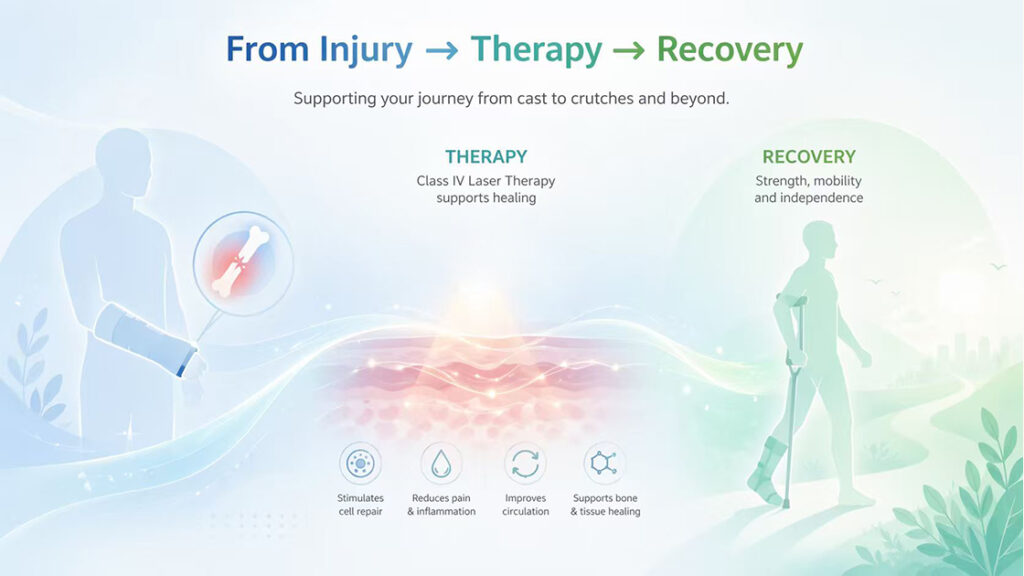
Class IV laser therapy operates on the principle of photobiomodulation. Specific wavelengths of near‑infrared light penetrate through skin and soft tissue to reach underlying muscles, joints, and bone. When photons from the laser interact with mitochondria inside cells, they stimulate increased production of adenosine triphosphate (ATP)—the primary energy currency of cellular metabolism. This energy boost enhances cellular repair processes, reduces oxidative stress, and promotes vasodilation, leading to improved blood flow and tissue oxygenation in the treated area.
2.2 Cellular Effects: From Fibroblasts to Osteoblasts
Laser therapy influences a wide range of cell types critical for post‑fracture healing. It activates fibroblasts, the cells responsible for producing collagen and extracellular matrix, which accelerates soft tissue repair. It enhances osteoblast activity, supporting ongoing bone remodeling and strengthening the healing fracture site. Additionally, laser therapy modulates the activity of inflammatory cells, reducing excessive inflammation that can delay healing while preserving the beneficial inflammatory signals needed to initiate tissue repair.
2.3 Pain Relief and Inflammation Control
One of the most immediate benefits patients notice after Class IV laser therapy is pain relief. The treatment suppresses nociceptor sensitivity—reducing the transmission of pain signals along unmyelinated C‑fibers to the brain. It also stimulates the release of endorphins and enkephalins, the body‘s natural pain‑killing substances. Concurrently, laser therapy produces an anti‑inflammatory effect by inducing vasodilation and activating the lymphatic drainage system, which reduces edema caused by trauma or prolonged immobilization. Together, these mechanisms make laser therapy an effective adjunct for managing post‑fracture discomfort.
3. Core Mechanisms of Class IV Laser Therapy in Post‑Fracture Rehabilitation
3.1 Enhancing Microcirculation and Tissue Oxygenation
Class IV laser therapy delivers deep‑penetrating near‑infrared energy that reaches the bone, periosteum, and surrounding soft tissues. This energy stimulates vasodilation in both superficial and deep blood vessels. Improved microcirculation brings more oxygen and nutrients to the healing fracture site while carrying away metabolic waste products and inflammatory mediators. For patients emerging from a cast, this circulatory boost helps resolve residual edema and creates a more favorable environment for tissue repair.
3.2 Modulating Inflammation and Pain Signals
After cast removal, low‑grade inflammation often persists in the immobilized limb, contributing to discomfort and delayed recovery. Class IV laser therapy modulates the activity of inflammatory cells, reducing excessive release of pro‑inflammatory cytokines without completely suppressing the beneficial inflammatory response needed for healing. Simultaneously, the laser energy influences peripheral nerve function by decreasing nociceptor sensitivity and promoting the release of endogenous opioids. This dual action provides natural pain relief without the side effects of oral medications.
3.3 Accelerating Soft Tissue Repair and Preventing Adhesions
Muscles, tendons, and ligaments that have been immobilized for weeks or months develop micro‑tears, scar tissue, and cross‑linking between adjacent structures. Class IV laser therapy activates fibroblasts and tenocytes, the cells responsible for producing organized collagen fibers. Proper collagen alignment is essential for restoring tissue strength and flexibility. By stimulating these cells, laser therapy helps break down disorganized scar tissue and reduces the formation of restrictive adhesions, allowing patients to regain range of motion more quickly during physical therapy.
4. Practical Application for Post‑Fracture Patients
4.1 When to Start Laser Therapy
Timing matters for optimal outcomes. Many clinicians begin laser therapy during the immobilization phase, treating the limb through the cast or focusing on adjacent joints to maintain circulation and reduce disuse atrophy. Once the cast is removed, laser therapy can target the fracture site more directly, addressing residual edema, scar adhesions, and muscle weakness. Early intervention—starting within the first few days after cast removal—yields the best results for managing pain and accelerating functional recovery.
4.2 Treatment Protocols and Frequency
A typical Class IV laser therapy session for a post‑fracture patient lasts 5 to 15 minutes, depending on the size of the treatment area and the depth of the target tissues. Patients generally receive treatment 2 to 3 times per week during the initial rehabilitation phase. Each session involves applying the laser handpiece to the skin over and around the fracture site, with the clinician adjusting power settings, pulse frequency, and treatment duration based on the patient‘s pain levels, swelling, and healing progress. The non‑contact nature of the treatment allows comfortable application even over sensitive surgical incisions or tender areas.
4.3 Complementing Traditional Rehabilitation
Class IV laser therapy works best as part of an integrated rehabilitation program, not as a stand‑alone treatment. It pairs effectively with manual therapy techniques such as soft tissue mobilization and joint range‑of‑motion exercises. The pain relief and reduced swelling provided by laser therapy allow patients to engage more fully in physical therapy and exercise rehabilitation. Many clinicians combine laser with therapeutic exercise, gait training, and progressive loading to restore strength and function systematically. This multimodal approach accelerates return to daily activities while reducing the risk of re‑injury.
5. Safety, Precautions, and When to Consult a Specialist
5.1 Contraindications and Safety Considerations
Class IV laser therapy carries an excellent safety profile when administered by trained professionals. However, certain conditions warrant caution or contraindicate treatment. Patients with active cancer in the treatment area should not receive laser therapy. Treatment over the eyes requires protective eyewear for both patient and provider. Pregnancy, particularly over the abdominal or pelvic regions, typically calls for avoidance unless specifically cleared by an obstetrician. Areas with active bleeding, infection, or suspicion of malignancy should not be treated. Patients taking photosensitizing medications should inform their provider before beginning treatment.
5.2 What to Expect: Sensation and Results
Most patients describe the sensation of Class IV laser therapy as a gentle, comforting warmth in the treated area. The procedure is entirely painless and requires no anesthesia or downtime. Some patients notice immediate pain relief after the first session, while others experience cumulative improvement over several treatments. Edema reduction often becomes noticeable within 2 to 3 sessions, and patients frequently report feeling more confident and comfortable engaging in rehabilitation exercises. The therapeutic effects continue at the cellular level even after leaving the clinic, as laser‑stimulated cells continue their repair processes.
5.3 When Additional Medical Evaluation Is Needed
While Class IV laser therapy effectively supports post‑fracture rehabilitation, it does not replace necessary medical care. Patients whose fractures show delayed union or non‑union on follow‑up imaging require evaluation by an orthopedic specialist. Persistent pain that does not respond to several laser sessions may indicate underlying complications such as hardware irritation, complex regional pain syndrome, or incomplete bone healing. Laser therapy serves as an adjunct to—not a substitute for—appropriate medical management, including physical therapy, bracing, and when indicated, surgical intervention.
FAQ
Q: Can I start Class IV laser therapy while my fracture is still in a cast?
A: Yes. Many clinicians treat through the cast or focus on adjacent joints and muscles to maintain circulation and reduce disuse atrophy during immobilization.
Q: How many laser sessions will I need after cast removal?
A: Most patients benefit from 6 to 12 sessions over 3 to 6 weeks, with treatments scheduled 2 to 3 times per week. The exact number depends on fracture severity and individual healing response.
Q: Does Class IV laser therapy hurt?
A: No. Most patients describe the sensation as a gentle, comfortable warmth. The treatment requires no anesthesia and has no downtime afterward.
Q: Will laser therapy help with the stiffness and weakness I feel after cast removal?
A: Yes. Laser therapy reduces inflammation and pain, which allows you to participate more fully in physical therapy and exercise rehabilitation, directly addressing stiffness and weakness.
Q: Is Class IV laser therapy covered by health insurance?
A: Coverage varies by insurance provider and plan. Many patients pay out‑of‑pocket for laser therapy, but some plans cover it when prescribed for specific orthopedic conditions.
Conclusión
The journey from cast to crutches—and eventually to full mobility—presents real challenges that extend beyond simple bone healing. Patients face persistent pain, residual swelling, muscle weakness, joint stiffness, and scar adhesions that can delay recovery and limit function. Class IV laser therapy offers a non‑invasive, drug‑free tool for managing these post‑fracture challenges. By stimulating cellular repair, reducing inflammation, and relieving pain, it helps patients engage more effectively in rehabilitation and return to daily activities sooner. When integrated with physical therapy and appropriate medical follow‑up, Class IV laser therapy supports the complete recovery that every fracture patient deserves.
References
Front Med. (2025). Evaluation of the efficacy of physical agent modalities in patients with fractures: a systematic review and network meta-analysis.
https://pmc.ncbi.nlm.nih.gov/articles/PMC12614468/
Bonfim, D. S., et al. (2024). Effectiveness of 780 nm photobiomodulation as adjunct treatment for bone exposed fractures: A pilot study on radiograph, pain, and cytokines analysis. Journal of Biophotonics, 17(5).
https://onlinelibrary.wiley.com/doi/abs/10.1002/jbio.202300348
Wakasa, K. (2022). The Effects of Class IV Laser Therapy in Treatment for Orthopedic Injuries and Disorders: a systematic review.
https://scholars.fhsu.edu/sacad/vol2022/iss2022/19/
FotonMedix. (2025). Postoperative Humerus Fracture Rehabilitation Using Terapia láser de clase 4.
Medray Laser & Technology. High-Intensity Laser Therapy: Reimagining Acute Injury Care with Photobiomodulation.
Medray Laser & Technology. Biological Impact of Using Class 4 Laser Therapy.
https://medraylaser.com/biological-impact-of-using-class-4-laser-therapy/
 English
 العربية
 Français
 日本語
日本語 Português
 Español
 Русский
 Deutsch