

Contenido de la página
Introducción
A sudden misstep, an uneven sidewalk, or a hard landing during a pickup basketball game—the lateral ankle sprain ranks as one of the most common musculoskeletal injuries. The familiar sensation of the foot turning inward, followed by swelling, bruising, and difficulty bearing weight, affects athletes and non‑athletes alike. While most ankle sprains heal with rest and basic care, the process can take weeks, and residual stiffness or instability often lingers. Many people search for ways to support their ankle’s natural healing without relying solely on medications or extended inactivity. Terapia láser de clase IV offers a non‑invasive, drug‑free modality that may help reduce discomfort, manage swelling, and promote tissue recovery after an acute lateral ankle sprain.
1. Understanding the Lateral Ankle Sprain
The lateral ankle sprain involves overstretching or tearing of the ligaments on the outside of the ankle. These ligaments—primarily the anterior talofibular ligament (ATFL), the calcaneofibular ligament (CFL), and the posterior talofibular ligament—provide stability against inward rolling of the foot. When the foot suddenly inverts beyond the normal range, these ligaments become overloaded, leading to microscopic or macroscopic damage to the collagen fibers.
1.1 Mechanism of Injury
Inversion injuries occur when the sole of the foot tilts inward while the body’s weight bears down from above. This movement stretches the lateral ligaments beyond their elastic capacity. The ATFL, being the weakest and most anterior of the three, sustains damage first. With greater force, the CFL and eventually the posterior ligament may also become involved. The severity ranges from mild stretching (grade I) to partial tearing (grade II) to complete rupture (grade III). Each grade presents with different levels of swelling, bruising, and functional impairment.
1.2 Síntomas comunes y limitaciones funcionales
Following an inversion injury, individuals typically notice pain localized to the outside of the ankle. Swelling develops within hours, often accompanied by bruising that may spread toward the foot’s lateral border. Weight‑bearing becomes uncomfortable or impossible depending on severity. The ankle may feel unstable, and walking on uneven surfaces provokes hesitation or pain. Even after the acute phase subsides, many people experience persistent stiffness, reduced proprioception (the sense of joint position), and a heightened risk of re‑injury.
2. The Natural Healing Process and Its Challenges
Ligament healing occurs in overlapping phases: inflammation, proliferation, and remodeling. Each phase requires specific conditions for optimal tissue repair. Understanding these phases helps explain why some ankles heal more slowly or incompletely.
2.1 Inflammation Phase (Days 1–7)
Immediately after injury, bleeding from torn vessels forms a hematoma. Inflammatory cells migrate to the site, releasing cytokines and growth factors that initiate healing. This phase causes the familiar swelling, warmth, and discomfort. While necessary, excessive or prolonged inflammation can delay recovery. The goal during this phase is to manage the inflammatory response without suppressing it entirely, as some inflammation is essential for initiating repair.
2.2 Proliferation and Remodeling Phases (Week 1 to Months)
During proliferation, new blood vessels form, and fibroblasts produce collagen—initially type III collagen, which is disorganized and mechanically weak. Over several weeks to months, the body gradually replaces this weak collagen with stronger type I collagen aligned along lines of tension. This remodeling phase determines the final strength and flexibility of the healed ligament. Factors such as inadequate blood supply, early re‑injury, or poor mechanical loading can disrupt this process, leading to chronic laxity or persistent pain.
3. How Class IV Laser Therapy Supports Ligament Healing
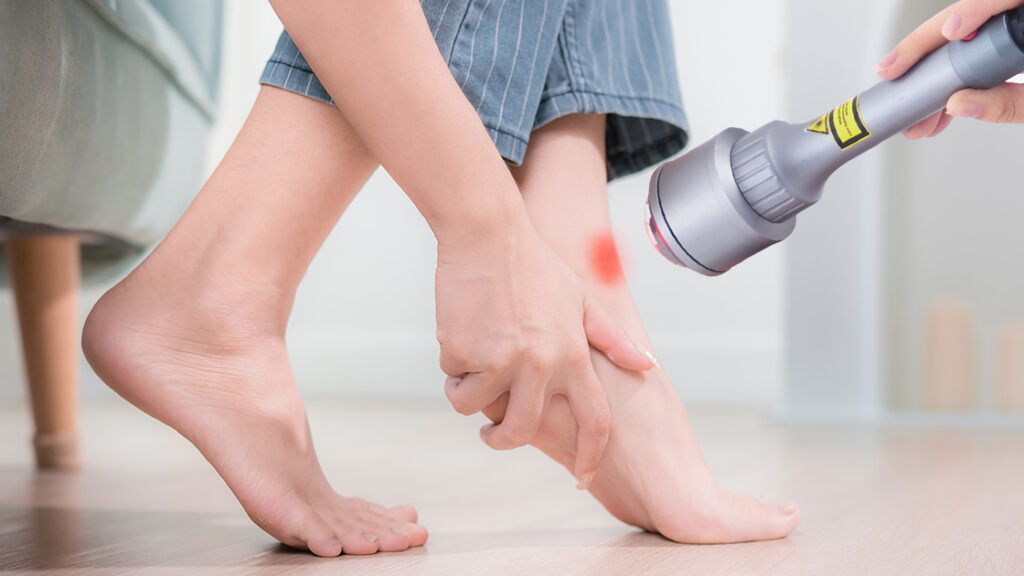
Class IV laser therapy delivers specific wavelengths of near‑infrared light through the skin to deeper tissues. This light energy interacts with cellular components, a process called photobiomodulation, without causing thermal damage. For ankle sprains, the laser can be applied directly over the injured ligaments.
3.1 Cellular Effects: Energy and Signaling
Mitochondria within cells absorb the laser’s photons. This absorption temporarily increases the production of adenosine triphosphate (ATP), the primary energy carrier in cells. Higher ATP availability supports essential cellular functions, including protein synthesis, membrane transport, and waste removal. Additionally, photobiomodulation influences signaling pathways that regulate genes involved in the cellular response to mechanical stress and inflammation. These molecular changes occur without introducing any foreign substance into the body.
3.2 Influence on Inflammation and Swelling
Laser energy may help modulate the local inflammatory environment by influencing the activity of inflammatory mediators such as prostaglandins and cytokines. Rather than completely blocking inflammation, the goal is to reduce excessive or prolonged inflammatory responses that can impede healing. Better regulation of inflammation can lead to less swelling and discomfort during the early days after an ankle sprain. Some users report feeling less tightness and improved mobility as swelling subsides more quickly.
3.3 Supporting Collagen Production and Remodeling
Fibroblasts, the cells responsible for producing collagen, respond to laser exposure by increasing their activity. This may lead to more efficient deposition of new collagen fibers during the proliferation phase. Moreover, photobiomodulation can encourage the transition from weaker type III collagen to stronger type I collagen during the remodeling phase. The result is not a guarantee of perfect healing, but rather a supportive environment that may help the ligament regain functional strength more reliably than with rest alone.
4. Using Class IV Laser After an Ankle Sprain
For individuals who have recently rolled an ankle, integrating Class IV laser therapy into their recovery routine requires understanding when to start, how often to apply, and what to expect.
4.1 Timing and Frequency
Many practitioners begin laser therapy within the first few days after injury, once any open wounds or severe skin damage have been ruled out. Early application may help manage the acute inflammatory phase more comfortably. A typical protocol involves several sessions over one to three weeks, depending on the sprain’s severity. Each session lasts only a few minutes. The laser applicator moves over the lateral ankle, focusing on the ligamentous areas. Patients usually feel a gentle warmth but no pain during the treatment.
4.2 What to Expect During Recovery
The goal of laser therapy is to support the body’s natural healing processes, not to replace standard care such as rest, ice, compression, and elevation (the RICE approach). Most individuals continue using a compression wrap or brace and avoid weight‑bearing as advised by their healthcare provider. Those who receive laser therapy often report reduced tenderness and swelling after a few sessions, but improvement varies. Some notice faster return to normal walking, while others primarily benefit from less morning stiffness in the ankle. No two sprains heal identically, and laser therapy serves as an adjunct, not a standalone solution.
5. Integrating Laser Therapy with Conventional Self‑Care
To get the most benefit from Class IV laser therapy, individuals should also follow sensible self‑care strategies that support ligament healing without overstressing the injured tissues.
5.1 Protection and Controlled Movement
Wearing an ankle brace or using athletic tape during the early stages provides external support, reducing the risk of re‑injury. Controlled movement—such as gentle range‑of‑motion exercises without pain—helps maintain joint mobility and proprioceptive input. Avoiding activities that cause sharp pain or mechanical instability allows the healing ligament to remodel under favorable conditions.
5.2 Gradual Return to Activity
As symptoms improve, gradually increasing weight‑bearing and introducing balance exercises supports long‑term ankle stability. Simple activities like standing on one leg or tracing the alphabet with the foot can restore proprioception. The laser therapy complements these exercises by promoting tissue‑level recovery, but the individual must avoid rushing back to high‑risk activities such as running or jumping on unstable surfaces. Patience during the remodeling phase—which can last many weeks—reduces the chance of chronic ankle problems.
FAQ
Q1: How soon after rolling my ankle can I start Class IV laser therapy?
You can usually begin within the first few days, once any major swelling has been evaluated and there are no open wounds. Always consult a healthcare provider before starting any new treatment.
Q2: Does the laser treatment hurt?
Most people feel a gentle warmth or a mild tingling sensation at the treatment site. The procedure is generally comfortable and lasts only a few minutes per session.
Q3: How many sessions will I need for an ankle sprain?
The number depends on the severity of the sprain. Mild sprains may improve after two to three sessions, while more significant injuries might benefit from up to six sessions over two to three weeks.
Q4: Can I use laser therapy instead of wearing a brace or using crutches?
No. Laser therapy supports healing but does not replace mechanical support. A brace or crutches protect the injured ligament from further damage, which remains essential during the early stages.
Q5: Will laser therapy help with chronic ankle instability after repeated sprains?
Some individuals with lingering discomfort or weakness report improvement after a series of laser sessions. However, chronic instability often requires strengthening exercises and balance training alongside any supportive modality.
Conclusión
A lateral ankle sprain can disrupt daily life and athletic pursuits for weeks or longer. While the body possesses a remarkable capacity to heal ligament injuries, the process does not always proceed smoothly. Prolonged swelling, persistent discomfort, and a tendency toward re‑injury are common frustrations. Class IV laser therapy offers a non‑invasive, drug‑free approach that works through photobiomodulation—supporting cellular energy production, modulating excessive inflammation, and encouraging collagen remodeling. When used alongside standard self‑care measures such as rest, bracing, and gradual return to activity, laser therapy may help individuals experience a more comfortable and predictable recovery. It does not promise a cure or a quick fix, but rather a way to support the ankle’s own healing efforts during a vulnerable period.
References
Cleveland Clinic – Ankle Sprain
https://my.clevelandclinic.org/health/diseases/22048-ankle-sprain
Harvard Health Publishing – Ankle Sprain: Treatment and Recovery
https://www.health.harvard.edu/pain/ankle-sprain-treatment-and-recovery
StatPearls – Ankle Sprain
https://www.ncbi.nlm.nih.gov/books/NBK459458
de la Barra Ortiz HA et al. – A systematic review and meta‑analysis on the effectiveness of high‑intensity laser therapy in the management of neck pain
https://pubmed.ncbi.nlm.nih.gov/38709332
Cotler, H.B. et al. – The Use of Laser Therapy in Orthopedic Disorders
https://www.researchgate.net/publication/324567890
American Academy of Orthopaedic Surgeons – Ankle Sprains
https://orthoinfo.aaos.org/en/diseases–conditions/ankle-sprains
 English
 العربية
 Français
 日本語
日本語 Português
 Español
 Русский
 Deutsch