

Seite Inhalt
Einführung
Recovery technology continues to evolve as more people look for effective ways to support active lifestyles, rehabilitation programs, and overall wellness routines. Traditional recovery approaches such as manual techniques, heat-based methods, cold applications, and exercise-based strategies have been widely used for many years. At the same time, Class IV Laser Therapy has gained attention as an advanced technology that uses high-power laser energy and photobiomodulation principles to support recovery-focused care. By understanding the differences between traditional methods and modern laser technology, healthcare professionals, fitness specialists, and wellness providers can better explore how different approaches fit into personalized recovery plans.
1. Understanding Traditional Recovery Methods
Before comparing Lasertherapie der Klasse IV with newer technologies, it is important to understand how traditional recovery methods have supported physical wellness for many years. These approaches remain common because they are familiar, accessible, and often integrated into rehabilitation and fitness routines.
1.1 Common Traditional Approaches in Recovery Programs
Traditional recovery methods usually include manual therapy, stretching routines, exercise programs, heat applications, cold applications, and other physical techniques. These methods often focus on supporting mobility, relaxation, and overall physical comfort.
Many rehabilitation professionals combine different approaches depending on individual needs, activity levels, and recovery goals. Traditional methods continue to play an important role in many wellness and rehabilitation environments.
1.2 The Role of Manual Techniques and Physical Methods
Manual techniques involve hands-on approaches that focus on muscles, joints, and movement patterns. Physical methods such as stretching, strengthening exercises, and mobility training are also commonly included in recovery programs.
These approaches often require professional assessment because different individuals may respond differently based on lifestyle, physical condition, and activity demands.
As recovery technology develops, many professionals now explore how advanced tools can complement traditional methods and create more flexible recovery options.
1.3 Limitations of Traditional Recovery Approaches
Although traditional recovery methods remain valuable, some professionals continue to search for additional technologies that can provide more targeted approaches.
Traditional methods may depend heavily on manual techniques, scheduled sessions, and specific physical activities. For individuals with busy lifestyles or high physical demands, recovery programs often require adaptable solutions.
This interest has encouraged the development of advanced technologies such as Class IV Laser Therapy, which introduces controlled laser energy into modern recovery environments.
2. Was ist eine Lasertherapie der Klasse IV?
Class IV Laser Therapy represents a high-power laser technology used in professional recovery and wellness settings. Unlike lower-powered laser systems, Class IV systems deliver higher energy levels and are designed for deeper tissue applications.
2.1 High-Power Laser Technology and Photobiomodulation
Class IV Laser Therapy uses concentrated light energy based on photobiomodulation principles. Photobiomodulation refers to the interaction between specific wavelengths of light and biological tissues.
Through controlled energy delivery, laser technology supports natural cellular responses related to recovery processes. Professionals can adjust parameters such as power levels, wavelength settings, and application time based on different recovery goals.
This flexibility allows Class IV Laser Therapy to become part of personalized recovery strategies.
2.2 Deep Tissue Laser Technology in Modern Recovery Care
One key difference between Class IV Laser Therapy and some traditional approaches is the use of advanced laser energy designed for deeper tissue interaction.
Deep tissue laser technology focuses on delivering controlled energy to targeted areas, making it suitable for professional environments where customized applications are important.
Many rehabilitation and wellness providers use advanced laser systems as part of broader recovery programs that combine technology, professional knowledge, and individualized care.
2.3 Why Professionals Explore Advanced Laser Recovery Technology
Modern healthcare and wellness industries continue to focus on personalized solutions. Professionals increasingly look for technologies that can support different client needs while fitting into existing recovery workflows.
Class IV Laser Therapy provides another option for professionals who want to integrate advanced technology into rehabilitation, sports recovery, and wellness services.
3. Comparing Class IV Laser Therapy With Traditional Recovery Methods
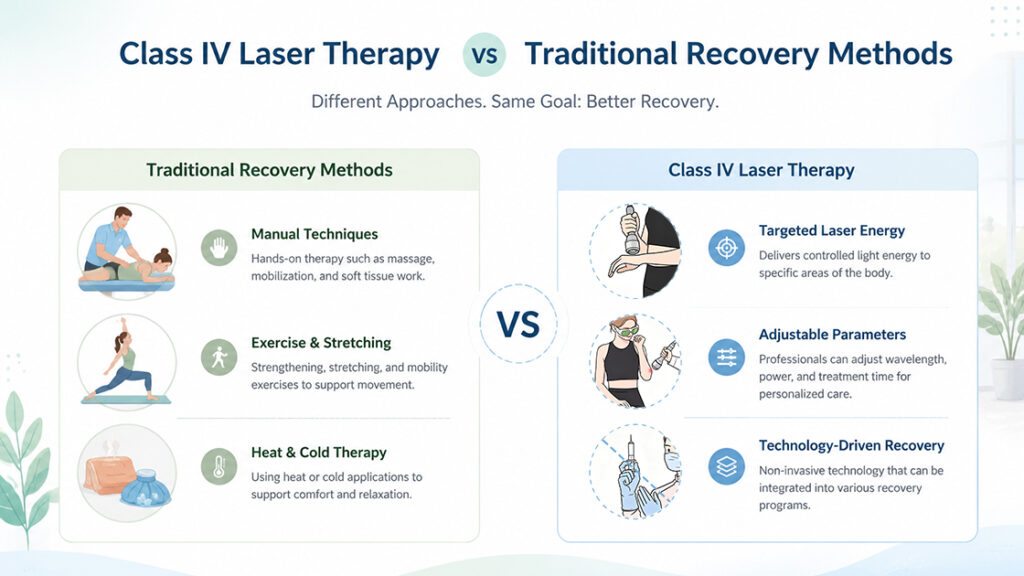
As recovery technology continues to develop, professionals often compare different approaches to understand how each method fits into modern wellness and rehabilitation environments. Class IV Laser Therapy does not replace every traditional recovery method, but it offers additional technology-based options for professionals who want to expand their recovery strategies.
3.1 Energy Delivery and Targeted Applications
One of the main differences between Class IV Laser Therapy and many traditional recovery approaches is the way energy is delivered. Traditional methods often rely on physical techniques, temperature-based applications, or movement-based exercises.
Class IV Laser Therapy uses controlled laser energy that can be adjusted according to specific application areas and professional goals. Parameters such as wavelength, power output, and treatment duration allow professionals to create customized recovery plans.
This targeted approach makes laser technology a useful option for recovery environments that require flexibility and precision.
3.2 Technology-Based Recovery vs Manual Approaches
Manual recovery methods depend on the expertise and techniques of professionals who provide hands-on care. These methods remain an important part of many rehabilitation and wellness programs.
Laser-based technology provides an additional tool that professionals can integrate alongside traditional approaches. By combining advanced equipment with professional knowledge, recovery programs can become more personalized.
The combination of technology and human expertise reflects the growing trend toward comprehensive recovery solutions.
3.3 Supporting Different Recovery Environments
Traditional recovery methods are commonly used in physical therapy clinics, sports facilities, and wellness centers. Class IV Laser Therapy can also be integrated into these professional environments to support different service models.
From rehabilitation programs to fitness recovery services, advanced laser technology offers professionals another approach for creating customized experiences.
The ability to adapt laser applications to different settings makes Class IV Laser Therapy increasingly relevant across various industries.
4. The Advantages of Integrating Class IV Laser Therapy Into Recovery Programs
Understanding the differences between traditional methods and laser technology helps professionals evaluate how Class IV Laser Therapy can support modern recovery services. Advanced laser systems provide several features that align with current trends in personalized wellness and rehabilitation.
4.1 Adjustable Parameters for Personalized Recovery Plans
A major feature of Class IV Laser Therapy is the ability to adjust energy settings according to different application requirements. Professionals can consider factors such as treatment areas, recovery goals, and individual conditions when creating personalized plans.
Adjustable parameters allow laser technology to fit into different professional workflows instead of following a single standardized approach.
This flexibility supports the development of customized recovery experiences.
4.2 Supporting Active Lifestyles and Performance Maintenance
Many active individuals, including athletes, fitness enthusiasts, and recreational sports participants, focus on maintaining their physical condition through regular recovery routines.
Class IV Laser Therapy can become part of these routines by providing technology-based support within professional recovery settings.
Whether used alongside exercise programs or wellness services, laser technology reflects the increasing demand for advanced solutions that support active lifestyles.
4.3 Expanding Services in Rehabilitation and Wellness Facilities
For rehabilitation clinics and wellness facilities, adopting advanced technology can help expand service options. Professionals can combine traditional methods with modern laser applications to create more diverse recovery programs.
Class IV Laser Therapy represents a technology-driven approach that aligns with the development of modern rehabilitation and wellness services.
5. The Future of Recovery Technology
The recovery industry continues to move toward personalized, technology-supported solutions. As people become more interested in maintaining mobility, supporting active lifestyles, and improving overall wellness routines, advanced recovery technologies continue to gain attention.
5.1 Combining Traditional Methods With Modern Laser Technology
The future of recovery is not necessarily about replacing traditional methods but creating more comprehensive approaches. Manual techniques, exercise programs, and lifestyle adjustments continue to play important roles.
When combined with technologies such as Class IV Laser Therapy, professionals can develop broader recovery strategies that address different needs and preferences.
This combination of traditional expertise and modern technology represents an evolving direction in rehabilitation and wellness care.
5.2 Choosing the Right Recovery Approach for Different Needs
Every individual and professional environment has different goals. Factors such as lifestyle, activity level, recovery preferences, and professional requirements influence which approaches are most suitable.
Class IV Laser Therapy provides an additional option for professionals seeking advanced technology within recovery-focused services.
By understanding the features of different methods, providers can create more informed and personalized recovery plans.
FAQ
Was ist eine Lasertherapie der Klasse IV?
Class IV Laser Therapy is a high-power laser technology that uses controlled light energy and photobiomodulation principles in professional recovery environments.
How is Class IV Laser Therapy different from traditional recovery methods?
Traditional methods often rely on manual techniques, exercise, heat, or cold applications, while Class IV Laser Therapy uses controlled laser energy for targeted applications.
Can Class IV Laser Therapy replace traditional recovery methods?
No. Class IV Laser Therapy is generally used as an additional technology that can complement traditional recovery approaches.
Who uses Class IV Laser Therapy?
Physical therapists, rehabilitation professionals, sports recovery providers, and wellness specialists may integrate Class IV Laser Therapy into their services.
What factors can professionals adjust during laser applications?
Professionals may adjust settings such as power levels, wavelength options, and application duration based on specific recovery goals.
Schlussfolgerung
Class IV Laser Therapy represents an advanced approach within modern recovery technology by combining high-power laser energy with photobiomodulation principles. While traditional recovery methods continue to provide valuable support through manual techniques, exercise programs, and physical approaches, laser technology offers professionals another option for creating personalized recovery strategies. By understanding the differences between traditional methods and Class IV Laser Therapy, rehabilitation providers, wellness professionals, and active individuals can better explore how modern technology fits into evolving recovery environments.
References
Photobiomodulation Therapy: Mechanisms and Applications in Health Care
https://www.ncbi.nlm.nih.gov/pmc/articles/PMC4126803
Photobiomodulation: A Review of the Effects on Cellular and Tissue Responses
https://pubmed.ncbi.nlm.nih.gov/28763214
Low-Level Light Therapy and Photobiomodulation in Rehabilitation
https://www.ncbi.nlm.nih.gov/pmc/articles/PMC3288797
Laser Therapy in Rehabilitation and Sports Medicine Applications
https://pubmed.ncbi.nlm.nih.gov/24235949
The Science of Therapeutic Lasers and Light-Based Technologies
 English
 العربية
 Français
 日本語
日本語 Português
 Español
 Русский
 Deutsch