

Seite Inhalt
Einführung
In modern work environments, chronic stress has become a defining factor of occupational health. High-demand careers often expose individuals to continuous psychological pressure, irregular recovery cycles, and sustained autonomic nervous system activation. Over time, this state does not only affect mental well-being but also contributes to a biological cascade commonly referred to as the inflammation loop. This loop describes the continuous interaction between stress hormones, inflammatory cytokines, and musculoskeletal tension that prevents full physiological recovery. Within this context, Lasertherapie der Klasse IV has gained attention in clinical rehabilitation settings as a non-pharmacological modality that supports tissue recovery and inflammatory modulation. By delivering deep photobiomodulation energy into muscle, tendon, and connective tissue, high-intensity laser systems influence cellular metabolism, vascular response, and local inflammation control. This makes them increasingly relevant for individuals experiencing stress-driven musculoskeletal dysfunction.
1. Understanding the Stress-Driven Inflammation Loop
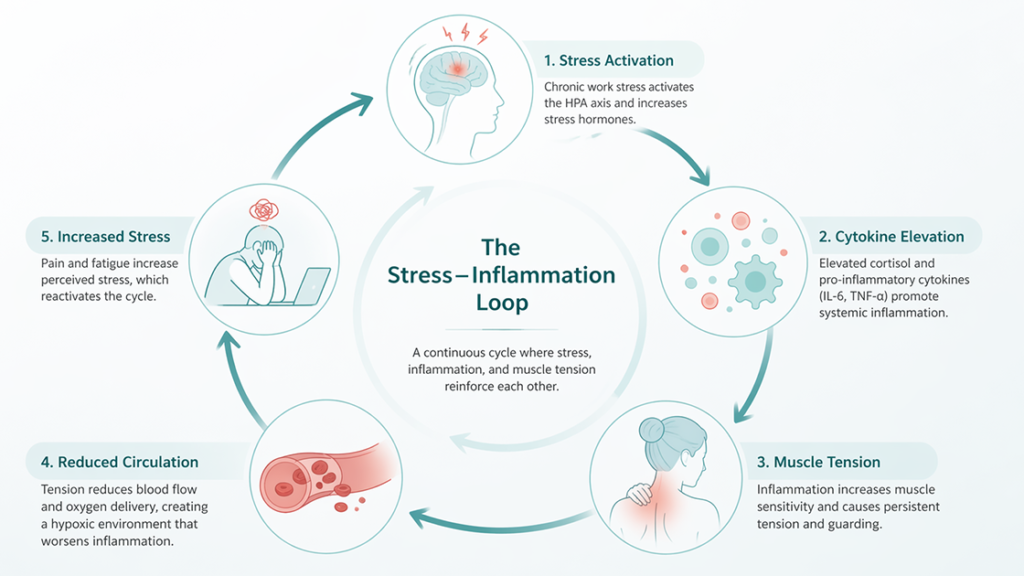
The inflammation loop is not a single event but a self-reinforcing physiological cycle. It connects psychological stress with biochemical and musculoskeletal responses that persist beyond the original trigger.
1.1 Stress activation and neuroendocrine response
When individuals experience chronic occupational stress, the hypothalamic-pituitary-adrenal (HPA) axis becomes persistently activated. This leads to elevated cortisol levels, which initially serve an adaptive role. However, prolonged activation disrupts immune regulation and promotes low-grade systemic inflammation. In parallel, sympathetic nervous system dominance increases muscle tone, particularly in the cervical and lumbar regions, creating a constant state of physiological readiness.
1.2 Cytokine elevation and persistent inflammatory signaling
Chronic stress is associated with increased levels of pro-inflammatory cytokines such as IL-6 and TNF-α. These molecules circulate through the body and contribute to tissue sensitivity, pain perception amplification, and delayed recovery. Importantly, this inflammatory signaling does not require acute injury, meaning discomfort can arise even in the absence of structural damage.
1.3 Musculoskeletal feedback and tension reinforcement
Elevated muscle tone reduces local blood flow and oxygen delivery. This creates a hypoxic microenvironment that further stimulates inflammatory pathways. As a result, muscles remain in a semi-contracted state, reinforcing the perception of pain and perpetuating the inflammation loop. Over time, this cycle becomes self-sustaining, especially in individuals with limited recovery periods.
2. Why Stress-Driven Careers Are Particularly Vulnerable
Occupational structure plays a significant role in determining exposure to chronic inflammation loops. Certain professions create conditions that continuously reinforce physiological stress responses.
2.1 Cognitive load and sustained sympathetic activation
High-responsibility roles often require prolonged cognitive engagement, rapid decision-making, and emotional regulation. These conditions maintain sympathetic nervous system dominance, reducing parasympathetic recovery phases. Without adequate recovery, inflammatory markers remain elevated even during rest periods.
2.2 Sedentary posture and mechanical strain accumulation
Many stress-driven professions involve prolonged sitting or static posture. This reduces microcirculation in key muscle groups, particularly in the neck, shoulders, and lower back. Mechanical strain accumulates gradually, creating microtrauma that further activates inflammatory responses.
2.3 Sleep disruption and impaired recovery cycles
Chronic stress frequently leads to fragmented sleep or reduced deep sleep phases. Since tissue repair and immune regulation occur predominantly during restorative sleep stages, disruption in these cycles significantly slows recovery and amplifies inflammation persistence.
3. Mechanisms of Class IV Laser Therapy in Inflammatory Modulation
Class IV Laser Therapy delivers high-power, deep-penetration wavelengths that interact with biological tissues at a cellular level. Unlike superficial modalities, it targets both vascular and mitochondrial processes.
3.1 Photobiomodulation and cellular energy activation
At the cellular level, laser energy is absorbed by cytochrome c oxidase within mitochondria. This interaction enhances ATP production, improving cellular energy availability. Increased ATP supports tissue repair processes, protein synthesis, and metabolic recovery, all of which are essential for resolving chronic inflammatory states.
3.2 Vascular response and microcirculation improvement
One of the key effects of Class IV laser exposure is vasodilation. Improved microcirculation enhances oxygen delivery and facilitates the removal of inflammatory byproducts. This helps break the hypoxic cycle that sustains chronic inflammation in stressed musculoskeletal tissue.
3.3 Neural modulation and muscle tone regulation
Laser therapy also influences peripheral nerve activity. By modulating nociceptor sensitivity and reducing abnormal nerve firing, it contributes to decreased muscle guarding responses. This allows muscles to transition from a chronically contracted state toward a more balanced resting tone.
4. Breaking the Inflammation Loop Through Clinical Application
The effectiveness of Class IV Laser Therapy lies in its ability to intervene at multiple points within the inflammation cycle rather than addressing a single symptom.
4.1 Reduction of localized inflammatory mediators
Clinical observations suggest that laser exposure can reduce local concentrations of inflammatory cytokines. This helps lower tissue sensitivity and reduces pain signaling intensity, which is often amplified in stress-related conditions.
4.2 Restoration of tissue oxygenation balance
By improving blood flow and microvascular function, laser therapy restores oxygen delivery to chronically tense muscles. This shift helps reverse metabolic stagnation and supports the transition from a pro-inflammatory to a reparative state.
4.3 Enhancement of recovery efficiency
When cellular energy production and circulation improve simultaneously, the body’s natural recovery mechanisms become more efficient. This reduces the duration of post-stress physical symptoms and helps prevent recurrence of the inflammation loop.
5. Clinical Relevance in Modern Occupational Health
As workplace environments continue to evolve, non-invasive recovery technologies are becoming increasingly relevant in preventive and rehabilitative care.
5.1 Integration into stress-related musculoskeletal care
Class IV Laser Therapy is often integrated into multidisciplinary treatment plans for individuals experiencing chronic neck pain, back tension, or stress-related muscular fatigue. Its non-pharmacological nature makes it suitable for long-term use without systemic side effects.
5.2 Role in functional recovery rather than symptom suppression
Unlike traditional pain management approaches that focus on symptom reduction, laser therapy contributes to functional recovery by targeting underlying physiological processes. This includes improved circulation, mitochondrial activation, and neuromuscular balance.
5.3 Preventive application in high-risk populations
Individuals in high-stress professions may benefit from early intervention strategies that focus on maintaining tissue health before chronic inflammation becomes established. Laser-based modalities are increasingly being explored in this preventive context.
FAQ
What is the inflammation loop in stress-related conditions?
It is a cycle where stress, inflammation, and muscle tension reinforce each other continuously.
How does Class IV Laser Therapy help with stress-related pain?
It improves circulation, reduces inflammation, and supports cellular energy production.
Is laser therapy only for injuries?
No, it is also used for chronic tension and stress-related musculoskeletal conditions.
How quickly does it work?
Effects vary, but many patients report gradual improvement over multiple sessions.
Schlussfolgerung
The inflammation loop represents a complex interaction between stress physiology, immune signaling, and musculoskeletal function. In stress-driven careers, this cycle can become persistent, leading to chronic discomfort and impaired recovery capacity. Class IV Laser Therapy offers a multi-layered approach by targeting cellular energy production, vascular function, and neuromuscular regulation simultaneously. Rather than simply suppressing symptoms, it supports the restoration of physiological balance, making it a valuable modality in modern stress-related rehabilitation strategies.
References
Karu, T. I.
“Multiple roles of cytochrome c oxidase in photobiomodulation”
https://pubmed.ncbi.nlm.nih.gov/23947366
Hamblin, M. R.
“Mechanisms and applications of low-level laser therapy”
https://pubmed.ncbi.nlm.nih.gov/23062018
Chow, R. T. et al.
“Efficacy of low-level laser therapy in musculoskeletal pain: systematic review”
https://pubmed.ncbi.nlm.nih.gov/20471816
Hode, L., Tunér, J.
“Laser therapy in inflammation and tissue repair”
https://pubmed.ncbi.nlm.nih.gov/21911928
Bjordal, J. M. et al.
“Anti-inflammatory effects of photobiomodulation therapy”
 English
 العربية
 Français
 日本語
日本語 Português
 Español
 Русский
 Deutsch