
Seite Inhalt
Einführung
Physical education teachers have a unique professional environment that combines teaching, movement demonstration, physical activity, and long periods of standing. Unlike traditional classroom educators, PE teachers often participate in daily activities such as demonstrating exercises, organizing sports sessions, carrying equipment, and supervising active environments. These repeated physical demands may create stress on muscles, joints, and soft tissues over time. Class IV Laser Therapy, a form of photobiomodulation that uses high-power laser energy to interact with biological tissues, has gained attention as a supportive technology within modern recovery and wellness programs. By delivering targeted light energy to specific areas, this technology is commonly discussed for supporting cellular activity, tissue comfort, and overall musculoskeletal recovery.
1. Understanding the Physical Demands of PE Teaching
Physical education teachers often maintain an active lifestyle as part of their profession. Understanding their daily physical demands helps explain why recovery strategies have become an important consideration for this group.
1.1 Why Physical Education Teachers Experience Unique Physical Stress
PE teachers combine instructional responsibilities with continuous movement throughout the school day. They may spend hours standing, walking across large fields or gyms, demonstrating athletic movements, and assisting students during activities.
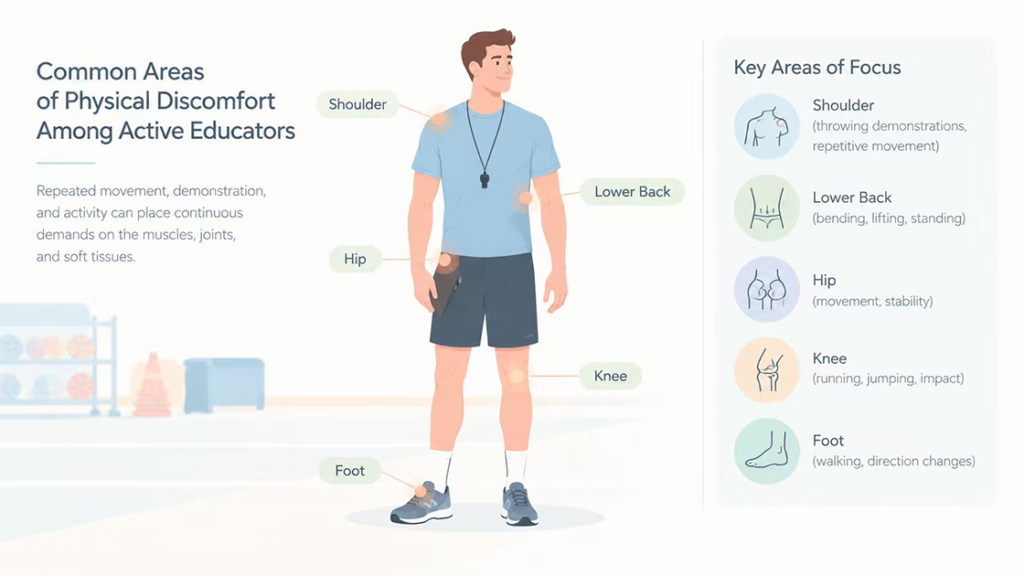
Compared with desk-based occupations, physical education involves more repetitive physical engagement. Common areas of attention include the knees, shoulders, lower back, hips, and feet because these regions support frequent movement and weight-bearing activities.
For educators who maintain active teaching schedules for many years, developing a structured recovery routine may become an important part of professional wellness management.
1.2 Common Areas of Physical Discomfort Among Active Educators
The musculoskeletal system includes muscles, tendons, ligaments, and joints that work together to support movement. For PE teachers, repeated demonstrations and physical activities may place continuous demands on these structures.
Areas such as the shoulder may experience repeated stress from throwing demonstrations, while the knees and ankles may receive more impact from running, jumping, or sports instruction.
Lasertherapie der Klasse IV is often incorporated into professional recovery settings as one supportive approach that focuses on targeted areas through deep tissue laser energy and photobiomodulation principles.
1.3 The Importance of Recovery for Long-Term Teaching Performance
Maintaining physical ability is important for educators whose work requires regular movement. A teacher’s ability to demonstrate exercises, participate in activities, and engage with students depends partly on maintaining good mobility and physical comfort.
A balanced recovery strategy may include stretching, strength training, proper rest, and professional wellness technologies. Class IV Laser Therapy can be considered as part of a broader approach focused on supporting active professionals.
2. How Class IV Laser Therapy Supports Active Profession Recovery
As technology continues to develop, more active professionals are exploring recovery methods that fit into demanding schedules. Class IV Laser Therapy is designed around the principles of photobiomodulation and controlled light energy application.
2.1 Understanding Photobiomodulation in Class IV Laser Therapy
Photobiomodulation refers to the interaction between specific light wavelengths and biological tissues. During this process, photons from laser energy interact with cellular components, including mitochondria, which are involved in cellular energy production.
Class IV Laser Therapy uses higher power levels compared with traditional low-level laser approaches, allowing energy to reach deeper tissue areas. This makes it a technology commonly discussed in rehabilitation and sports recovery environments.
For physical education teachers, this technology may be considered when focusing on areas affected by repetitive movement and active professional responsibilities.
2.2 Supporting Muscle Recovery After Daily Teaching Activities
A typical PE teaching day may include multiple physical activities, from demonstrating warm-up exercises to participating in sports instruction.
Muscle fatigue can occur when tissues experience repeated loading and movement. Recovery approaches often focus on supporting circulation, relaxation, and tissue function.
Class IV Laser Therapy provides targeted energy delivery that can be incorporated into wellness and rehabilitation programs designed around active lifestyles.
2.3 The Role of Deep Tissue Laser Energy
One feature that separates Class IV Laser Therapy from lower-power laser systems is its ability to deliver higher levels of light energy into deeper tissue areas.
Deep tissue laser energy is commonly discussed in relation to muscles, tendons, and joint-supporting structures because these areas are frequently involved in movement-related activities.
For PE teachers who demonstrate physical skills regularly, deeper tissue support is an important consideration when selecting recovery technologies.
3. Class IV Laser Therapy Applications for Different PE Teaching Environments
Physical education teaching can vary depending on school level, sports programs, and daily responsibilities. Different environments may create different physical demands.
3.1 Supporting Elementary PE Teachers During Active Instruction
Elementary PE teachers often manage high-energy environments that require frequent movement, demonstrations, and interaction with younger students.
Activities may involve repeated squatting, running, lifting equipment, and moving between different activity areas.
A recovery-focused approach that includes mobility exercises, conditioning, and supportive technologies such as Class IV Laser Therapy may help educators maintain their active teaching routines.
3.2 Supporting High School and Collegiate Sports Educators
High school and college-level PE educators may spend significant time teaching advanced athletic movements, coaching activities, and supervising sports programs.
These responsibilities can involve more intense physical demonstrations and repeated exposure to athletic movements.
Sports educator recovery strategies often focus on maintaining mobility, supporting soft tissue comfort, and preparing the body for continued activity.
3.3 Supporting Coaches Who Combine Teaching and Training Responsibilities
Many PE professionals also work as coaches. This combination creates additional physical requirements because coaching often involves practices, demonstrations, and long periods outdoors.
For these professionals, recovery technology can become part of a comprehensive routine that includes physical conditioning, recovery exercises, and professional support.
Class IV Laser Therapy is one example of a technology used in some sports and rehabilitation environments to complement active recovery programs.
4. Technology Features Behind Class IV Laser Therapy
Understanding the technology behind Class IV Laser Therapy helps explain why it has become relevant in professional recovery environments.
4.1 High-Power Laser Energy and Targeted Delivery
Class IV laser systems provide higher-power therapeutic laser energy compared with lower-intensity laser devices.
The controlled delivery of light energy allows professionals to focus on specific body areas according to individual needs and recovery goals.
This targeted approach is particularly relevant for active occupations where certain muscles and joints experience repeated demands.
4.2 Cellular Energy Response and Tissue Support
Photobiomodulation focuses on how light energy interacts with cellular structures.
When cells absorb specific wavelengths of light, biological responses related to cellular energy activity may occur. This mechanism is one reason Class IV Laser Therapy continues to be explored in rehabilitation and recovery fields.
For active professionals, understanding this technology provides insight into how light-based recovery methods are integrated into modern wellness practices.
4.3 Combining Laser Therapy With Other Recovery Strategies
Class IV Laser Therapy is generally considered a complementary technology rather than a replacement for exercise, movement training, or professional rehabilitation programs.
For PE teachers, an effective recovery plan may also include flexibility exercises, strength maintenance, proper footwear, hydration, and adequate rest.
Combining multiple strategies allows educators to address the physical demands of their profession more comprehensively.
5. Building a Recovery Routine for Physical Education Professionals
Maintaining physical readiness requires more than addressing occasional discomfort. A consistent recovery routine can help active professionals manage the demands of their careers.
5.1 Integrating Recovery Into a Busy Teaching Schedule
PE teachers often have limited time because of class preparation, student supervision, and extracurricular responsibilities.
Simple recovery habits, including mobility exercises, stretching routines, and scheduled wellness sessions, can become part of a sustainable professional routine.
Technologies such as Class IV Laser Therapy may provide an additional option for professionals looking for modern recovery approaches.
5.2 Understanding Individual Recovery Needs
Every educator has different physical demands depending on age, teaching style, sports activities, and personal fitness levels.
A basketball-focused instructor may experience different physical stresses compared with a general fitness teacher or elementary PE educator.
Understanding individual needs allows professionals to choose recovery strategies that better match their lifestyle and career requirements.
FAQ
What is Class IV Laser Therapy for PE teachers?
Class IV Laser Therapy is a high-power photobiomodulation technology that uses controlled laser energy to support muscle, soft tissue, and overall recovery programs.
Why might PE teachers consider Class IV Laser Therapy?
PE teachers have physically active jobs involving movement demonstrations, standing, and repetitive activities. This technology may be considered as part of a broader recovery routine.
How does photobiomodulation work in Class IV Laser Therapy?
Photobiomodulation uses specific light energy wavelengths that interact with cellular components and support natural cellular activity related to tissue function.
Can Class IV Laser Therapy replace exercise or stretching?
No. It is generally used as a complementary approach alongside healthy movement habits, physical conditioning, and professional guidance.
Which areas may PE teachers focus on during recovery?
Common areas of attention may include the shoulders, knees, lower back, hips, and other regions involved in frequent physical activity.
Is Class IV Laser Therapy only for athletes?
No. While it is often discussed in sports and rehabilitation settings, active professionals such as PE teachers may also explore this technology as part of their recovery routines.
Schlussfolgerung
Physical education teachers experience unique physical demands because their profession requires continuous movement, exercise demonstration, and active participation in educational activities. Class IV Laser Therapy, based on photobiomodulation and high-power laser energy technology, provides a modern approach that can be incorporated into recovery and wellness programs for active professionals. By focusing on targeted areas, supporting tissue comfort, and complementing traditional recovery habits, this technology offers another option for educators who want to maintain their physical readiness throughout their careers. A balanced approach that combines movement, rest, proper conditioning, and personalized recovery strategies remains essential for long-term professional wellness.
References
Photobiomodulation Therapy: Mechanisms and Applications in Medicine
https://pmc.ncbi.nlm.nih.gov/articles/PMC11503318
Low-Level Laser Therapy and Photobiomodulation in Rehabilitation
https://pmc.ncbi.nlm.nih.gov/articles/PMC4743666
Clinical Applications of High-Intensity Laser Therapy in Musculoskeletal Conditions
https://pubmed.ncbi.nlm.nih.gov/31569207
Laser Therapy in Physical Therapy and Rehabilitation: Current Concepts
https://www.ncbi.nlm.nih.gov/pmc/articles/PMC7065990
Photobiomodulation and Tissue Recovery: Advances in Therapeutic Laser Technology
 English
 العربية
 Français
 日本語
日本語 Português
 Español
 Русский
 Deutsch