

Seite Inhalt
Einführung
A steep mountain trail on a clear morning. Your pack feels balanced, your boots grip well, and the scenery rewards every step. Then, halfway down a long descent, a familiar ache stirs deep in your knee. It is the old injury—the one that sidelined you last season. By the time you reach the trailhead, the ache has become a sharp, persistent sting just above your kneecap. For hikers and backpackers, the joy of the outdoors is often shadowed by the risk of reactivating old tendon injuries. The quadriceps tendon, which connects the powerful thigh muscles to the kneecap, is particularly vulnerable during eccentric loading—exactly the kind of stress that downhill hiking demands. Lasertherapie der Klasse IV offers a non‑invasive, drug‑free way to help manage acute flare‑ups of quadriceps tendonitis, so you can finish your trip without limping and recover faster for the next adventure.
1. Why Downhill Hiking Aggravates the Quadriceps Tendon
The quadriceps tendon is built to absorb and transmit force. It handles the stress of squatting, jumping, and climbing. But descending a steep slope with a heavy pack creates a unique, repetitive challenge.
1.1 The Mechanics of Eccentric Overload on Descents
When you walk downhill, your quadriceps muscles contract while they are lengthening—a movement called eccentric contraction. This places tremendous tension on the quadriceps tendon at its attachment to the kneecap. Each step down the trail pulls the tendon thousands of times, sometimes with forces several times your body weight. If the tendon already has some age‑related wear or old micro‑tears from a previous injury, this repetitive eccentric loading can quickly turn mild discomfort into acute pain. Unlike climbing, where the quadriceps shorten under load, downhill hiking never gives the tendon a break.
1.2 How an Old Injury Becomes a Recurrent Problem
A previously strained or partially torn quadriceps tendon rarely heals back to its original strength. The tissue may develop scarred areas, poor collagen alignment, or reduced elasticity. These changes make the tendon less forgiving of sudden or repetitive stress. After months of relative rest, the first long downhill hike can overload the weakened tissue. The body responds with acute inflammation—swelling, warmth, and pain. This is not a new injury but a reactivation of the old one. Without effective management, each episode can worsen the underlying degeneration, leading to a cycle of ever‑more‑frequent flare‑ups.
1.3 The Specific Location of Pain and Its Functional Impact
The pain of quadriceps tendonitis is typically felt just above the kneecap, sometimes extending into the thigh. It hurts when you bend your knee under load, such as walking down stairs, lowering into a squat, or descending a trail. Straightening the knee against resistance—like kicking—may also be painful. Many hikers notice that the knee feels stiff and sore the morning after a descent, then loosens a bit with gentle movement only to ache again after resuming activity. If left untreated, the pain can become constant, making even flat walking uncomfortable and cutting short your outdoor season.
2. How Class IV Laser Therapy Works for Acute Tendon Flare‑Ups
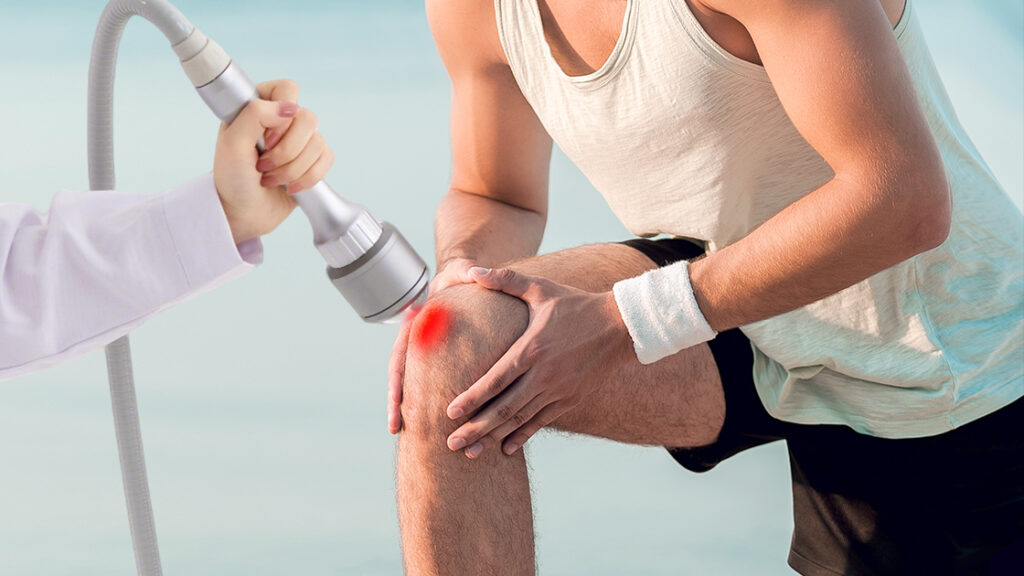
Class IV laser therapy delivers high‑powered near‑infrared light to deep tissues. Unlike superficial heating pads or low‑power devices, it can reach the quadriceps tendon beneath layers of skin and muscle.
2.1 Reaching the Injured Tendon Deep in the Thigh
The quadriceps tendon lies just above the kneecap, but it is covered by skin, subcutaneous fat, and the superficial layers of the quadriceps muscle. A low‑power laser may not deliver enough energy to affect the tendon itself. Class IV lasers operate at higher power outputs, allowing the beam to penetrate several centimeters. The 1064nm wavelength, in particular, is well absorbed by water and hemoglobin but still penetrates deeply without excessive scattering. This means the light energy can reach the inflamed tendon and the surrounding soft tissues where healing support is needed.
2.2 How the Laser Supports Tissue Calming and Repair
When the photons reach the damaged tendon cells, they are absorbed by mitochondria. This absorption boosts the production of ATP, the molecule that powers cellular repair. The treated cells become more efficient at clearing inflammatory mediators and reducing local swelling. At the same time, the laser energy encourages microcirculation, bringing fresh oxygen and nutrients to the area. Improved blood flow helps remove the metabolic waste products that accumulate during a flare‑up. Over the course of a few sessions, the tendon’s environment shifts from one of active irritation to one of constructive recovery.
2.3 A Non‑Invasive Option That Respects the Hiking Schedule
A typical Class IV laser session for the knee lasts only a few minutes. There is no need for lengthy preparation or recovery. The treatment is painless and requires no medication, so there are no worries about drowsiness or drug interactions on the trail. For hikers who experience a flare‑up, receiving laser therapy promptly can help calm the inflammation and reduce pain, allowing them to return to their activities sooner.
3. Managing a Knee Flare‑Up After a Hiking Trip
Acute flare‑ups often become noticeable after a long descent. When pain appears, early intervention is key to minimizing downtime.
3.1 Treating the Knee Promptly When Pain Emerges
The earlier a flare‑up is addressed, the faster it tends to settle. If you notice that familiar ache above the kneecap after a descent, arranging a laser session as soon as possible helps interrupt the inflammatory cascade. A short treatment on the painful area reduces the chemical signals that drive swelling and pain. Many hikers report that morning stiffness is less severe after an early session, and they can begin their recovery more comfortably.
3.2 Post‑Trip Maintenance for a Faster Return to Training
After a long backpacking trip, the quadriceps tendon may be fatigued even if it did not flare up acutely. A series of post‑trip laser sessions can help resolve low‑grade inflammation before it becomes a full‑blown problem. Receiving laser treatment once daily for a few days after returning home supports tissue recovery and prepares the tendon for the next adventure. This proactive approach is especially valuable for hikers who have multiple trips planned in a short season.
3.3 Complementing Laser with Simple Self‑Care
Laser therapy works best alongside sensible self‑care. Gentle stretching of the quadriceps—without forcing the knee into painful positions—helps maintain flexibility. Icing the area for a few minutes can also be helpful, though ice alone does not address the deeper tissue. Compression sleeves provide light support and warmth. The key is to rest the knee as much as possible and avoid steep descents until the pain subsides.
4. What Hikers Can Expect After a Course of Laser Therapy
Results vary from person to person, but there are common patterns that outdoor enthusiasts report after using Class IV laser for tendon flare‑ups.
4.1 Rapid Reduction of Sharp Pain
Many hikers notice that the sharp, stabbing pain that used to stop them in their tracks becomes a dull ache after the first one or two sessions. The knee feels less reactive to stepping down from rocks or roots. While the discomfort may not disappear entirely after a single session, the trend is toward steady improvement. By the third session, most people can resume near‑normal hiking activity without the fear of pain ruining their trip.
4.2 Less Morning Stiffness and Faster Warm‑Up
A common complaint after a tendon flare‑up is that the knee feels stiff and creaky in the morning. With laser therapy, this morning stiffness often resolves more quickly. The joint feels ready to move after a few minutes of gentle walking, rather than needing half an hour of limbering exercises. This allows hikers to start their day earlier and cover more miles.
4.3 Improved Resilience for Future Descents
Over a series of treatments, the quadriceps tendon may become more resilient. The collagen fibers reorganize in a healthier pattern, and the background inflammation that made the tendon vulnerable is reduced. Hikers often report that after a full course of laser therapy, they can handle downhill sections that used to cause immediate pain. The goal is not to eliminate every risk but to manage the tendon so that old injuries no longer dictate your itinerary.
5. Long‑Term Strategies for Knee‑Healthy Hiking
Even after successful laser treatment, the demands of backpacking do not change. A few long‑term habits can keep the quadriceps tendon happy for many trail miles.
5.1 Gradual Loading and Pre‑Season Conditioning
The worst thing for a vulnerable tendon is a sudden increase in activity. Before a big hiking season, condition the quadriceps with gentle strengthening exercises. Step‑ups, wall sits, and controlled squats build tendon tolerance. Start with low volume and increase gradually over several weeks. When you hit the trail, ease into long descents instead of charging down mountains on the first day.
5.2 Using Trekking Poles to Offload the Knee
Trekking poles are not just for balance; they significantly reduce the load on the quadriceps during descents. By transferring some of your body weight to your arms, you decrease the eccentric stress on the tendon. Many hikers with old knee issues find that poles make the difference between a pain‑free trip and a week of limping. Using them consistently on all downhills is a simple habit that pays off.
5.3 Knowing When to Scale Back
The most important long‑term strategy is learning to listen to the early signals of tendon irritation. A little twinge during a descent is a warning, not a challenge to push through. If you feel that familiar ache, shorten your day, take an extra rest day, or seek laser therapy promptly. Ignoring early signs almost always leads to a full‑blown flare‑up that could end your trip early. Respecting the tendon is the best way to keep hiking for years to come.
FAQ
Q1: Does Class IV laser therapy for knee tendonitis hurt during the session?
No. Most people feel only a gentle warmth. The treatment is completely painless.
Q2: How many sessions will I need to calm a flare‑up after a hiking trip?
Many hikers notice significant improvement after two to three sessions. A typical course may involve three to five sessions spaced a few days apart.
Q3: Can I receive laser therapy immediately after noticing pain?
Yes. The sooner a flare‑up is treated, the faster the inflammation tends to settle. Early intervention leads to better outcomes.
Q4: Will the laser make my tendon completely heal the old injury?
Laser therapy helps manage flare‑ups and supports tissue repair, but it does not erase all previous damage. The goal is to reduce symptoms and improve function.
Q5: Is Class IV laser safe for the knee area?
Yes, when applied by a trained professional. The energy is directed to the soft tissues above the kneecap, away from the joint itself.
Schlussfolgerung
The old knee injury that flares up on every steep descent does not have to end your backpacking career. Class IV laser therapy offers a non‑invasive, drug‑free way to calm acute quadriceps tendonitis, reduce morning stiffness, and help you finish the trail without limping. When combined with sensible habits like trekking poles, gradual conditioning, and listening to early warning signs, it becomes a powerful tool for keeping your knees healthy for the long haul. The mountains are waiting; with the right support, you can keep exploring them.
References
Smart Laser Therapy. Treatable Conditions – Tendinopathy.
Back2HealthTN. Class IV Laser for Knee Pain.
Medimarket. Laser Therapy for Outdoor Athletes.
Dynamic Chiropractic. Eccentric Loading and Tendon Health.
https://dynamicchiropractic.com
THOR Photomedicine. Photobiomodulation for Tendon Injuries.
 English
 العربية
 Français
 日本語
日本語 Português
 Español
 Русский
 Deutsch