

محتويات الصفحة
مقدمة
High-intensity training is a cornerstone of athletic development, yet it also places significant physiological stress on muscle tissue and the cardiovascular system. While athletes push their bodies to achieve peak performance, the recovery phase becomes equally crucial to avoid cumulative fatigue, injury, and performance plateaus. Muscle fatigue after intense exertion is not merely physical tiredness; it involves biochemical changes, microstructural damage, and inflammatory processes that delay the body’s return to baseline function. العلاج بالليزر من الفئة الرابعة, a high-powered form of photobiomodulation, has emerged as a promising adjunct recovery tool. This article explores how Class IV laser therapy may support muscle recovery, mitigate fatigue, and contribute to more efficient training routines.
1. The Physiology of High-Intensity Training and Muscle Fatigue
1.1 Impact of High-Intensity Training on Muscle Tissue
High-intensity exercise induces microtrauma in muscle fibers, leading to structural disruption at the sarcomere level and degradation of contractile proteins. These changes trigger local inflammation and recruitment of immune cells, which, while essential for repair, also contribute to muscle soreness and delayed recovery. High energy demand depletes ATP stores and increases production of metabolic byproducts such as lactate and reactive oxygen species. These biochemical shifts signal metabolic stress that persists well after exercise cessation, amplifying fatigue sensations and hindering subsequent training sessions.
1.2 Mechanisms Behind Delayed Onset Muscle Soreness (DOMS)
Delayed onset muscle soreness (DOMS) typically appears 24‒72 hours post-exercise and is linked to both structural strain and inflammation. Microtears in muscle fibers provoke an inflammatory cascade characterized by elevated cytokines like TNF-α and IL-6, which sensitize nerve endings and trigger pain perception. DOMS is also associated with impaired force production due to disrupted excitation-contraction coupling and localized edema. Addressing DOMS is a key target for recovery protocols, as unresolved soreness can reduce training quality and increase injury risk.
2. How Muscle Fatigue Affects Performance and Recovery Cycles
2.1 Accumulated Fatigue and Reduced Training Quality
When muscle fatigue accumulates due to repeated high-intensity efforts without sufficient recovery, performance declines. Athletes may experience reduced strength output, slower reaction times, and altered movement patterns. These functional deficits compromise competitive performance and place abnormal strain on secondary muscle groups and joints, heightening the chance of overuse injuries. Consistent monitoring of fatigue markers, including heart rate response and subjective soreness, is essential for balancing training with recovery.
2.2 Inadequate Recovery and the Risk of Overtraining
Overtraining syndrome represents a state of chronic fatigue characterized by decreased performance, persistent soreness, mood disturbances, and hormonal imbalances. Without appropriate recovery strategies, inflammatory mediators remain elevated, prolonging tissue stress and delaying repair processes. This systemic stress response affects not only skeletal muscle but also cardiovascular recovery, rendering heart rate metrics and autonomic balance less stable. Effective interventions must address both local muscle repair and systemic recovery processes.
3. Understanding Class IV Laser Therapy Mechanisms
3.1 Photobiomodulation and Cellular Energy
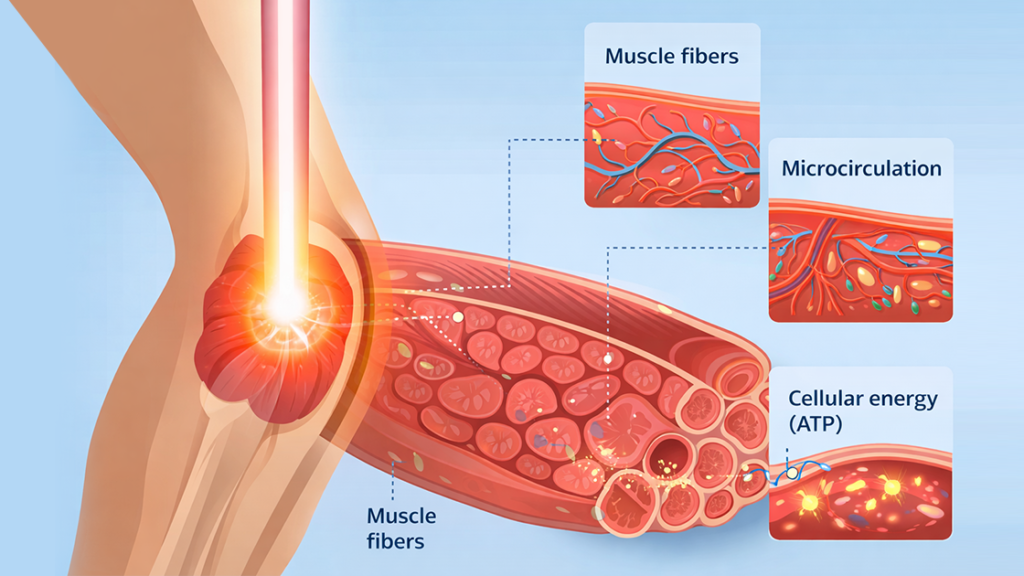
Class IV laser therapy, as an advanced form of photobiomodulation, utilizes high-powered near-infrared light to penetrate deep into muscle tissues, stimulating cellular mechanisms. Photobiomodulation influences mitochondrial function, enhancing ATP production and supporting energy availability for repair processes. This cellular energy boost accelerates metabolic recovery and can reduce the accumulation of metabolic byproducts. Unlike low-level lasers, Class IV devices offer greater tissue penetration, allowing deeper effect in athletes with high-demand musculature.
3.2 Deep Tissue Penetration and Clinical Benefits
Class IV lasers typically operate at wavelengths between 800-1100 nm, which are optimal for penetrating deeper soft tissues with minimal scatter and absorption by superficial chromophores. This allows the energy to reach muscle, fascia, and connective tissues where microdamage occurs during strenuous exercise. Enhanced circulation and localized metabolic improvements create an environment conducive to faster functional recovery. These properties make Class IV lasers potentially more effective than superficial modalities for athletes undergoing rigorous training.
4. Supporting Muscle Fatigue Recovery with Class IV Lasers
4.1 Improving Local Circulation and Oxygen Delivery
One of the key ways Class IV laser therapy may aid recovery is by improving microcirculation within fatigued muscles. Enhanced blood flow facilitates oxygen delivery to cells and accelerates clearance of metabolic waste products such as lactate and reactive oxygen species. This can help restore homeostasis more quickly after intense exercise. By optimizing tissue perfusion, photobiomodulation helps support repair processes and reduces the physiological burden on fatigued muscle.
4.2 Modulating Inflammation and Pain Perception
Class IV laser therapy appears to influence inflammatory pathways by modulating cytokine production and reducing inflammatory markers. Studies evaluating photobiomodulation have shown improved markers of inflammation and reduced muscle soreness after exercise, suggesting a systemic benefit to recovery processes. By lowering inflammatory mediators, laser therapy may reduce pain sensation and expedite functional restoration, allowing athletes to return to high-intensity training sooner.
5. Class IV Laser Therapy and DOMS Management
5.1 Potential Effects on Soreness and Functional Recovery
DOMS is a common challenge for athletes engaging in high-intensity or unfamiliar training, yet effective management strategies remain limited. Photobiomodulation research indicates potential benefits in reducing muscle damage markers and improving muscle function after training. Some studies have reported that athletes receiving laser therapy show reduced creatine kinase levels and enhanced muscle performance metrics, indicating accelerated recovery. This suggests that laser therapy may complement traditional recovery strategies such as rest, hydration, and active recovery.
5.2 Influence on Recovery Window and Training Continuity
By accelerating the resolution of inflammation and facilitating metabolic recovery, Class IV laser therapy may shorten the recovery window between training sessions. Shorter recovery periods can help athletes maintain training continuity and adapt more effectively to training loads. This advantage is particularly valuable in competitive environments where athletes must balance performance demands with sufficient physiological restoration to prevent burnout or injury.
6. Real-World Applications in High-Intensity Training Scenarios
6.1 Strength and Power Training Integration
Strength athletes, including powerlifters and Olympic weightlifters, routinely subject their muscles to high loads that induce microdamage and fatigue. Integrating Class IV laser therapy into post-session recovery routines may help reduce mechanical stress from repeated contractions and support cellular repair. This can lead to better peak performance adaptations over time, as tissues maintain functional integrity and resistance to fatigue.
6.2 High-Intensity Interval and Functional Training
Functional training modalities like CrossFit and high-intensity interval training (HIIT) combine strength, speed, and endurance elements in demanding sessions. The multi-system fatigue induced by these formats requires robust recovery frameworks. Laser therapy’s deep penetration and potential anti-inflammatory effects can contribute to quicker restoration of muscular and connective tissue function, thereby supporting athletes who train multiple times per week.
7. Integrating Laser Therapy with Other Recovery Methods
7.1 Pairing with Active Recovery Techniques
Active recovery strategies—such as dynamic stretching, low-intensity aerobic activity, and mobility work—remain foundational in sports recovery. When combined with Class IV laser therapy, athletes may experience a more pronounced reduction in muscle stiffness and enhanced metabolic clearance. This multimodal approach addresses both mechanical and cellular aspects of recovery, offering a synergistic effect that optimizes overall post-exercise restoration.
7.2 Positioning Laser in a Multi-Modal Recovery Protocol
Recovery is rarely a one-size-fits-all process; effective conditioned athletes often use a spectrum of modalities including massage, cold therapy, compression, and photobiomodulation. Class IV laser therapy can occupy a unique niche in this spectrum, particularly for deeper tissue recovery or persistent soreness. When aligned with individual training goals and monitored with performance metrics, laser therapy becomes a strategic tool rather than a standalone solution.
FAQ
Is Class IV laser therapy safe for all athletes?
Generally, Class IV laser therapy is considered safe when administered by trained professionals, but individuals with certain conditions should consult healthcare providers before use.
How soon after training should laser therapy be applied?
Optimal timing of laser therapy varies; many practitioners recommend post-training sessions or within the first 24 hours of muscle fatigue onset for best effects.
How many sessions are typically needed?
Treatment frequency depends on training intensity, recovery goals, and individual response. Some athletes notice changes within a few sessions, while others benefit from consistent weekly protocols.
Can laser therapy replace traditional recovery methods?
It is best used as a supplement to traditional recovery practices, not as a replacement.
الخاتمة
Muscle fatigue is an inevitable by-product of high-intensity training, but its impact on performance and recovery can be mitigated through strategic interventions. Class IV laser therapy, a high-powered form of photobiomodulation, offers promising support by enhancing cellular energy production, improving circulation, and modulating inflammatory responses. When integrated with active recovery and medical oversight, laser therapy can help athletes recover more efficiently, maintain training continuity, and optimize long-term performance.
References
Photobiomodulation as Medicine: Low-Level Laser Therapy (LLLT) for Acute Tissue Injury or Sport Performance Recovery
https://pubmed.ncbi.nlm.nih.gov/39449475
آثار العلاج بالليزر منخفض المستوى على الأداء العضلي والتعافي من التقرح لدى الرياضيين: تحليل تلوي للتجارب العشوائية المضبوطة
https://pubmed.ncbi.nlm.nih.gov/34428975
The Effect of Photobiomodulation Therapy on Muscle Performance in Volleyball and Football Players: A Meta-Analysis
https://pubmed.ncbi.nlm.nih.gov/40995827
How Light and Energy Therapies Are Revolutionizing Sports Recovery
 English
 العربية
 Français
 日本語
日本語 Português
 Español
 Русский
 Deutsch